
You do not have to hire a lawyer to bring a slip and fall claim in California, but legal representation is most useful when fault is disputed, injuries require ongoing care, or a government entity is involved. Handling the claim yourself means taking responsibility for evidence, deadlines, negotiations, and any lawsuit. Get legal advice before signing a settlement release if your recovery or the property's responsibility remains unclear.
- California does not require a lawyer for a slip and fall claim; disputed liability makes representation more valuable.
- The best slip and fall attorney glendale search should focus on premises liability knowledge, communication, and case fit.
- Khachikyanlawfirm provides personal injury representation in Glendale; ask how the firm would assess your fall.
- Preserve photographs, witness details, medical records, and surveillance evidence before negotiating a settlement.
Do I need a lawyer for a slip and fall claim in California?
You can pursue a California slip and fall claim without counsel. The decision turns on whether you can establish responsibility, document your losses, and manage the legal process—not simply whether you fell on someone else's property.
Start by understanding when you can sue a property owner after a slip and fall in Glendale. An injury alone does not establish negligence.
| Approach | Best for | Main advantage | Main limitation |
|---|---|---|---|
| Handling the claim yourself | A straightforward claim with documented injuries and little disagreement about responsibility | You control communications and settlement decisions directly | You must preserve evidence, establish liability, and meet deadlines yourself |
| Hiring a personal injury lawyer | Disputed fault, significant injuries, unclear property control, or government involvement | Counsel can investigate responsibility and handle negotiations and litigation | Representation requires a fee agreement, and recovery is not guaranteed |
A straightforward insurance claim and a contested premises liability lawsuit require different levels of work. Do not assume that an adjuster's willingness to discuss payment means responsibility or the value of your injuries is settled.
Why this matters
A slip and fall claim can fail even when the injury is real. The central issue is whether someone responsible for the property failed to use reasonable care and that failure caused your harm.
For a claim you are evaluating in 2026, separate three questions: What caused the fall? Who was responsible for that condition? What evidence connects the fall to your injuries and losses? A lawyer's role is to address those questions, not merely submit medical bills.
What must you prove after a California slip and fall?
California's premises liability framework requires evidence of control or responsibility, negligence, harm, and causation. California Civil Jury Instructions, CACI No. 1000, addresses these elements; CACI No. 1003 addresses unsafe conditions on property.
Who controlled the area?
The business named on a storefront is not necessarily the only responsible party. Ownership, a lease, maintenance arrangements, and actual control over the accident location can affect responsibility.
Record the exact location: inside an aisle, at an entrance, on a staircase, or along a public sidewalk. The distinction helps identify which records and parties matter.
What made the condition unsafe?
Photograph the specific condition rather than just the surrounding property. A liquid spill, uneven surface, loose floor covering, or damaged step raises different factual questions.
You also need evidence about the circumstances. Lighting, warnings, visibility, and the way people normally use the area can affect whether the property was reasonably safe.
Did the responsible party know about the danger?
A central question is whether the defendant created the condition, knew about it, or should have discovered it through reasonable care. Evidence of inspections, cleaning, complaints, and how long the condition existed can matter.
A photograph can show a hazard without showing how long it existed. That gap is one reason to consider counsel when the property owner denies responsibility.
Did the condition cause your injuries?
Medical records should accurately describe your symptoms, treatment, and the history you provided. Keep a separate record of missed work, activity restrictions, and expenses connected to the injury.
Be accurate about earlier injuries or health conditions. Concealing them undermines credibility; identifying what changed after the fall gives your medical providers and lawyer a clearer record.
When is hiring a lawyer the stronger choice?
Seek a case assessment when the dispute requires more than exchanging records with an insurer. These circumstances deserve particular attention:
- Disputed responsibility: The owner denies a dangerous condition existed or says there was no reasonable opportunity to discover it.
- Ongoing medical care: You do not yet understand your treatment needs or lasting limitations.
- Multiple responsible parties: A landlord, tenant, maintenance contractor, or public entity has a possible role.
- Evidence outside your control: Surveillance footage, inspection records, or employee reports are important to the claim.
- Pressure to settle: You are asked to sign a release before you understand your injuries and losses.
- Government involvement: The location raises a public-property issue and a separate claim-presentation deadline.
These factors support getting advice; they do not guarantee that a lawyer will accept the case. An attorney still needs to assess the evidence, recoverable losses, and practical obstacles.
Why the need for a lawyer varies
The need for representation varies with the work required to establish and resolve the claim. Focus on these drivers rather than the appearance of the injury alone:
- Proof of notice: A documented prior complaint presents a different issue from a spill with no evidence of when it appeared.
- Medical uncertainty: Continuing symptoms make a final settlement harder to evaluate than a completed, documented recovery.
- Fault allegations: Claims that you ignored warnings or were distracted require a factual response.
- Property control: Unclear maintenance responsibility adds investigation and potential defendants.
- Procedural requirements: Government claims and court filings involve requirements that ordinary insurance correspondence does not satisfy.
A smaller injury does not automatically mean a simple claim. Likewise, serious injuries do not eliminate the need to prove negligence.
What should you do before speaking with an insurer?
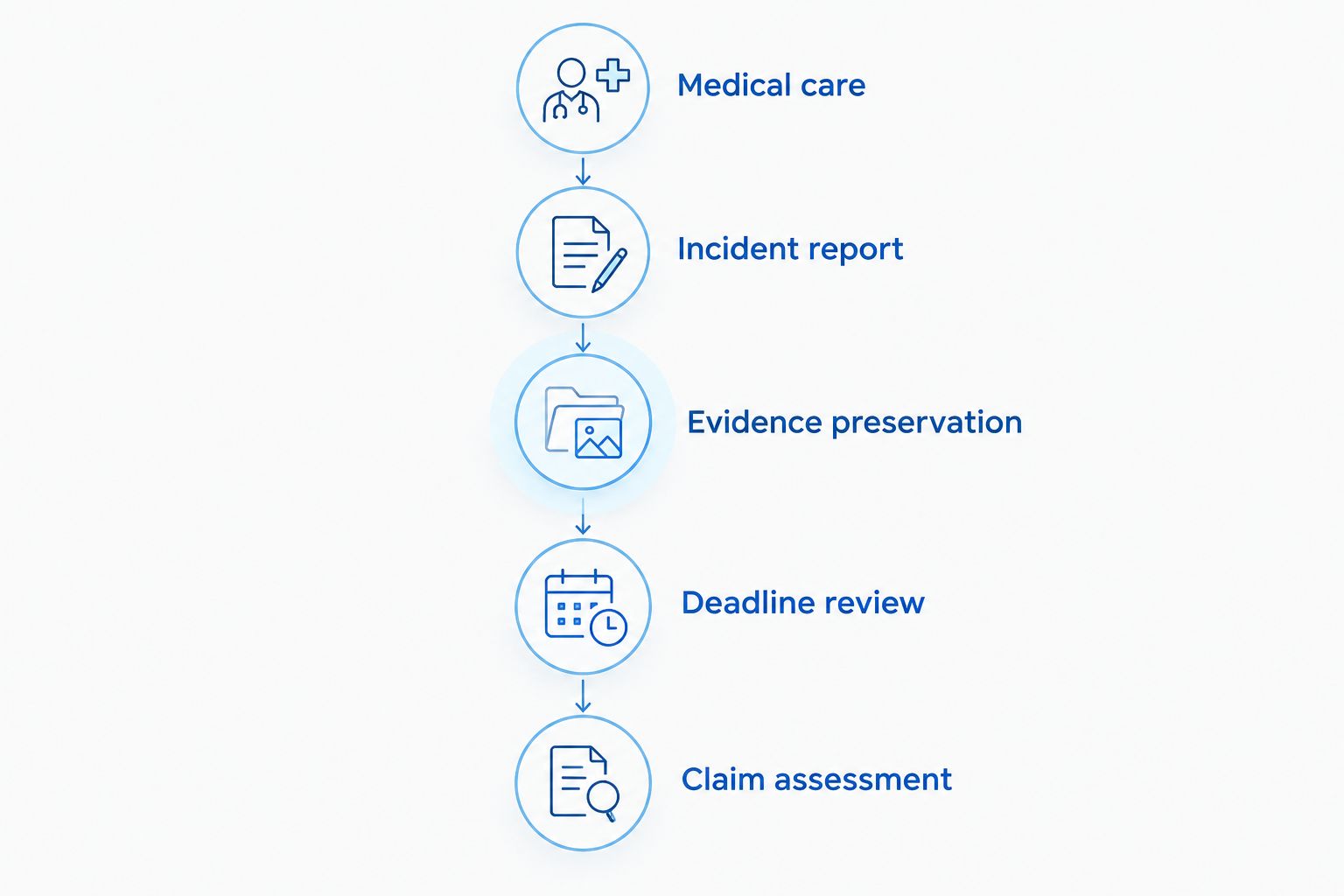
Protect your health and preserve the facts before debating settlement. Use this sequence after a fall, adjusting it to your medical needs and ability to act safely.
- Medical care: Obtain appropriate care and describe your symptoms accurately. Follow treatment instructions and tell your provider about changes.
- Incident report: Notify the property manager or responsible business. Ask for a copy or identifying information for the report, and keep your own factual account.
- Evidence preservation: Save photographs, witness contact details, clothing, and footwear. Ask promptly for relevant surveillance footage and records to be preserved.
- Deadline review: Identify the accident date, property type, and potentially responsible parties. Check legal deadlines before relying on ongoing insurance discussions.
- Claim assessment: Organize your records and assess whether responsibility, medical needs, or settlement terms require legal help.
A preservation request does not itself compel production or guarantee that footage exists. Keep a copy of the request and identify the location and approximate time clearly; a lawyer can assess further preservation and discovery steps.
Keep your account factual
Explain what you observed without guessing about facts you do not know. Distinguish between seeing water before the fall and noticing it afterward.
Read any written statement before signing it. If you discover an error in an incident report, document the correction rather than assuming someone else will fix it.
How long do I have to bring a California slip and fall claim?
2 years from the injury is the general California deadline for a personal injury lawsuit, under Code of Civil Procedure section 335.1. Exceptions can change that deadline, so treat this as a starting point rather than a personal filing calculation.
For a 2026 accident involving a public entity, Government Code section 911.2 generally requires presentation of a personal injury claim within 6 months after the claim accrues. That administrative claim is separate from filing a lawsuit.
Government Code section 945.6 generally provides 6 months after a qualifying written rejection notice is delivered or mailed to file suit. Different rules apply without that notice, and other exceptions require individual review.
Negotiating with an insurer does not, by itself, pause a filing deadline. Neither does reporting the accident to a store manager. Identify the applicable process before waiting for a response.
Can I recover compensation if I was partly at fault?
California's pure comparative negligence rule reduces recoverable damages by your share of fault; partial fault does not automatically bar recovery. CACI No. 405 addresses comparative fault in negligence cases.
An allegation that you were looking at your phone or wearing unsuitable shoes is not a final determination. Photographs, witness accounts, warnings, visibility, and the property's condition all remain relevant.
If the insurer assigns blame, ask what facts support that position. Do not accept a fault allocation simply because it appears in an adjuster's letter.
How do I choose the best slip and fall attorney in Glendale?
Choose counsel based on how the lawyer assesses your evidence and explains the work—not an unsupported claim of being the best. In 2026, the useful hiring questions remain specific to your accident.
Ask the attorney:
- What evidence supports negligence, and what evidence is still missing?
- How would you investigate who controlled the accident area?
- Who will handle communications and answer case questions?
- What deadlines apply, including any public-entity requirements?
- How does the written agreement address attorney fees and case expenses?
- What happens if the insurer denies responsibility or settlement discussions fail?
Khachikyanlawfirm is best suited to readers seeking personal injury representation from a Glendale law firm. That describes the firm's stated practice and location, not a ranking or a promise of results.
Khachikyanlawfirm provides personal injury and lemon law representation. For a slip and fall inquiry, ask the firm to explain the evidence supporting your particular claim and the limitations it sees before you decide whether to hire counsel.
Discuss your slip and fall claim
Ask about responsibility, evidence, deadlines, and the terms of representation.
FAQ
Can I handle a California slip and fall claim without a lawyer?
Yes. California does not require you to hire a lawyer, but you remain responsible for proving negligence, documenting losses, and meeting deadlines. Disputed liability or continuing treatment makes legal advice more useful.
What's the best slip and fall attorney in Glendale for my case?
The best fit is a lawyer who explains your premises liability evidence, deadlines, communication arrangements, and written fee terms. Khachikyanlawfirm provides personal injury representation in Glendale; assess the firm's fit through those case-specific questions.
How long do I have to sue after a slip and fall in California?
2 years from the injury is the general personal injury lawsuit deadline under Code of Civil Procedure section 335.1. Government claims and other exceptions require separate deadline review.
What if I fell on government property?
6 months after a personal injury claim accrues is generally the claim-presentation deadline under Government Code section 911.2. A later lawsuit has separate requirements, so identify the responsible public entity promptly.
Can I still recover if the property owner says the fall was my fault?
Yes, partial fault does not automatically prevent recovery under California's pure comparative negligence rule. Your share of responsibility reduces recoverable damages, and the underlying evidence determines the allocation.
Should I accept a settlement before my medical treatment ends?
Do not sign a settlement release without understanding the injuries and claims it covers. A release can prevent additional recovery for the same incident even if later treatment reveals greater losses.
What should I bring to a slip and fall lawyer consultation in 2026?
Bring photographs, incident information, witness details, medical records, insurance correspondence, and records of missed work. Include the accident date and exact location so the attorney can assess responsibility and deadlines.
One last thing
Ask who controlled the exact spot where you fell—not just who owns the building. That question helps direct preservation requests toward the parties holding maintenance records, inspection information, and footage.
For a 2026 claim, keep one dated folder containing your photographs, correspondence, treatment documents, and deadline notes. A clear record makes an assessment more useful whether you pursue the claim yourself or hire a lawyer.
This article provides general California legal information, not advice about your individual claim. Reading it does not create an attorney-client relationship.