Instead of repeating your dealer fraud complaint to each new representative, build a documented California claim that separates sales misconduct from warranty defects, preserves repair evidence, and supports the correct legal action. A dealer complaint does not automatically become a lemon law lawsuit; the facts must support the claim against the right defendant.
- The dealer fraud complaint lemon law lawsuit workflow starts by separating sales representations from warranty repair failures.
- Khachikyan Law Firm represents California drivers seeking lemon law legal help.
- Preserve contracts, advertisements, repair orders, and manufacturer correspondence before escalating your claim.
- A regulatory complaint does not replace a lawsuit or automatically pause filing deadlines.
Why this matters
Dealer fraud and lemon law address different conduct. A dealer's false statement about a vehicle's history concerns the sale; a manufacturer's failure to meet warranty obligations concerns the vehicle and its repair history. Both issues can exist in the same transaction, but neither proves the other.
Khachikyan Law Firm is best for California drivers seeking legal representation for a lemon law claim. You can start with Khachikyan Law Firm when repeated vehicle problems require a legal assessment rather than another customer-service exchange.
For a 2026 claim, organize the evidence before choosing a complaint channel. Sending an accusation to the wrong business creates correspondence, not necessarily progress toward a remedy.
Before you start
- Collect the source documents. Keep the signed purchase or lease agreement, warranty materials, advertisements, vehicle-history representations, repair orders, and messages with the dealer or manufacturer. Preserve originals and work from copies.
- Identify everyone involved. Record the selling dealer's legal name, manufacturer, warranty provider, lender, vehicle identification number, and relevant account or case references. These businesses have different responsibilities.
- Check deadlines before waiting for a response. An agency complaint or manufacturer case number does not automatically pause a lawsuit deadline. California warranty procedures also depend on the applicable law and facts; have counsel check notice, timing, and any required dispute process before filing.
You do not need to resolve every legal question before organizing records. You do need enough information to distinguish what the salesperson promised from what happened during warranty repairs.
Claim classification
- Write the sales issue separately. Record the specific statement or omission, who made it, when it occurred, and what document or message supports it. Explain how it affected your purchase decision without replacing facts with accusations.
- Write the defect issue separately. Describe the symptom, when you first reported it, the repair facility, the work performed, and whether the symptom returned. Keep your description consistent with the actual experience.
- Identify the requested remedy. State whether you want a repair, correction of transaction records, reimbursement, replacement, repurchase, or another remedy for counsel to assess. A requested outcome is not proof of entitlement.
- Choose the initial legal review. Ask counsel whether the evidence supports dealer misconduct, warranty claims, or both. Do not assume every claim belongs against the selling dealer alone.
Expected result: You have separate factual summaries for the sale and the repair history, with supporting documents attached to each.
Which route fits the evidence?
These routes serve different purposes. This comparison describes their function, not a ranking of outcomes.
| Route | Best for | Main benefit | Main limitation |
|---|---|---|---|
| Dealer complaint | Requesting correction directly from the seller | Creates a written account of the dispute and requested response | Does not itself establish fraud or require a court remedy |
| Manufacturer warranty claim | Reporting recurring defects and requesting warranty action | Connects the complaint to the manufacturer and repair history | A case number does not establish lemon law eligibility |
| Regulatory complaint | Reporting conduct within an agency's authority | Gives the agency information for review or enforcement | Does not replace your private claim or control its deadline |
| Civil lawsuit | Seeking relief through a legally supported court claim | Provides a formal process for pursuing claims and obtaining evidence | Requires proper pleadings, service, and compliance with applicable procedures |
For California dealer licensing or sales-conduct concerns, the Department of Motor Vehicles investigates matters within its authority. It does not decide every contract dispute or substitute for your lawyer.
Evidence file
- Create a transaction folder. Save the complete signed agreement, financing documents, warranty terms, advertisements, and communications about condition, history, or coverage. Preserve the full conversation rather than selected screenshots alone.
- Create a repair chronology. List each visit's intake date, return date, mileage, reported symptom, diagnosis, work performed, and result. Mark missing information as unknown instead of estimating it.
- Match each statement to evidence. Put the relevant advertisement, email, text, or contract page beside the statement it supports. Distinguish a salesperson's statement from your own interpretation.
- Preserve current symptoms safely. Save existing photographs, warning messages, videos, and towing records. Never recreate a dangerous malfunction to obtain footage or operate an unsafe vehicle for documentation.
- Record financial effects. Keep receipts and supporting records for towing, transportation, and other claimed losses. Whether an expense is recoverable depends on the legal claim and evidence.
Expected result: Another person can follow the dispute from sale through the latest repair without relying on your memory.
Use the California lemon law claim documents guide to identify gaps before sending your file for review. A missing repair order matters more than polished complaint language.
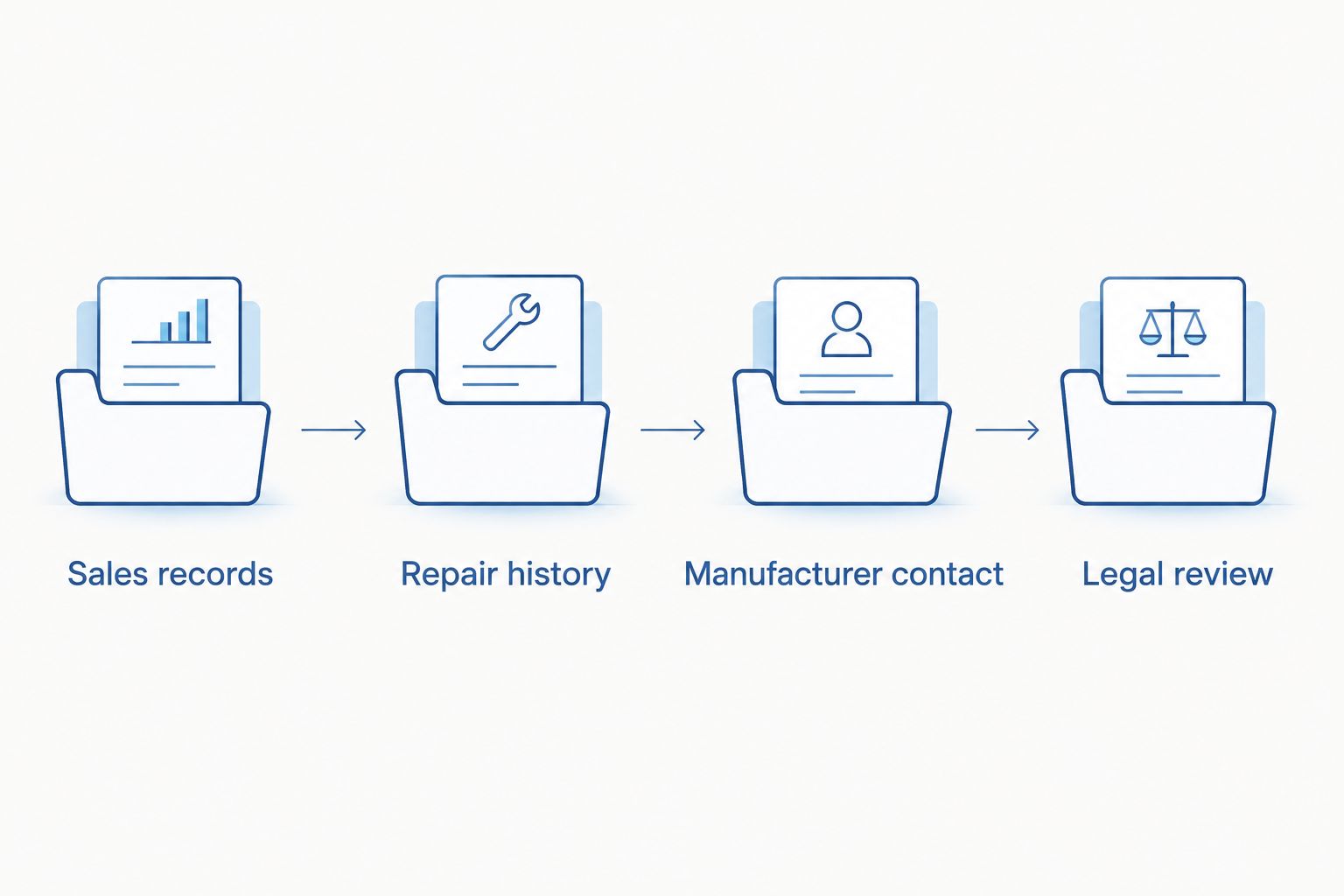
For your 2026 file, use factual folder labels: Sales records, Repair history, Manufacturer contact, and Legal review. These are organizational labels, not required court forms.
Complaint and manufacturer contact
- Send a factual dealer complaint. Identify the vehicle, transaction, disputed representation, supporting evidence, and requested correction. Keep a copy of exactly what you sent and proof of transmission or delivery.
- Contact the manufacturer about warranty defects. Describe the recurring condition and repair history, and request a written response. Dealer knowledge and manufacturer notice are not interchangeable for every legal requirement.
- Keep separate reference numbers. Record each business's case number and contact details beside its correspondence. A dealer ticket, manufacturer case, and agency complaint are different records.
- Use the appropriate agency process when warranted. Report the conduct accurately and provide supporting records through the agency's current official process. Do not label a contract disagreement as proven fraud.
- Track promises without suspending legal review. Record any promised inspection, document correction, or response. Ask counsel whether waiting affects your rights before agreeing to additional delay.
Expected result: You can show who received the complaint, what each recipient received, and what each business did afterward.
A complaint should read like a factual record, not a courtroom speech. Replace broad statements such as everyone knew with the actual speaker, statement, document, and date.
Do not sign a release simply to close a customer-service case. A settlement, replacement agreement, or other document can affect existing claims; obtain a legal review before accepting its terms.
Lawsuit readiness
- Have counsel assess warranty coverage. Provide the warranty documents and vehicle history, especially for a used vehicle. Remaining manufacturer coverage alone does not answer every California lemon law eligibility question.
- Check the legal requirements against the facts. Counsel should assess the defect, repair opportunities, notice, applicable deadlines, and any required preliminary procedure. Do not use an online checklist as a substitute for this analysis.
- Identify defendants and claims. A dealer-misrepresentation claim and a manufacturer warranty claim can involve different parties, proof, and remedies. Include only claims supported by the evidence.
- Review dispute-resolution provisions. Give counsel every arbitration provision and any prior arbitration decision. Whether a dispute must proceed in arbitration or court depends on the agreement and applicable law.
- Authorize filing only after the review. Counsel prepares the appropriate complaint and arranges filing and service when a lawsuit is the correct route. An agency complaint is not a court pleading.
Expected result: You understand the proposed claims, defendants, forum, supporting evidence, and unresolved issues before litigation begins.
Repair counts are not a universal filing rule
California Civil Code section 1793.22 contains a lemon law presumption involving specified events within 18 months after delivery or 18,000 miles, whichever occurs first. One branch addresses qualifying repair-related downtime totaling more than 30 calendar days, subject to statutory conditions and exceptions.
Those figures describe a presumption, not the entire lemon law. A claim outside that window requires its own analysis, and reaching a number does not erase the other requirements.
For a 2026 assessment, have counsel review the current statutory text, applicable procedures, and your vehicle's coverage. Do not wait for a particular repair count or downtime total before asking about deadlines.
When another repair fails
A new repair visit updates the evidence file; it does not automatically require starting the entire complaint process again. Follow this adjacent workflow whenever the same symptom returns or the dealer records a new diagnosis.
- Describe the symptom accurately at intake. Ask the service department to record what you reported, including intermittent conditions and safety concerns. Do not instruct the technician to adopt a diagnosis you cannot establish.
- Obtain the completed repair order. Compare the reported concern, findings, work, mileage, and dates with what happened. Request a written correction for material errors.
- Update the chronology and correspondence. Add the new visit and send the relevant record to counsel or the manufacturer contact handling the matter. Keep the previous versions.
- Reassess the claim before making commitments. Ask whether the additional evidence changes the proposed remedy, notice requirements, or litigation decision. Do not assume a new visit restarts a deadline.
Expected result: Your 2026 claim file reflects the latest facts without losing the earlier history.
Continue seeking appropriate repairs while counsel evaluates the claim, subject to safety and case-specific advice. Filing a complaint does not make continued vehicle use safe.
Troubleshooting
The dealer says it cannot reproduce the problem
Ask for a repair order documenting your reported symptom, inspection, and findings. Provide existing recordings or accurate descriptions of operating conditions; a no-fault-found entry is part of the history, not proof that your report was false.
The repair order describes a different concern
Request a written correction promptly and retain both versions. If the dealer refuses, send a factual written account of the discrepancy and preserve the response with the original record.
The manufacturer says the dealer must handle it
Keep that response and clarify whether the issue concerns the sale or warranty performance. A dealer's alleged misrepresentation and a manufacturer's warranty obligations require separate analysis, even when they concern the same vehicle.
The agency closes the complaint
Obtain the closure explanation and preserve the submission. Agency closure does not, by itself, decide whether you have a private civil claim; ask counsel to assess the underlying evidence and deadlines.
The vehicle has been sold, traded, or repossessed
Tell counsel immediately and preserve the disposition documents. These events affect the factual and remedy analysis; do not conceal them or assume the claim is automatically unchanged.
Customize your workflow
Choose the next task based on the gap in your file. Missing repair dates call for records requests; unclear coverage calls for warranty review; an arbitration decision calls for analysis of that decision and any applicable deadline.
Khachikyan Law Firm provides lemon law representation, but the firm's stated practice does not establish whether your particular dealer-fraud allegations are within its engagement. Ask what claims the representation includes before authorizing work.
Bring both evidence tracks to the discussion. In 2026, the useful question is not simply whether your car is a lemon, but which supported claims, procedures, and remedies apply to your transaction.
Get your lemon law claim reviewed
Discuss your warranty documents, repair history, and the next legal step.
FAQ
Does a dealer fraud complaint automatically become a lemon law lawsuit?
No. Dealer fraud concerns alleged misconduct in the sale, while a lemon law lawsuit requires facts supporting applicable warranty claims. Counsel must assess the evidence, defendants, and procedures separately.
Can I have dealer fraud and lemon law claims for the same car?
Yes, the same transaction can support both types of claims when the evidence establishes their separate requirements. A false sales statement does not by itself prove a warranty violation.
Should I complain to the dealer or the manufacturer first?
Direct sales-related concerns to the dealer and warranty concerns to the manufacturer, while checking legal deadlines promptly. Some claims involve specific notice requirements, so do not assume an informal complaint satisfies them.
Does filing a DMV complaint stop the lawsuit deadline?
Do not assume a DMV complaint pauses a lawsuit deadline. A regulatory complaint and a private civil claim serve different purposes, and counsel should assess the applicable timing rules.
Do I need a certain number of repairs before contacting a lawyer?
No fixed repair count is required before seeking legal advice. Eligibility and available remedies depend on the defect, warranty, repair opportunities, and applicable law.
Can a used car qualify for a California lemon law claim?
A used vehicle requires a coverage-specific legal review. Its sale circumstances and warranty terms matter, and remaining manufacturer coverage does not automatically resolve eligibility.
What should I bring to Khachikyan Law Firm for a lemon law review?
Bring your purchase or lease agreement, warranty documents, complete repair orders, and communications with the dealer and manufacturer. Include sales representations and a factual chronology so the legal review can distinguish transaction issues from repair failures.
One last thing
Preserve the advertisement before asking the dealer to correct it. A corrected listing can remove the easiest record of what you saw before purchasing; retain the original screenshot, the date captured, and any saved copy of the page.
This guide provides general California legal information, not advice about your individual claim. Have counsel assess your documents and deadlines before choosing a legal route.