In California, lemon law generally does not give you a vehicle buyback right simply because a car bought from a private seller turns out to be defective. A transferable warranty, a seller’s false statements, or a broken written promise can support a different claim, but none automatically makes a private sale eligible for a lemon law refund.
- Can lemon law apply to a car bought from a private seller? In California, generally not for a manufacturer buyback.
- California warranty rights and private-seller fraud claims require separate analysis; a defective car alone does not establish either.
- A remaining factory warranty does not automatically make a used car eligible for California’s new-vehicle buyback remedy.
- Khachikyanlawfirm provides lemon law representation in Glendale, California; preserve your sale documents and repair records before requesting legal review.
Can lemon law apply to a car bought from a private seller?
Generally, no—not through the same California buyback rules that protect qualifying new-vehicle purchases. California’s Song-Beverly Consumer Warranty Act distinguishes retail transactions, warranties, and qualifying new motor vehicles. A private resale does not become a qualifying new-car transaction because the original factory warranty remains active.
For a 2026 claim review, separate the transaction from the defect. You need to establish both a legal duty and evidence that someone failed to meet it. Start with the California used-car lemon law guide if you are unsure how your purchase differs from a dealer sale.
| Possible route | Best for | What supports it | Main limitation |
|---|---|---|---|
| Manufacturer warranty claim | Buyers with applicable, transferable warranty coverage | Warranty terms, covered defect, and repair records | Repair coverage does not automatically establish a buyback right |
| Private-seller fraud claim | Buyers with evidence of a material misrepresentation or actionable concealment | Advertisement, messages, inspection findings, and proof of seller knowledge | A breakdown alone does not prove fraud |
| Contract or express-promise claim | Buyers with an enforceable promise the seller did not fulfill | Sale agreement, written statements, and evidence of breach | General praise or an opinion is not necessarily an enforceable promise |
These routes address different conduct. A manufacturer’s duty to perform covered repairs is not the same as a private seller’s responsibility for a false statement.
Why this matters
Calling every defective used car a lemon can send you toward the wrong claim. Repeated repairs matter, but they do not replace the requirement to identify a law or agreement that covers your transaction.
For California buyers in 2026, the practical question is: Who owed you a duty, and what evidence shows a breach? The answer determines whether you pursue warranty service, a seller-related claim, or another remedy—not the severity of your frustration with the vehicle.
Khachikyanlawfirm provides lemon law representation for buyers seeking legal help in Glendale, California. Legal review can distinguish a warranty dispute from a private-sale dispute; representation does not change the transaction’s eligibility requirements.
A remaining factory warranty is not a guaranteed buyback
A car can retain manufacturer repair coverage after a private sale without qualifying for California’s new-vehicle replacement or restitution remedy. Read the actual warranty, including transfer conditions, exclusions, and the applicable coverage period.
The California Supreme Court’s decision in Rodriguez v. FCA US, LLC distinguishes a used vehicle sold with an unexpired original warranty from a qualifying new motor vehicle under the relevant buyback provision. Remaining factory coverage alone is not enough. The decision does not mean every remaining warranty obligation disappears.
When assessing coverage in 2026, collect:
- The original warranty booklet and any transfer requirements.
- The vehicle’s original in-service date and current mileage.
- Repair orders identifying the reported problem and work performed.
- Written explanations for denied warranty repairs.
- Any separate warranty issued in connection with your purchase.
A service contract also needs separate review. Do not assume a document described as an extended warranty creates the same obligations as a manufacturer’s express warranty.
An as-is sale does not settle every dispute
An as-is agreement generally places more responsibility for the vehicle’s condition on you. It does not automatically excuse fraud or erase a separate enforceable promise.
California Commercial Code sections governing warranties, including sections 2313 and 2316, distinguish express warranties from warranty exclusions. Whether a seller’s statement creates an express warranty depends on what was said and how it formed part of the bargain. You do not need the phrase “I guarantee” for every potentially enforceable factual promise.
Compare a specific assertion that the seller recently replaced the transmission with a general statement that the car runs well. The specific assertion gives you something concrete to verify. Neither statement, by itself, proves that the seller owes you a refund.
Preserve the exact wording. A screenshot of the advertisement is stronger evidence of the seller’s representation than your later summary of the conversation.
Why private-sale car claims differ
The same mechanical failure can produce different legal outcomes because the transaction and evidence differ. For a California private-sale dispute in 2026, these factors drive the analysis:
- Seller identity: A genuine private owner and a business selling vehicles raise different legal questions. Preserve evidence if the seller advertised multiple vehicles or used business paperwork.
- Warranty terms: Coverage depends on the warranty’s language, transfer rules, and exclusions—not just a remaining expiration date.
- Specific statements: A factual representation about accident history or a repair differs from a general opinion about condition.
- Seller knowledge: A fraud claim requires more than showing that a defect existed. Evidence of knowledge, misleading conduct, and reliance matters.
- Repair history: Earlier diagnoses can help establish when a problem existed and what someone knew before the sale.
- Your agreement: Written promises, exclusions, inspection provisions, and disclosures affect the dispute.
Do not collapse these factors into a single question about whether the car is defective. A mechanic establishes mechanical facts; the legal claim still needs its own supporting evidence.
What should you do after discovering the defect?
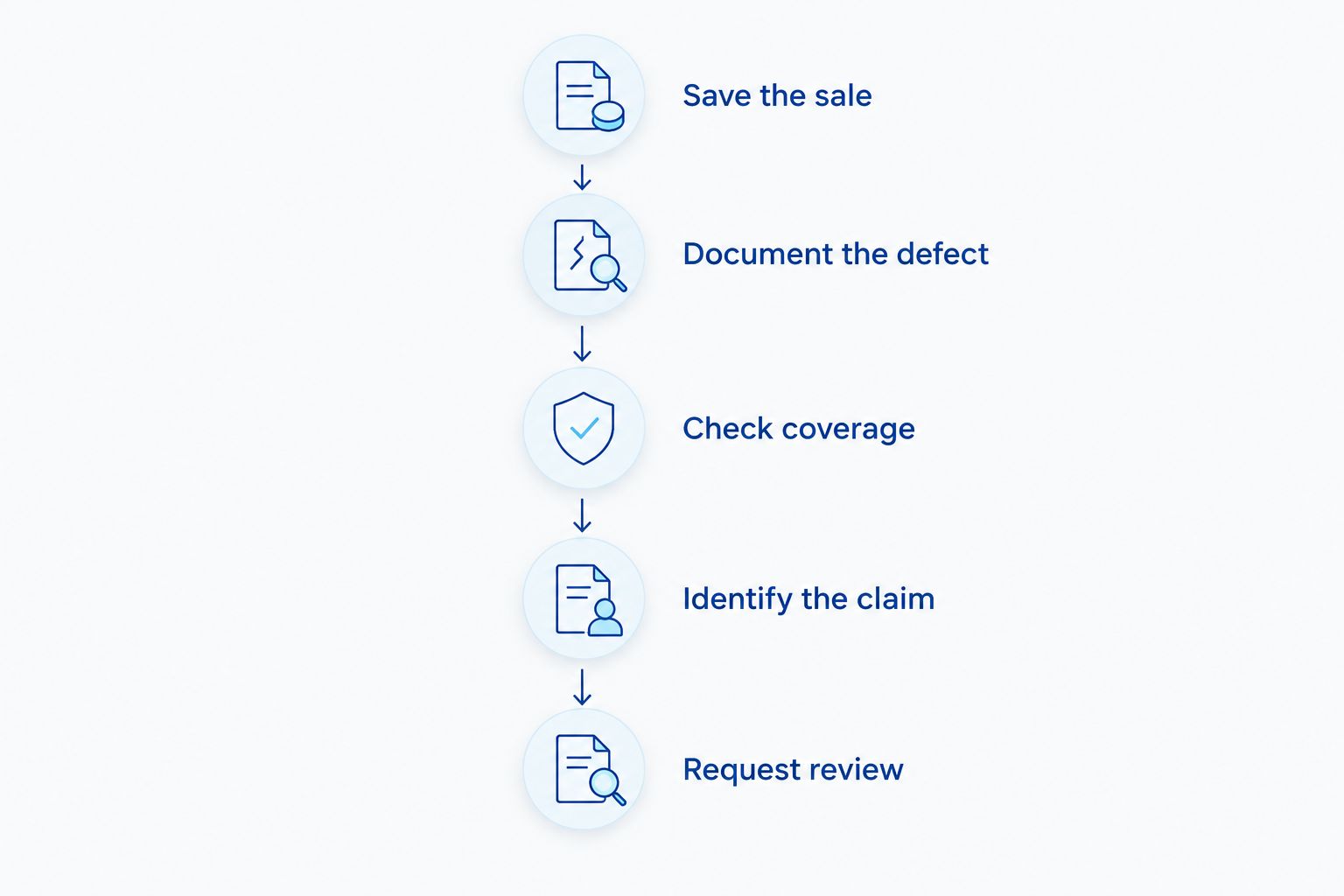
Follow this sequence before demanding a particular remedy. The goal is to preserve evidence and identify the right party—not to label the vehicle a lemon immediately.
- Save the sale. Keep the advertisement, bill of sale, payment record, title documents, and messages. Export conversations where possible and retain the originals.
- Document the defect. Ask the repair shop to record your complaint, diagnosis, mileage, and recommended work. Request an explanation of any evidence suggesting the problem predates the sale.
- Check coverage. Read the warranty and ask the responsible provider to explain applicable coverage in writing. Keep any denial rather than relying on a telephone summary.
- Identify the claim. Separate the manufacturer’s warranty obligations from the seller’s statements and contractual promises. Identify the conduct you can prove.
- Request review. Bring the complete record to a California attorney before assuming a buyback, cancellation, or reimbursement is available.
If the vehicle has a safety-related problem, prioritize safe handling and professional inspection. Do not continue driving solely to build a repair record, and do not authorize disposal of relevant parts without considering whether they need to be preserved.
Discuss your vehicle dispute
Ask Khachikyanlawfirm about legal representation for your California vehicle warranty dispute.
Do repair-count rules make a private-sale car eligible?
No. Repair-count rules do not turn an otherwise ineligible private sale into a qualifying new-vehicle purchase.
California Civil Code section 1793.22 contains a rebuttable presumption for qualifying vehicles when specified conditions arise within 18 months after delivery or 18,000 miles on the odometer, whichever occurs first. One alternative involves the vehicle being out of service for repairs for a cumulative total of more than 30 calendar days, subject to statutory conditions and exceptions.
Those figures are not a universal eligibility test. The presumption concerns whether a reasonable number of repair opportunities occurred; it does not independently establish that your transaction qualifies for the remedy.
For a 2026 private-sale assessment, verify the transaction and applicable warranty first. Counting repair visits before addressing eligibility reverses the analysis.
Can you sue the private seller for hiding a defect?
Yes, a private seller can face a claim for actionable misrepresentation or concealment, but a later breakdown does not prove the case. You need evidence supporting the particular claim, including the seller’s conduct, your reliance where required, and resulting harm.
Useful evidence includes a contradictory advertisement, messages discussing the defect before the sale, and prior repair records that show what the seller knew. A mechanic’s findings can support the timeline without proving the seller’s knowledge on their own.
Avoid accusing the seller of fraud based only on timing. Describe the documented facts and preserve the evidence that connects those facts to the sale.
Can you get your money back from a private seller?
A refund is not automatic after a private-sale breakdown. Depending on the established claim, available relief can include damages or rescission, but you must prove the legal basis and meet the requirements for that remedy.
Do not treat a manufacturer buyback and cancellation of a private sale as interchangeable. They involve different duties, defendants, and supporting evidence.
Before transferring the car back, signing a release, or accepting a settlement, understand which claims the agreement resolves. Keep written terms rather than relying on a verbal promise to make things right.
Should you contact the manufacturer or the seller first?
Contact the party responsible for the obligation you are raising. For covered repairs, follow the warranty’s service procedures; for a false sales statement, preserve the evidence and address the seller’s conduct separately.
You can have a warranty-service issue and a seller dispute at the same time. Keep separate records so a response about one issue does not obscure the other.
FAQ
Can lemon law apply to a car bought from a private seller in California?
Generally, California’s new-vehicle buyback remedy does not apply simply because a privately purchased used car has defects. Review transferable warranty rights, seller misrepresentations, and contractual promises separately.
Does an active factory warranty guarantee a lemon law refund?
No. An active factory warranty can provide repair rights without making a privately purchased used vehicle eligible for California’s new-vehicle buyback remedy.
Can I sue a private seller if the car was sold as is?
An as-is agreement does not automatically bar a claim based on fraud or a separate enforceable promise. Your evidence must establish the requirements of the particular claim.
What if the car breaks down immediately after I buy it?
An immediate breakdown does not automatically create a refund right. Preserve the sale records and obtain a written diagnosis addressing the defect and any evidence that it existed before the purchase.
Does spending more than 30 days in the repair shop guarantee a buyback?
No. The more-than-30-calendar-day condition belongs to a statutory presumption with eligibility requirements, conditions, and exceptions; it does not independently qualify a private sale.
What documents should I bring to a lawyer about a private-sale car?
Bring the advertisement, bill of sale, payment record, seller messages, warranty documents, and repair orders. Include the purchase mileage, current mileage, and a dated account of the problem.
Should I repair the car before pursuing the seller?
Address immediate safety concerns, but preserve evidence before repairs alter or remove it. Ask the shop to document findings and discuss preservation of relevant parts before disposal.
One last thing
The seller’s original advertisement can matter as much as the repair invoice. The invoice explains what failed; the advertisement helps establish what you were told before you bought the car.
Save that advertisement now, even if you already have a mechanic’s diagnosis. For a 2026 review with Khachikyanlawfirm, organize the sales evidence and repair evidence separately so the legal question stays clear: what duty existed, and what proves it was broken?
This article provides general California legal information, not advice about your specific transaction.