
Usually, you cannot sue your employer for a workplace injury in California because workers’ compensation is the exclusive remedy for covered injuries, even when your employer was negligent. You can sue in specific situations, including certain intentional misconduct or an employer’s failure to carry required workers’ compensation insurance; a separate claim against a responsible third party is another route. This 2026 guide explains those exceptions, the evidence you need, and the deadlines that require immediate attention.
- Can I sue my employer for a workplace injury in California? Usually no; workers’ compensation applies, subject to specific exceptions.
- Employer negligence alone does not create a right to file a personal injury lawsuit.
- A third-party injury lawsuit targets someone other than your employer and can accompany workers’ compensation.
- Khachikyanlawfirm provides personal injury representation; distinguish a potential civil claim from a workers’ compensation benefits dispute.
Why this matters
Choosing the wrong claim can leave the right claim unprotected. A workers’ compensation application and a civil lawsuit have different requirements, defendants, and deadlines. Reporting an accident to your supervisor does not automatically preserve a lawsuit against another business.
Start by identifying who employed you, who controlled the hazard, and who caused the injury. The workers’ compensation-to-third-party injury lawsuit workflow explains how those separate tracks fit together.
Can I sue my employer for a workplace injury in California?
Usually not for an ordinary workplace accident covered by workers’ compensation. California Labor Code sections 3600 and 3602 establish the coverage conditions and exclusive-remedy rule: qualifying injuries generally belong in the workers’ compensation system rather than an employer-negligence lawsuit.
You generally do not need to prove employer fault to receive workers’ compensation benefits. In exchange, the system limits the remedies available against your employer. A serious injury does not, by itself, create an exception.
The following comparison summarizes the main routes under California law in 2026. These routes are not interchangeable, and some can proceed together.
| Claim route | Best for | Main advantage | Main limitation |
|---|---|---|---|
| Workers’ compensation | Employees with covered work-related injuries | Employer negligence generally does not need to be proved | Benefits do not include ordinary civil pain-and-suffering damages |
| Employer civil lawsuit | Workers whose facts satisfy a recognized exception | Civil damages are potentially available | Unsafe conditions or negligence alone are insufficient |
| Third-party injury lawsuit | Workers injured by a legally responsible outside party | Can address losses beyond workers’ compensation benefits | Requires proof of the third party’s liability and coordination of reimbursement rights |
The question is not simply whether your employer caused the accident. It is whether California law permits a civil claim against that employer.
Uninsured employer: a possible civil lawsuit
California Labor Code section 3706 permits an injured employee to bring an action for damages when an employer fails to secure required workers’ compensation coverage. This is a specific exception, not permission to sue whenever an insurer disputes treatment or benefits.
A denied claim does not establish that your employer was uninsured. Neither does a supervisor’s statement that the business does not handle workplace injuries. Confirm the employer’s coverage status for the injury date before choosing this route.
Preserve pay records, the employer’s legal name, work schedules, and any insurance correspondence. Those records help establish who employed you and whether the coverage requirement applied.
Intentional misconduct: narrow exceptions, not ordinary negligence
Labor Code section 3602(b) recognizes specific situations in which an employee can bring a civil action against an employer. Two involve employer misconduct:
- Willful physical assault: The injury results from a willful physical assault by the employer. A coworker assault does not automatically satisfy this employer-specific exception.
- Fraudulent concealment: The employer fraudulently conceals both the injury’s existence and its connection to employment, aggravating the injury. Recovery under this exception is limited to the aggravation caused by the concealment.
These standards are narrower than deliberately ignoring a hazard. An employer’s knowledge that equipment is dangerous does not automatically transform an accident into an intentional-injury lawsuit.
Serious and willful employer misconduct can also support a separate request for increased workers’ compensation benefits under Labor Code section 4553. That remedy is not the same as permission to sue your employer in civil court.
Defective products and power presses: specialized exceptions
Labor Code section 3602(b)(3) addresses a narrow product-liability situation involving a defective product manufactured by the employer, transferred for value to an independent third person, and then provided for the employee’s use by that third person. A defective tool at work does not automatically meet this test.
Labor Code section 4558 creates another narrow exception involving an employer’s knowing removal of, or failure to install, a manufacturer-required point-of-operation guard on a qualifying power press. The statute imposes specific equipment, knowledge, and authorization requirements.
For either situation, preserve equipment identification, photographs, maintenance records, purchase records, and witness names. Do not alter the machine or attempt to recreate the accident yourself. The equipment’s history matters as much as its condition afterward.
Can I sue someone other than my employer?
Yes, if a third party is legally responsible for your injury. Labor Code section 3852 preserves an employee’s action against a person other than the employer, even when the employee also receives workers’ compensation benefits.
Examples include a negligent driver who hits you during a work assignment or an outside manufacturer whose defective equipment injures you. A property owner or separate contractor also requires investigation when its conduct contributed to the accident. These are possible defendants, not automatic findings of liability.
A company being separate from your payroll employer does not settle the issue. Special-employment relationships and other legal rules can affect whether that company receives workers’ compensation protection.
Workers’ compensation benefits and civil damages cannot simply be added together without accounting for reimbursement and credit rights. A compensation insurer can have rights affecting a third-party recovery. Review those rights before agreeing to a settlement.
Why your right to sue varies
The answer depends on the legal relationship and the injury’s cause, not just how badly you were hurt. For a 2026 claim assessment, focus on these factors:
- Employment status: An employee and a genuine independent contractor do not necessarily have the same remedies. A contractor label or tax form does not decide classification by itself.
- Work connection: Workers’ compensation exclusivity depends on whether the statutory coverage conditions apply to the injury.
- Insurance coverage: Failure to secure required coverage raises a different issue from a covered claim that the insurer denies.
- Responsible party: A claim against your employer differs from a claim against a driver, manufacturer, or other outside party.
- Specific conduct: Assault, fraudulent concealment, and qualifying equipment facts require separate statutory analysis.
- Timing and evidence: Delayed reporting, missing records, and expired deadlines can restrict an otherwise valid claim.
Tell your lawyer about every business involved at the location. Uniforms, vehicles, equipment labels, and work orders can help distinguish your employer from outside companies.
What should I do after a workplace injury?
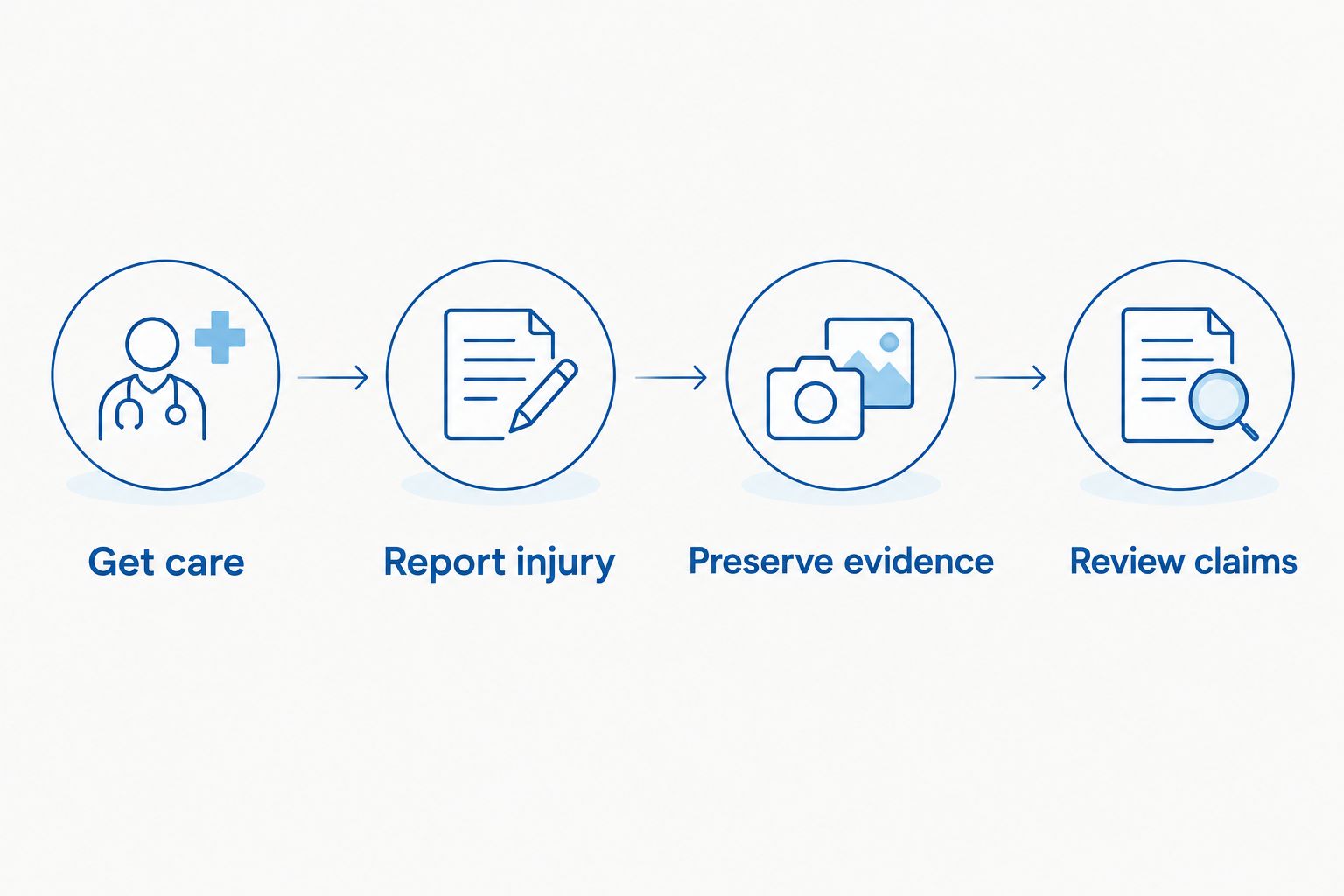
Protect your health first, then preserve both possible claim tracks. You do not need to decide whether an employer lawsuit is available before reporting the injury or obtaining appropriate care.
- Get care. Seek emergency treatment when needed and tell the provider how the injury happened. Give an accurate account of your symptoms, including when they started.
- Report injury. Notify your employer promptly and keep a dated copy of the report. Describe the event and affected body parts without guessing about medical diagnoses.
- Preserve evidence. Save photographs, witness details, messages, work assignments, medical records, and receipts. Request preservation of relevant surveillance footage and equipment records before they disappear.
- Review claims. Identify the employer’s coverage, potential outside defendants, and any facts supporting an exception. Ask for separate analysis of workers’ compensation and civil deadlines.
Keep copies outside an employer-controlled account or device, using lawful access and protecting confidential information. Do not sign a settlement or broad release without understanding which claims it resolves.
Khachikyanlawfirm provides personal injury representation in Glendale. For a workplace accident, ask whether the facts support a third-party injury claim or an employer-liability exception; do not assume personal injury representation includes handling workers’ compensation benefits.
Discuss your potential personal injury claim
Ask whether your workplace accident supports a civil claim against an employer or outside party.
What deadlines apply to a California workplace injury?
30 days is the general deadline for giving your employer written notice of a workplace injury under Labor Code section 5400. Exceptions and employer knowledge can affect the notice requirement, but prompt written reporting avoids an unnecessary dispute.
Workers’ compensation proceedings generally face a 1-year filing period under Labor Code section 5405. The statute provides alternative starting points tied to the injury, benefit payments, and medical treatment. Occupational diseases and cumulative injuries require additional attention to the legal injury date.
An ordinary negligence-based personal injury lawsuit generally has a 2-year limitation period under Code of Civil Procedure section 335.1. That is not a universal deadline: public-entity claims, different causes of action, and special circumstances require separate analysis.
For injury claims involving a public entity, Government Code section 911.2 generally requires a claim presentation within 6 months of accrual before a lawsuit. Do not apply the ordinary civil deadline alone to that situation.
These are general California deadlines for this 2026 guide, not a calculation of your filing date. Do not assume a workers’ compensation filing pauses a separate civil deadline.
Can I sue if my employer caused an unsafe workplace?
Employer negligence alone generally does not let you sue outside workers’ compensation. Missing training, unsafe procedures, and poor maintenance can explain how an injury happened without defeating the exclusive-remedy rule.
Document those conditions anyway. They can matter to an outside party’s liability, an equipment investigation, or another legally available remedy. The absence of an employer-negligence lawsuit does not make the evidence irrelevant.
Can I sue if workers’ compensation denies my claim?
A denial does not automatically create a right to sue your employer. A dispute over whether an injury is work-related or whether treatment is necessary generally belongs in the workers’ compensation process.
Investigate a civil claim separately if the employer lacked required insurance, a statutory exception applies, or an outside party caused the injury. Do not treat a denial letter as proof of any of those circumstances.
Can I recover pain and suffering after a workplace injury?
Workers’ compensation does not provide ordinary civil pain-and-suffering damages. A valid third-party lawsuit or permitted employer civil action can include those damages when supported by the evidence and applicable law.
Civil recovery is not guaranteed, and reimbursement rights can affect what you retain. Evaluate the available damages and the claim’s legal basis together, rather than assuming a lawsuit always produces a better outcome.
FAQ
Can I sue my employer for a workplace injury in California in 2026?
Usually no: workers’ compensation is the exclusive remedy for covered workplace injuries in California. Specific exceptions include an employer’s failure to secure required coverage and narrowly defined misconduct or equipment circumstances.
What if my employer says the accident was my fault?
Your own negligence generally does not prevent workers’ compensation benefits for an otherwise covered injury. Statutory exclusions still apply, and fault can affect a separate civil claim.
Can I collect workers’ compensation and sue a negligent driver?
Yes, a work-related crash can support both workers’ compensation and a lawsuit against a legally responsible outside driver. Reimbursement and credit rights must be addressed so the same losses are not recovered twice.
Does a workers’ compensation denial mean my employer has no insurance?
No, denial of a claim does not establish that your employer lacked insurance. Coverage status and the insurer’s reason for denying benefits are separate questions.
Can I sue a coworker who injured me?
Coworkers generally receive protection from civil liability for covered workplace injuries under Labor Code section 3601. Exceptions include specified conduct, such as a willful and unprovoked physical act of aggression; identify the exact facts before assuming a lawsuit is available.
Can my employer punish me for filing workers’ compensation?
California Labor Code section 132a prohibits specified discrimination connected to workers’ compensation claims and related protected conduct. A section 132a petition generally must be filed within 1 year of the discriminatory act, and other employment remedies require separate analysis.
What should I ask Khachikyanlawfirm about my workplace accident?
Ask Khachikyanlawfirm whether your accident supports a personal injury claim against an outside party or a recognized employer-liability exception. Also confirm who will handle any workers’ compensation benefits dispute and preserve each claim’s separate deadline.
One last thing
The business name on your paycheck is not necessarily the name on every relevant insurance policy, vehicle, or piece of equipment. Photograph identifying labels and preserve work orders, not just the injury scene. Those details help identify an outside defendant when workers’ compensation blocks an ordinary lawsuit against your employer.
This 2026 guide provides general California legal information, not advice for your specific case. Have the employment relationship, insurance coverage, and filing dates assessed before accepting a settlement or abandoning a potential claim.