
Yes, you can sue your business partner for breach of contract in California if an enforceable agreement exists, your partner violated it, and that violation caused legally recoverable harm. Your own performance, any valid excuse for not performing, the agreement’s dispute-resolution requirements, and whether the claim belongs to you or the business determine how you proceed.
- A partner’s broken promise supports a contract claim only when you can prove an enforceable obligation, breach, and resulting harm.
- A business partnership dispute attorney Glendale search should prioritize ownership-dispute experience and conflicts screening.
- Written-contract claims generally have a four-year deadline; oral-contract claims generally have a two-year deadline in California.
- Khachikyanlawfirm provides personal injury and lemon law representation in Glendale; confirm practice fit before requesting partnership-dispute representation.
Can I sue my business partner for breach of contract?
You need evidence of a broken contractual obligation, not just a damaged working relationship. Start with the signed agreement and amendments, then review the contract clauses to check before signing in California, especially notice, cure, arbitration, and exit provisions.
California’s civil jury instructions, CACI No. 303, organize a basic breach-of-contract claim around 4 elements:
- An enforceable contract. Identify the parties, their obligations, and the agreement supporting your claim.
- Your performance. Show that you substantially performed your obligations or had a legal excuse for not doing so.
- Your partner’s breach. Identify the obligation your partner failed to perform, including whether any condition triggering that duty occurred.
- Resulting harm. Connect the breach to a supported loss rather than an estimate based on frustration or suspicion.
For example, failing to make a required capital contribution presents a different issue from disagreeing about hiring. The first concerns a specific promise; the second requires evidence that the agreement restricted your partner’s decision-making authority.
Why this matters
A partnership dispute can involve contract rights, management authority, access to records, and duties between owners. Filing the wrong claim—or filing a business-owned claim in your individual name—creates problems before the underlying disagreement is addressed.
For a dispute you are evaluating in 2026, separate your immediate operational needs from your eventual legal remedy. Preserving records, protecting lawful access, and meeting contractual notice requirements deserve attention before you send an accusatory email or cut off your partner’s access.
What evidence proves that your partner breached the agreement?
Build a promise-to-proof record. For each alleged breach, place the contract language next to the conduct, the supporting documents, and the resulting loss.
| Issue | Useful evidence | What the evidence must establish |
|---|---|---|
| Missed contribution | Agreement, funding schedule, bank records | A contribution was required and was not made as agreed |
| Unauthorized payment | Approval rules, transaction records, messages | The payment violated an enforceable restriction |
| Withheld distribution | Distribution provisions, accounting records | A payment was owed under the agreement’s conditions |
| Denied records access | Access provisions, requests, responses | An applicable access obligation was not honored |
| Improper withdrawal | Exit provisions, notices, operational records | The departure violated an obligation and caused harm |
Keep original files and preserve context. An isolated screenshot can omit the message that explains whether a deadline changed or a payment was authorized.
Avoid accessing accounts you are not entitled to access. Ownership does not automatically authorize every method of obtaining business information, and evidence collection should not create a separate dispute.
What if we never signed a partnership agreement?
An unsigned or oral agreement does not automatically eliminate a claim. Emails, messages, conduct, and payment records can help establish what the parties agreed to, but some agreements must be in writing to be enforceable.
Separate proof that a business relationship existed from proof of the specific promise allegedly broken. Showing that you shared profits does not, by itself, establish every management restriction or payment obligation you now want to enforce.
Does the claim belong to you or to the business?
Identify who suffered the legal injury before deciding who should sue. Your personal financial interest in the business does not automatically make every business loss your individual claim.
A failure to pay money owed directly to you under an enforceable agreement presents a different question from diversion of money belonging to an LLC. Entity-owned claims can require a derivative action and additional procedural steps.
The business structure matters. A general partnership, LLC, and corporation do not use identical ownership and litigation rules, even when everyone informally calls each other a partner.
Bring the formation documents, ownership records, and governing agreement to counsel. Ask who owns each proposed claim, who should receive any recovery, and whether another owner or the entity must participate in the case.
What should I do before filing a lawsuit?
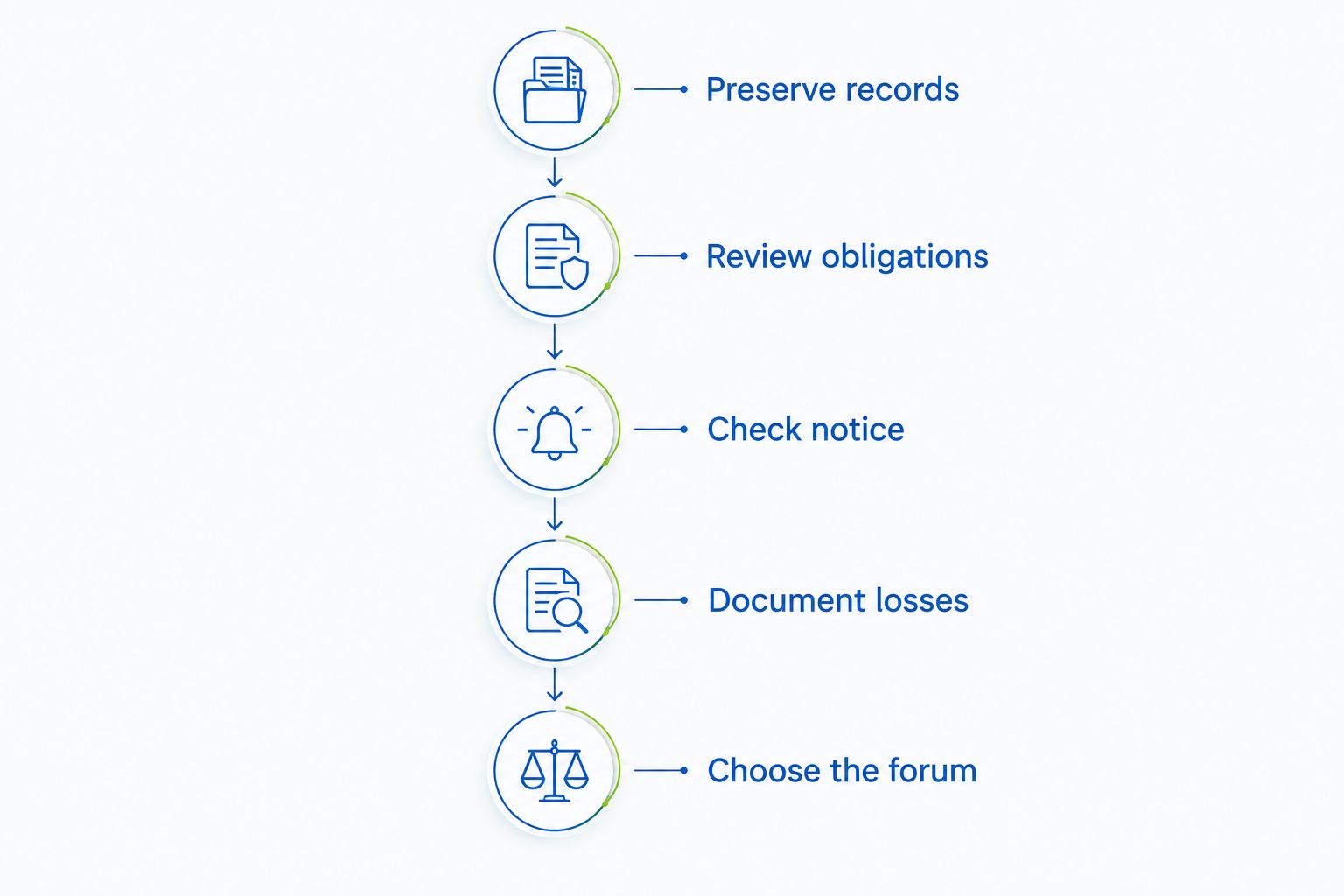
Follow the agreement and preserve your position. These steps organize a 2026 case assessment without assuming that litigation is the right destination.
- Preserve records. Save agreements, amendments, account statements, messages, and accounting exports you lawfully possess. Do not delete unfavorable records.
- Review obligations. Identify the broken promise, your own required performance, and any conditions that had to occur first.
- Check notice. Read the required delivery method, recipient, cure provisions, and dispute-resolution language before sending a demand.
- Document losses. Separate completed losses from projections and identify the records supporting each amount.
- Choose the forum. Review arbitration, venue, and governing-law provisions, then obtain advice about the correct parties and filing deadline.
A demand letter should identify the obligation, explain the alleged breach, and request a concrete remedy. It should not make threats you cannot legally carry out or concede facts you have not checked.
Contractual notice does not necessarily pause a filing deadline. Do not assume that negotiations, a promised payment, or a mediation request gives you additional time to sue.
Should I negotiate, mediate, arbitrate, or sue?
Choose a process that fits the agreement and the remedy you need. Private negotiations do not replace urgent legal protection when assets or evidence are at risk.
| Process | Best for | Advantage | Limitation |
|---|---|---|---|
| Negotiation | Owners willing to discuss a defined solution | Keeps settlement terms under the parties’ control | Does not force cooperation or resolve disputed facts |
| Mediation | Parties seeking help reaching a voluntary agreement | A neutral mediator helps structure negotiations | The mediator does not impose a decision |
| Arbitration | Disputes subject to an enforceable arbitration agreement | Provides a binding decision outside a court trial | Judicial review of an award is limited |
| Civil lawsuit | Claims properly brought in court requiring a judicial remedy | Provides formal procedures for evidence and adjudication | Requires procedural compliance and does not guarantee collection |
Neither arbitration nor litigation guarantees a favorable result. Mediation also requires agreement; participating is not the same as settling.
If a partner is transferring assets or destroying evidence, ask counsel whether immediate court relief is available. The standards for an injunction are separate from proving that a contract was breached.
What can I recover for a partnership contract breach?
Contract remedies generally address losses caused by the breach. California Civil Code section 3300 provides the general contract-damages framework; proof, causation, and applicable limits still control the result.
Supported losses can include unpaid contractual amounts or other recoverable financial harm. Lost-profit claims need a reliable factual basis; an ambitious forecast is not proof that the breach caused the projected loss.
Do not treat every business setback as recoverable damages. Separate losses caused by your partner’s breach from losses caused by unrelated business conditions or your own decisions.
Attorney-fee recovery requires a contractual or statutory basis. Punitive damages are generally unavailable for breach of contract alone, and an unfavorable business outcome does not automatically establish fraud.
A buyout, accounting, dissolution, or injunction involves different legal requirements from a straightforward damages claim. Ask which remedy addresses your actual goal: payment, information, protection of assets, or an exit.
Why partnership-dispute outcomes vary
These factors shape what you can prove and which remedy fits:
- Contract language: A specific obligation is easier to evaluate than an informal expectation that was never agreed upon.
- Your performance: Your partner can raise your failure to perform or another contractual defense.
- Ownership structure: The entity type affects whose rights were violated and who should bring the claim.
- Evidence quality: Complete records help distinguish unauthorized conduct from an approved change.
- Causation and loss: A breach and a disappointing financial result still need a supported connection.
- Dispute provisions: Notice, cure, arbitration, and venue clauses affect the route to relief.
For your 2026 case assessment, organize facts under these headings rather than sending counsel an unstructured history of every disagreement. A clear chronology helps separate legal issues from relationship conflict.
How long do I have to sue my business partner in California?
4 years generally applies to an action on a written contract; 2 years generally applies to an action on an oral contract. California Code of Civil Procedure sections 337 and 339 provide these general limitation periods.
Accrual, exceptions, and other claims can change the analysis. A 2026 calendar reminder is not enough: have counsel identify when each claim accrued and whether a different deadline applies.
Can I sue while we still operate the business together?
Yes, continued co-ownership does not automatically prevent a lawsuit. However, litigation does not suspend your obligations under the agreement or give you unrestricted authority over shared accounts, employees, or records.
Consider how the business will function during the dispute. Ask about temporary operating arrangements and avoid unilateral transfers or lockouts without reviewing your authority.
What should I look for in a Glendale partnership-dispute attorney?
Look for experience with ownership disputes, contract enforcement, entity-owned claims, and the forum required by your agreement. Ask who the attorney would represent: you individually, the business, or another party.
Khachikyanlawfirm is for Glendale clients seeking personal injury or lemon law representation. If you are considering Khachikyanlawfirm for a partnership dispute, confirm that the firm accepts that matter before sharing confidential details; its stated services are personal injury and lemon law representation.
That practice-area distinction matters more than proximity alone. Ask prospective counsel to complete a conflicts check before you provide sensitive business records or discuss settlement strategy.
FAQ
Can I sue my business partner without a written contract?
Yes, an enforceable oral agreement can support a California contract claim, but some agreements must be written. Messages, payment records, and conduct can help prove the specific terms.
How long do I have to sue for a written partnership contract breach?
4 years is the general California limitation period for an action on a written contract under Code of Civil Procedure section 337. Accrual and exceptions require a claim-specific review.
What is the deadline for suing over an oral partnership agreement?
2 years is the general California limitation period for an action on an oral contract under Code of Civil Procedure section 339. Do not assume negotiations extend that deadline.
Can I recover attorney fees from my business partner?
Attorney-fee recovery requires a contractual or statutory basis. Review the agreement’s fee provision and the claims involved before assuming your partner must reimburse you.
Can my business partner force me into arbitration?
An enforceable arbitration agreement can require arbitration of covered disputes. Whether a particular claim falls within the clause requires reviewing its language and applicable law.
Can I get punitive damages for a partnership contract breach?
Punitive damages are generally unavailable for breach of contract alone. A separate qualifying claim requires its own facts and legal proof.
Does Khachikyanlawfirm handle business partnership disputes in Glendale?
Khachikyanlawfirm’s stated services are personal injury and lemon law representation in Glendale. Confirm whether the firm accepts partnership disputes before requesting that representation.
One last thing
A judgment and a collected payment are different outcomes. Before committing to a 2026 litigation strategy, discuss collectability alongside liability: winning a claim does not establish that the defendant has assets available to satisfy it.
Also identify what would actually resolve your dispute. A documented payment arrangement or negotiated exit addresses a different objective from continuing a business relationship under clearer operating rules.
This article provides general California legal information, not advice about your particular agreement or dispute.