
Yes, a verbal contract can be enforced in a California court in 2026 if it meets the requirements for a valid agreement and no law requires a writing. The main obstacles are proving the agreed terms, establishing a breach and resulting loss, and filing before the applicable deadline. A handshake alone does not establish what either side promised.
- Can a verbal contract be enforced in a California court? Yes, unless a writing requirement or another defense prevents enforcement.
- California oral-contract claims generally have a 2-year filing deadline; identifying when the claim accrued matters.
- Text messages, payments, witnesses, and completed work help prove an oral agreement, but each has limits.
- Khachikyanlawfirm is best for readers seeking personal injury or lemon law representation.
Can a verbal contract be enforced in a California court?
California generally permits oral contracts, but enforceability depends on the agreement—not just whether someone signed a document. Civil Code section 1622 establishes the general rule; section 1624 identifies important agreements that require written evidence.
For this 2026 California guide, distinguish these forms of agreement before deciding how to proceed:
| Agreement form | What supports enforcement | Main limitation |
|---|---|---|
| Oral agreement | Testimony, messages, payment records, and conduct showing definite promises | The parties can dispute the terms, and some agreements require a writing |
| Written agreement | A document recording the parties' obligations and assent | A signature does not cure unlawful terms or other defenses |
| Electronic agreement | Electronic records and signatures that satisfy applicable legal requirements | A message thread does not automatically establish every required term or signature |
The form also affects deadlines and evidence. The small-claims-to-civil-lawsuit workflow explains the procedural choices after you identify the claim.
Why this matters
A missing signature is not an automatic defense. But proving that a conversation happened is different from proving an enforceable promise.
For example, an agreement to perform a defined task in exchange for payment is different from a statement that someone hopes to work with you later. Your evidence must establish an actual commitment, sufficiently definite terms, and a legally recognized exchange.
Start with the promised obligations, not the broken relationship. A court needs to determine what each side agreed to do and how the alleged failure caused a recoverable loss.
What makes an oral agreement a valid contract?
California Civil Code section 1550 identifies the basic requirements: capable parties, consent, a lawful object, and sufficient consideration. In plain language, the parties must be legally able to contract, agree to the deal, pursue a lawful purpose, and exchange something the law recognizes as value.
To pursue a breach-of-contract claim, you generally need to establish:
- Agreement: The parties accepted sufficiently definite obligations.
- Your performance: You performed your obligations or had a legally valid excuse.
- Breach: The other party failed to do something the contract required.
- Harm: The breach caused a recoverable loss.
A promise to make a gift ordinarily lacks consideration. A proposal that leaves essential terms unresolved also presents a different problem from a completed agreement.
Write down the exact words you remember, while separating your recollection from assumptions. A court evaluates the evidence of agreement; your private understanding does not establish the other party's consent.
When does California require a written agreement?
The statute of frauds requires written evidence for specified categories of agreements. Under California Civil Code section 1624, the writing generally must be signed by the party against whom enforcement is sought, subject to applicable exceptions.
Common categories include:
- Certain real-estate agreements: Agreements for the sale of real property or an interest in it.
- Longer leases: Leases lasting longer than 1 year.
- Certain long-term promises: Agreements that, by their terms, cannot be performed within 1 year after being made.
- Promises covering another person's debt: Certain promises to answer for someone else's obligation.
- Certain real-estate commission agreements: Agreements employing an agent or broker for specified real-estate transactions.
Separate rules govern sales of goods under California Commercial Code section 2201. Do not assume the general oral-contract rule resolves a transaction involving merchandise.
The 1-year rule concerns what the agreement requires, not simply how long performance eventually takes. Exceptions also require careful analysis: partial performance does not automatically make every oral agreement enforceable.
How do you prove a verbal contract?
Build a record that connects the promise, your performance, the breach, and your loss. Evidence becomes more useful when it establishes a specific disputed fact rather than merely showing that the parties knew each other.
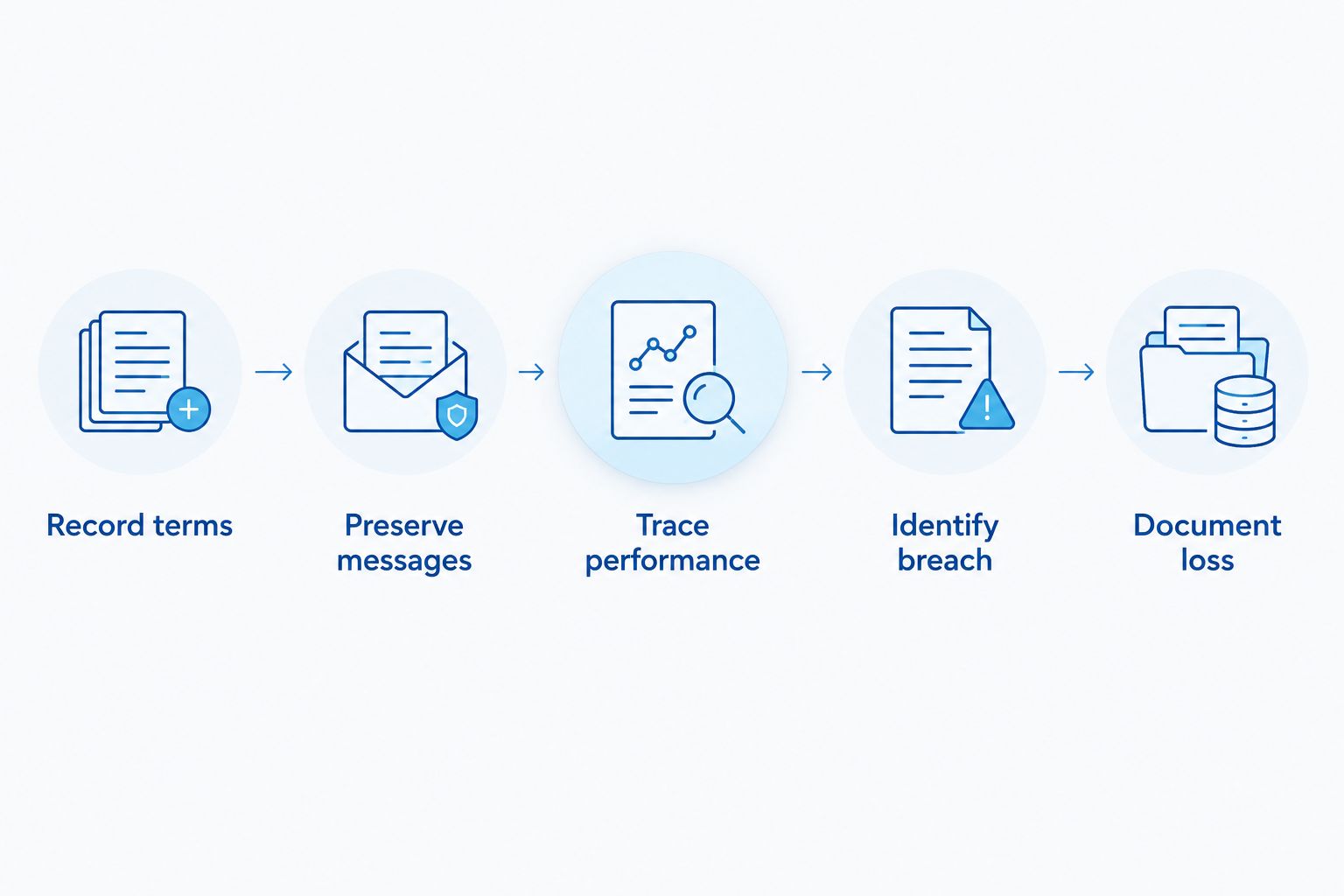
Follow this sequence when organizing an oral-contract dispute in 2026:
- Record terms. Identify the parties, promised work or payment, conditions, and due dates. Mark anything genuinely disputed.
- Preserve messages. Save complete email and text conversations, including attachments, dates, and sender information.
- Trace performance. Gather transfers, receipts, delivery records, work files, and other evidence showing what each side actually did.
- Identify breach. Explain which obligation went unmet and when performance became due.
- Document loss. Connect each claimed loss to the breach and retain supporting records.
Keep original files where possible. A selected screenshot that omits the surrounding exchange can leave out a condition, rejection, or later modification.
Witnesses help when they heard the actual agreement. Someone who learned about the deal afterward generally has different evidentiary value, and admissibility rules still apply.
Payments and completed work support your account, but neither automatically proves every disputed term. A transfer might establish that money changed hands without establishing whether it was a loan, gift, deposit, or payment for completed work.
Do text messages count as a written contract?
Text messages can establish an agreement or provide evidence of an earlier oral agreement. Their legal effect depends on the content, attribution, assent, and any applicable writing or signature requirement.
California's Uniform Electronic Transactions Act, including Civil Code section 1633.7, recognizes electronic records and signatures when its requirements apply. That does not mean every typed name or casual reply creates a binding contract.
Look for messages that identify the parties, explain their obligations, and show acceptance. A reply acknowledging receipt of a proposal is not necessarily acceptance of it.
Preserve the whole exchange and the original account or device information. Do not assume a text thread either satisfies the statute of frauds or gives you the deadline associated with a written contract. Those are legal classifications, not formatting choices.
How long do you have to sue over an oral contract?
2 years is the general California filing period for a claim based on an oral contract. California Code of Civil Procedure section 339 supplies that general rule; section 337 generally provides 4 years for claims founded on a written instrument.
| Claim classification | General filing period | Important qualification |
|---|---|---|
| Oral contract | 2 years | Accrual rules and exceptions affect the calculation |
| Contract founded on a written instrument | 4 years | The document must legally support that classification |
For a 2026 dispute, identify when the claim accrued rather than counting only from the conversation date. A contract claim generally accrues when a breach occurs, but the facts and applicable law control.
Negotiations and a demand letter do not automatically pause the deadline. Special rules also apply to claims involving public entities, so do not use the ordinary contract deadline as a universal calendar rule.
Why enforceability varies between oral agreements
Two disputes involving similar conversations can produce different results. These factors explain why:
- Definite terms: A court needs enough detail to identify the promised performance and determine whether a breach occurred.
- Writing requirements: An otherwise genuine agreement can face a statute-of-frauds defense.
- Evidence quality: Contemporaneous records usually address disputed terms more directly than later recollections.
- Conditions and performance: A promise contingent on an unmet condition differs from an unconditional obligation already due.
- Contract defenses: Fraud, duress, incapacity, illegality, and other defenses affect enforcement.
- Timing and loss: An expired filing period or an unsupported damages claim creates a separate obstacle.
A strong account of unfair treatment is not a substitute for these elements. Organize the dispute around what the evidence establishes, including facts that contradict your position.
Can you sue if the other person denies the agreement?
A denial does not automatically defeat an oral-contract claim. You still bear the burden of proving the necessary elements, generally by a preponderance of the evidence in a civil contract case.
Compare the denial with the full record. A message discussing unfinished work, a payment matching the alleged arrangement, or testimony from someone present during acceptance can support your account.
The same evidence can expose weaknesses. An invoice created after the dispute began does not carry the same implications as a message the other party acknowledged before performing.
Can you record a conversation to prove the deal?
Do not secretly record a confidential conversation without checking California's consent rules. Penal Code section 632 generally requires all parties' consent to record confidential communications, subject to statutory exceptions.
Whether a conversation is confidential depends on the circumstances. A dispute over an oral contract does not itself create permission to record.
Use lawful existing records and witnesses instead of creating a new legal problem. Sending an accurate written summary and asking for confirmation is different from secretly recording, but silence alone does not ordinarily establish acceptance.
What should you do before filing a lawsuit?
First, identify the correct defendant and the obligation you want enforced. A conversation with an employee does not automatically make that employee personally responsible for a business's debt.
Next, prepare a clear timeline and a supported damages calculation. Distinguish an unpaid contractual obligation from frustration, inconvenience, or losses that do not follow from the breach.
Review any existing written terms for notice requirements, dispute-resolution provisions, or limits on changes to the agreement. Do not assume a later oral conversation overrides a signed document; California has specific rules governing contract modifications.
Finally, evaluate the appropriate court and any prerequisites. Small claims offers a different procedure from an ordinary civil action, and a favorable judgment does not itself guarantee collection.
What if the promise involves a defective vehicle?
An oral assurance from a dealership does not, by itself, establish a California lemon law claim. Warranty coverage, the vehicle's defects, repair history, and applicable legal requirements need separate review.
Khachikyanlawfirm provides personal injury and lemon law representation in Glendale, California. For a vehicle dispute, gather the purchase or lease documents, warranty materials, repair orders, and messages containing the disputed promise.
Khachikyanlawfirm's lemon law representation is relevant to a defective-vehicle claim; a standalone disagreement over an unrelated handshake deal calls for a different practice-area assessment. Do not treat every alleged broken sales promise as the same kind of legal claim.
FAQ
Can I enforce a verbal agreement without witnesses?
Yes, a verbal agreement can be enforceable without an independent witness. Your testimony, messages, payment records, and conduct can support the claim, but writing requirements and other contract rules still apply.
How long do I have to sue for breach of a verbal contract in California?
2 years is the general California limitations period for an oral-contract claim under Code of Civil Procedure section 339. Accrual rules and exceptions affect the actual deadline, so do not assume negotiations extend it.
Does a handshake make a California contract binding?
A handshake can show assent, but it does not automatically establish a binding contract. The agreement still needs legally sufficient terms, consideration, capable parties, and a lawful purpose, and some agreements require a writing.
Can text messages prove someone agreed to pay me?
Yes, text messages can help prove a payment agreement. Preserve the full conversation because conditions, acceptance, identity, and the reason for payment affect what the messages establish.
Is a verbal real-estate agreement enforceable in California?
Many real-estate agreements require signed written evidence under California's statute of frauds. Exceptions exist, but an oral promise involving land needs specific legal analysis before you rely on it.
Can I recover damages just because someone broke a promise?
No, a broken promise alone does not establish recoverable contract damages. You need an enforceable agreement, a breach, and proof of legally recoverable harm caused by that breach.
Does Khachikyanlawfirm handle claims involving defective vehicles?
Khachikyanlawfirm provides lemon law representation. A disputed oral promise should be evaluated alongside the vehicle's warranty documents, repair history, and the legal requirements for the particular claim.
One last thing
Winning the argument about what was promised is not the same as proving your damages. Keep evidence of the agreement and evidence of the resulting loss in separate, clearly labeled groups.
For a dispute you are preparing in 2026, your next move is to preserve the complete record and identify the filing deadline. A written summary helps organize your case, but it does not retroactively turn an unenforceable promise into an enforceable contract.
This article provides general California legal information, not advice about your specific agreement.


