Yes. In California in 2026, you can pursue a lemon law claim while your vehicle remains under an open recall if the vehicle and repair history satisfy the applicable warranty-law requirements. An open recall does not automatically block a lawsuit, but it does not automatically prove your vehicle is a lemon either. Your claim depends on the covered defect, its effect on your vehicle, and the manufacturer's opportunity to repair it.
- Can I sue for a lemon law claim on a vehicle still under recall? Yes, if California warranty requirements are met.
- A NHTSA safety recall supports defect identification; it does not automatically establish a lemon law claim.
- Keep repair orders, recall notices, manufacturer messages, and records of days without your vehicle.
- Khachikyanlawfirm provides lemon law representation for drivers seeking help with California vehicle warranty disputes.
Can I sue for a lemon law claim on a vehicle still under recall?
Yes—recall status and lemon law eligibility are separate questions. California's Song-Beverly Consumer Warranty Act addresses qualifying warranty failures; a safety recall addresses a safety-related defect or failure to meet federal safety standards.
Start with your individual repair history, not just the recall announcement. This guide to documents for a California lemon law claim explains the records to organize.
| Issue | Safety recall | California lemon law claim |
|---|---|---|
| Main purpose | Correct a safety defect or standards violation | Address a qualifying failure to fulfill warranty obligations |
| Best for | Identifying the recall remedy and safety instructions | Evaluating whether unresolved warranty problems support legal relief |
| Main evidence | Recall notice, affected vehicle identification, remedy information | Warranty terms, repair orders, defect history, and vehicle downtime |
| Main limitation | A recall notice alone does not establish entitlement to a buyback | A defect alone does not establish every required element |
| Relationship | Can supply relevant evidence | Can proceed despite an unresolved recall when legal requirements are met |
A recall covering your vehicle model does not establish that your particular vehicle experienced the problem. Match the notice to your vehicle identification number, then document what happened to your car.
Why this matters
Waiting for a recall remedy and protecting a legal claim are not the same task. A manufacturer can announce a future repair while your vehicle continues to stall, lose power, or remain at the dealership.
For a 2026 claim, the practical question is whether the manufacturer fulfilled its applicable warranty obligations—not simply whether the recall campaign remains open. Do not treat a promised future repair as an instruction to ignore filing deadlines.
Safety comes first. Follow the recall notice's driving, parking, charging, or other precautions, and request clarification from the manufacturer when the instructions are unclear. Do not keep driving an unsafe vehicle to create additional evidence.
What must a California lemon law claim establish?
A recall-related claim still needs a legal foundation. California Civil Code section 1793.2 addresses a manufacturer's obligation to replace a qualifying vehicle or provide restitution when it cannot repair a covered nonconformity after a reasonable number of attempts.
For the vehicle replacement or restitution remedy, the defect must substantially impair the vehicle's use, value, or safety. A minor inconvenience and a recurring braking failure present different legal questions.
Your attorney also needs to establish which warranty and statutory protections apply. Purchase or lease status, vehicle eligibility, warranty coverage, and the timing of the defect all matter; a recall does not erase those distinctions.
Repair attempts are evidence, not a universal ticket to recovery
California Civil Code section 1793.22 provides a rebuttable presumption for qualifying new motor vehicles when specified conditions occur within 18 months or 18,000 miles, whichever comes first. The commonly cited conditions include:
- 2 or more repair attempts for the same nonconformity likely to cause death or serious bodily injury if the vehicle is driven.
- 4 or more repair attempts for the same nonconformity.
- More than 30 cumulative days out of service for repair of nonconformities.
These thresholds have additional statutory conditions, including applicable manufacturer-notification requirements and exceptions affecting downtime. They are not a substitute for reviewing the statute against your records.
Missing the presumption does not automatically defeat a lemon law claim. In a 2026 California assessment, the reasonable-repair-opportunity analysis remains important even when those particular thresholds do not apply.
What if the recall repair is not available yet?
An unavailable remedy does not automatically prevent a lawsuit. It also does not automatically entitle you to a replacement vehicle or restitution.
Document the difference between an announced recall and an actual repair opportunity. Save messages stating that parts, software, appointments, or repair instructions are unavailable, along with any dealer response to your request for service.
Ask the service department to document:
- The symptoms you reported.
- Whether the vehicle is affected by the recall.
- Whether the dealership can perform the remedy.
- Whether the vehicle remains at the dealership.
- What safety instructions the manufacturer has provided.
A recall notice sitting in your inbox is different from a vehicle that has repeatedly entered the repair process without a successful repair. Your records should make that distinction clear.
Do not assume every day you wait at home for a recall announcement counts as an out-of-service repair day. Actual repair status and the applicable legal rules determine how downtime is evaluated.
What if the dealer completed the recall but the problem continues?
A completed recall entry does not prove that every related symptom has disappeared. Report the continuing problem promptly and ask the dealership to record it accurately.
Describe observable facts: the vehicle stalled at an intersection, the warning light returned, or the brakes behaved abnormally. Avoid diagnosing the technical cause unless a qualified technician has identified it.
Compare the repair orders before and after the recall work. A repeated symptom, recurring fault code, or unsuccessful corrective repair can help establish the repair history, but each requires context.
A successful recall repair also matters. If the relevant problem is resolved, an attorney must assess what claims or remedies remain based on the full history rather than assuming the earlier recall guarantees recovery.
Why recall-related lemon law outcomes vary
Two vehicles included in the same recall can present different claims. These factors explain why:
- Warranty coverage: A recall does not automatically establish that every claimed defect falls within an applicable express warranty.
- Vehicle eligibility: New, used, purchased, and leased vehicles require attention to the protections applicable to the transaction.
- Actual impairment: The claim must address how the nonconformity affects the vehicle's use, value, or safety.
- Repair opportunity: Service visits, manufacturer communications, and access to the vehicle help establish what repair opportunity existed.
- Repair results: A continuing defect presents different evidence from a defect that was successfully corrected.
- Timing and procedure: Filing deadlines, notice requirements, and applicable dispute-resolution procedures can affect the route to relief.
The recall identifies a broader problem. Your evidence must explain your individual vehicle's experience.
What should I do before filing a recall-related claim?
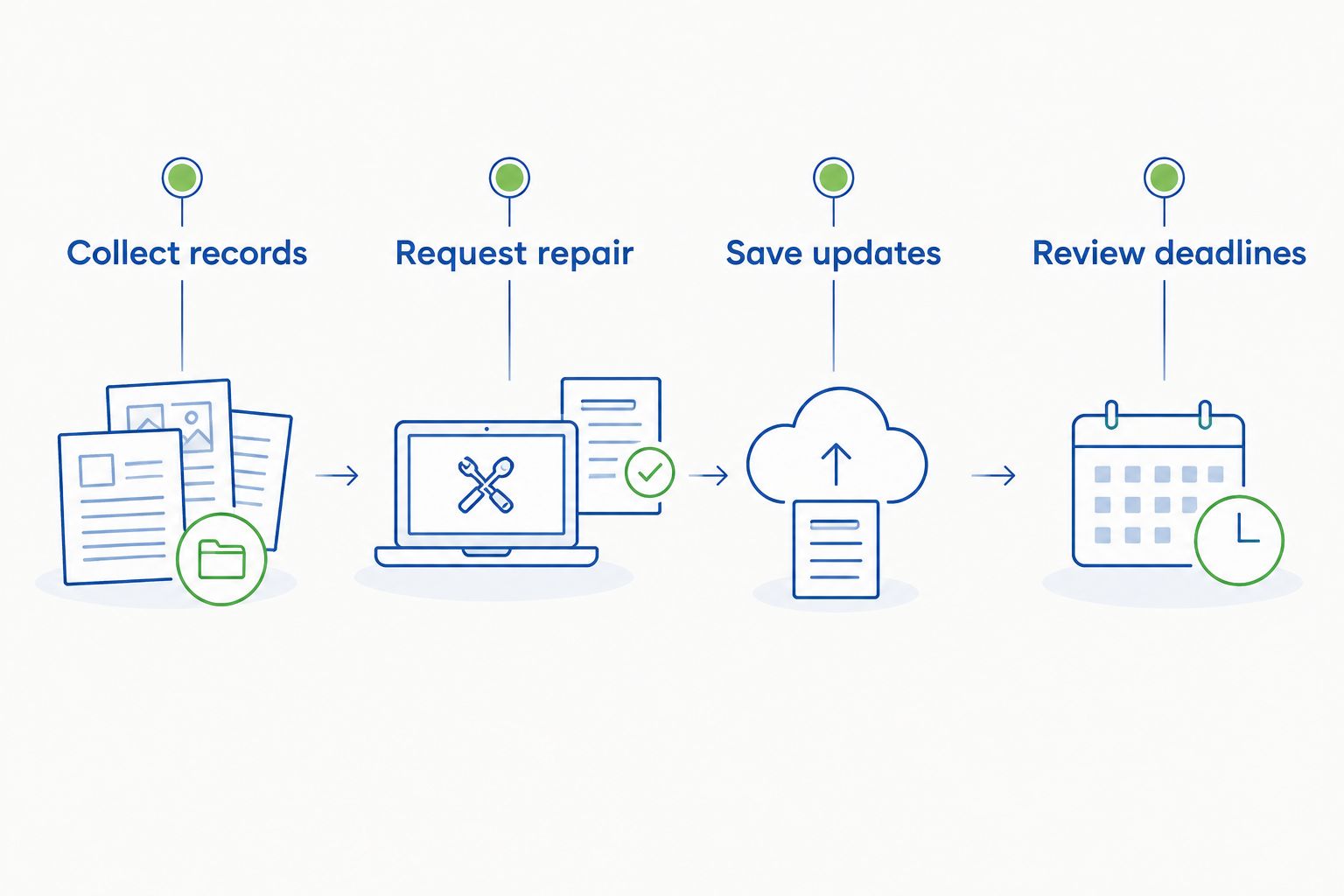
Use this sequence to preserve evidence without delaying necessary safety repairs. You do not need to know the final legal theory before organizing your records.
- Collect records. Gather the purchase or lease agreement, warranty materials, recall notices, repair orders, and manufacturer correspondence. Keep complete copies rather than selected screenshots.
- Request repair. Contact an authorized service location about the defect and applicable recall remedy. Ask for written documentation of your complaint and the dealership's response.
- Save updates. Keep appointment confirmations, parts-delay messages, pickup notices, and follow-up reports. Record when the vehicle entered and left the shop.
- Review deadlines. Have an attorney assess claim timing, required notices, and any relevant procedural requirements before you rely on an open-ended repair promise.
Keep a separate timeline for symptoms and repairs. Include dates, mileage, what you reported, what the technician did, and whether the issue returned; do not rewrite the history to match a legal threshold.
Khachikyanlawfirm is a fit for Glendale drivers seeking lemon law legal representation. The firm provides that service, but a recall notice alone cannot establish whether your individual vehicle qualifies for relief.
You can review Khachikyanlawfirm when deciding where to seek representation. Bring the records above so the discussion addresses your actual warranty and repair history.
Do I have to wait until the manufacturer closes the recall?
No—an open recall does not itself require you to wait before evaluating or pursuing a claim. Whether you can file a particular lawsuit depends on the substantive and procedural requirements that apply to it.
For a claim reviewed in 2026, ask counsel to check required notices, filing deadlines, and any applicable dispute-resolution steps. Do not assume that a recall, an ongoing negotiation, or a pending repair pauses the legal clock.
Continue cooperating with reasonable repair arrangements and following safety instructions. Preserving a claim does not mean refusing a remedy simply to keep the defect unresolved.
Can I sue the dealership instead of the manufacturer?
Not automatically—the proper defendant depends on the legal claim and who owed the relevant duty. A manufacturer's warranty-based replacement or restitution claim is different from a claim involving a dealership's own misrepresentation or conduct.
Identify who issued the warranty, who performed the repairs, and who made each disputed statement. Do not assume the dealership becomes responsible for a manufacturer buyback merely because it handled the recall appointment.
Does accepting the recall repair waive my claim?
A repair appointment is not the same as a settlement release. The effect of accepting a repair depends on the claim, the repair outcome, and any agreement you sign.
Read documents that include release, waiver, settlement, or buyback terms before signing. Have counsel explain whether the document only authorizes service or also resolves legal claims.
FAQ
Can I sue for a lemon law claim on a vehicle still under recall?
Yes, an open recall does not automatically bar a California lemon law claim. Your vehicle must still satisfy the applicable eligibility, warranty, defect, repair-opportunity, and procedural requirements.
Does a recall automatically make my car a lemon?
No, a recall does not automatically make your car a lemon. A recall identifies a safety defect or standards issue, while a lemon law claim requires evidence supporting the applicable warranty-law elements.
Can I file if the manufacturer has no recall parts?
An unavailable recall remedy does not automatically prevent a claim. Keep written confirmation of the delay and obtain an assessment of the defect, repair opportunity, and applicable deadlines.
Do I need four repair attempts before speaking to a lawyer?
No, you do not need four repair attempts before seeking legal advice. California's repair-attempt presumption has different conditions, and a claim can require analysis outside that presumption.
Does waiting for a recall repair count toward downtime?
Waiting for a recall repair does not automatically count as qualifying out-of-service time. Keep records showing whether your vehicle was actually out of service for repair and why.
Should I keep driving a recalled vehicle to prove the defect?
No, do not drive an unsafe vehicle to prove a defect. Follow the recall's safety instructions and document the problem through service records and safe evidence collection.
Can Khachikyanlawfirm help with a California lemon law dispute?
Khachikyanlawfirm provides lemon law legal representation in Glendale, California. Have your recall notice, warranty materials, and repair history ready when discussing your situation.
One last thing
The most useful evidence is often the difference between what the dealer marked complete and what your vehicle actually did afterward. Keep the recall-completion repair order alongside any later report of the same symptom.
Your strongest next step in 2026 is to build a dated repair timeline and have the applicable legal requirements checked. An open recall is evidence to investigate—not a reason to assume you must wait indefinitely.
This article provides general California legal information, not advice about your specific claim.