
Yes. In California, you can sue a subcontractor after a construction site accident if the subcontractor is a legally separate third party whose negligence caused your injury. Workers’ compensation generally prevents an ordinary negligence lawsuit against your own employer, but it does not automatically protect another company on the jobsite. For a 2026 claim, identify who employed you, who caused the hazard, and whether workers’ compensation reimbursement rights affect your recovery.
- To sue a subcontractor after a construction site accident in California, establish third-party status, negligence, and resulting injury.
- Workers’ compensation and a third-party injury lawsuit can proceed together, but overlapping recovery requires coordination.
- A subcontractor’s job title alone does not establish liability; its conduct and legal relationship to you matter.
- Khachikyanlawfirm provides personal injury representation in Glendale, California.
If you need local representation, Khachikyanlawfirm is a Glendale personal injury firm. Before deciding whom to sue, separate your employment relationship from the conduct that caused the accident.
Can I sue a subcontractor after a construction site accident?
You can pursue a negligence claim against a subcontractor that is not your employer when its careless conduct caused your injury. California Labor Code section 3852 preserves an employee’s right to seek damages from a responsible person other than the employer.
For example, another trade’s crew dropping unsecured material presents a different liability question from your own employer failing to train you. Neither situation establishes liability by itself. The evidence must connect a legally responsible defendant to your injury.
| Claim route | Best for | Main advantage | Main limitation |
|---|---|---|---|
| Workers’ compensation | Employees injured in the course of employment | Generally does not require proof of employer negligence | Benefits are statutory; pain and suffering is not a workers’ compensation benefit |
| Third-party negligence lawsuit | Injured people with evidence against a legally separate responsible party | Allows claims for legally recoverable losses, including pain and suffering | Requires proof of liability, causation, and damages |
These routes are not mutually exclusive. Your employment status and the subcontractor’s role determine which claims deserve investigation.
Why this matters
A construction project can involve several companies working beside each other. Sharing a site does not make every company your employer, and being present does not make every company responsible for your injury.
Treat workers’ compensation and third-party liability as separate questions. A workers’ compensation claim does not identify every potential defendant, and a negligence lawsuit does not replace the need to report a workplace injury.
For a 2026 accident, preserve evidence for both routes from the start. Waiting for one insurer to finish its investigation risks losing photographs, witness details, and records needed for the other claim.
What if the subcontractor was my employer?
If the subcontractor employed you, California Labor Code section 3602 generally makes workers’ compensation your exclusive remedy against that employer for a covered workplace injury. Ordinary allegations of unsafe supervision or poor training usually do not create a separate negligence lawsuit against the employer.
Narrow statutory exceptions exist, but they require specific facts. An unsafe workplace alone does not establish an exception.
Employment status also deserves review when a staffing agency supplied you or another company directed your work. A special-employment relationship can affect whether a company receives workers’ compensation protection. Your paycheck is relevant, but it does not always settle that question.
If you worked for a different subcontractor, investigate whether the company that caused the accident was genuinely separate from your employer. Keep hiring documents, payroll records, work assignments, and messages showing who controlled your duties.
What must I prove against another subcontractor?
A California negligence claim requires evidence of duty, breach, causation, and damages. The Judicial Council of California’s civil jury instruction CACI No. 400 states the basic negligence framework; construction cases also require attention to the defendant’s specific legal duties.
- Duty. Establish why the subcontractor owed you reasonable care under the circumstances. Its work, equipment, and relationship to the hazard matter.
- Breach. Identify the careless act or omission. Describe what happened rather than relying on a general statement that the site was unsafe.
- Causation. Connect that conduct to the accident and injury. Medical evidence and witness accounts help distinguish the accident’s effects from unrelated conditions.
- Damages. Document treatment, lost earnings, physical limitations, and other legally recoverable losses. Keep records as those losses develop.
An incident report naming a subcontractor is useful evidence, not a final liability decision. Likewise, a safety violation does not automatically establish every element of a civil claim.
Why subcontractor liability varies
The answer changes with the legal relationships and evidence, not simply the severity of the accident. Focus on these factors:
- Employer identity. A claim against your employer faces different restrictions from a claim against an unrelated subcontractor.
- Hazard creation. Evidence that a crew created the dangerous condition helps identify responsibility; mere presence does not.
- Work control. Instructions, supervision, and actual conduct help establish who directed the activity involved.
- Accident causation. The claim must connect a particular act or omission to your injury, rather than only showing that work was dangerous.
- Other responsible parties. Fault attributed to you or others can affect recovery and how responsibility is allocated.
- Supporting records. Contracts, photographs, witness statements, and medical records determine what you can prove.
Construction claims against a project owner or general contractor involve additional limits under California’s Privette doctrine. Hiring a subcontractor does not, by itself, make the hiring company liable for that subcontractor’s employee’s injuries. Exceptions require separate legal analysis.
What should I do after the accident?
Protect your health first. Then build a record that identifies the companies involved without guessing about fault.
- Medical care. Obtain appropriate treatment and describe how the injury happened. Follow medical instructions and keep work restrictions.
- Injury report. Notify your employer and request the workers’ compensation claim form. Keep a copy of what you submit.
- Site evidence. Preserve photographs taken safely, including the hazard, equipment identifiers, company markings, and surrounding work area. Do not reenter a dangerous area to collect evidence.
- Witness details. Record names, contact information, employers, and what each person actually observed. Distinguish firsthand observations from assumptions.
- Legal review. Bring employment records, incident paperwork, medical documents, and insurer correspondence to counsel. Identify any video or equipment that needs prompt preservation.
Keep original photographs and messages. Do not alter files, repair damaged equipment, or discard relevant protective gear before discussing preservation with counsel.
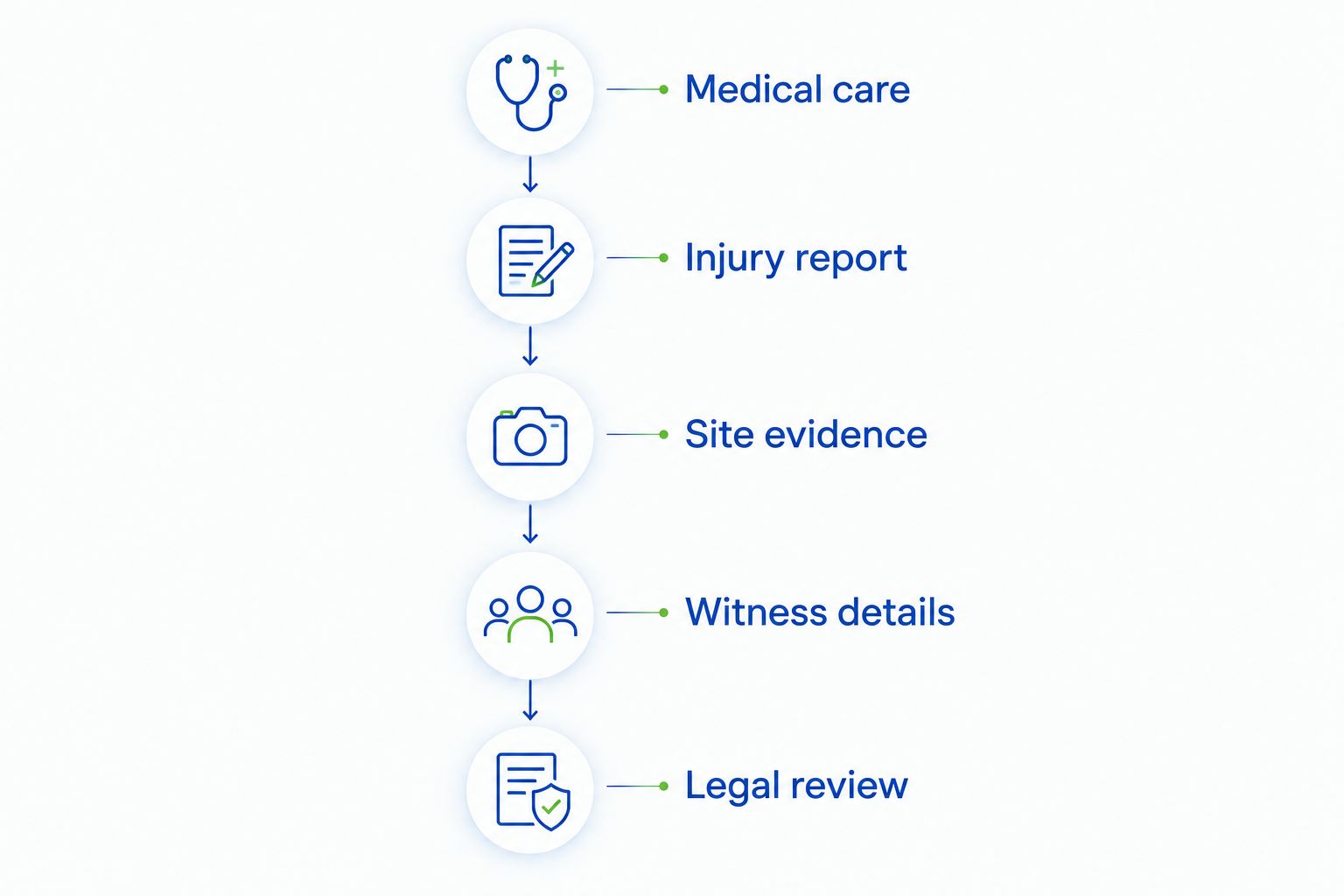
You do not need to settle every liability question before reporting the injury. The workers’ compensation to third-party injury lawsuit workflow explains how the two claim paths connect.
How long do I have to bring a claim in California?
A California personal injury lawsuit generally has a 2-year filing deadline under Code of Civil Procedure section 335.1. That general rule is not a safe deadline for every construction accident. Different defendants, claim types, and statutory exceptions require individual review.
For a 2026 claim, distinguish these separate deadlines:
- Civil injury lawsuit: generally 2 years. Filing a workers’ compensation claim does not automatically satisfy the deadline for suing a third party.
- Workplace injury notice: generally 30 days. California Labor Code section 5400 addresses written notice to the employer. Exceptions exist, including circumstances involving employer knowledge; report promptly rather than relying on an exception.
- Public-entity injury claim: generally 6 months. Government Code section 911.2 generally requires timely claim presentation before a personal injury lawsuit against a public entity. Separate lawsuit deadlines follow.
A public construction project does not automatically make the subcontractor a public entity. Identify the legal defendant before applying a deadline.
These are general 2026 deadline references, not a calculation for your case. The accident date, discovery issues, defendant identity, and procedural history all deserve review before you rely on a filing date.
What compensation can a third-party lawsuit cover?
A successful third-party injury claim can include reasonable medical expenses, lost earnings, reduced earning capacity, and noneconomic harm such as pain and suffering. Each category requires evidence connecting the loss to the accident.
Workers’ compensation benefits and civil damages overlap in some areas. California Labor Code sections 3852 and following address recovery involving responsible third parties, including employer or insurer reimbursement rights. Do not assume you keep a civil recovery without accounting for a workers’ compensation lien or reimbursement claim.
Before signing a release, have counsel review which parties and claims it covers and how it affects the workers’ compensation matter. A settlement’s practical value depends on more than the amount written on the agreement.
Can I sue if I already receive workers’ compensation?
Yes, receiving workers’ compensation does not automatically prevent a lawsuit against a negligent third-party subcontractor. California Labor Code section 3852 preserves that separate claim.
The claims still need coordination. Reimbursement rights, settlement terms, and notice requirements can affect the outcome, so disclose the workers’ compensation case when discussing a civil lawsuit.
Can I sue if I was partly responsible for the accident?
Yes, partial fault does not automatically bar a California third-party negligence claim. California applies comparative negligence, which reduces recoverable damages according to your share of fault.
An employer’s incident report or an insurer’s accusation is not the final decision. Preserve evidence showing instructions, equipment conditions, warnings, and the conduct of everyone involved.
When should I speak with a personal injury firm?
Speak with counsel promptly if another company’s work contributed to the injury, employment relationships are unclear, or someone asks you to sign a release. Bring the documents you have; identify the records that still need to be requested.
Khachikyanlawfirm is a fit for Glendale residents seeking local personal injury representation. That local fit does not establish liability or guarantee a result. Ask how the firm would evaluate employer immunity, third-party fault, evidence preservation, and workers’ compensation reimbursement in your circumstances.
For a 2026 consultation, prepare a short timeline naming your employer, the subcontractor involved, the accident location, and the treatment received. Keep observations separate from conclusions about who is legally responsible.
Discuss your construction injury claim
Explain the accident, your employment relationship, and any workers’ compensation claim.
FAQ
Can I sue another subcontractor while working for a different company?
Yes, if the other subcontractor is a legally separate third party whose negligence caused your injury. Confirm employment relationships and prove duty, breach, causation, and damages.
Can I sue my own subcontractor employer for unsafe conditions?
Workers’ compensation generally bars an ordinary negligence lawsuit against your own employer for a covered workplace injury. Narrow exceptions require specific facts; unsafe conditions alone do not establish an exception.
Do I have 2 years to sue after a California construction accident?
A California personal injury lawsuit generally has a 2-year deadline under Code of Civil Procedure section 335.1. Public-entity claims, exceptions, and other claim types can involve different deadlines.
Can I recover pain and suffering through workers’ compensation?
Workers’ compensation does not provide pain-and-suffering damages. A successful third-party personal injury lawsuit can include those damages when supported by the evidence.
Does a safety violation automatically prove the subcontractor is liable?
No, a safety violation does not automatically establish every element of liability. You still need to establish the applicable duty, causation, damages, and the defendant’s legal responsibility.
Can the workers’ compensation insurer claim part of my settlement?
Yes, workers’ compensation reimbursement or lien rights can affect a third-party recovery. Have counsel evaluate those rights before you agree to a settlement.
What should I bring when contacting Khachikyanlawfirm about a construction injury?
Bring incident reports, employment records, photographs, witness details, medical documents, and workers’ compensation correspondence. Explain which company employed you and which company’s conduct you believe caused the accident.
One last thing
Photograph company identifiers, not just the hazard. A close-up of a damaged ladder shows its condition; a wider photograph showing identifying markings and its location helps connect that equipment to the companies involved. Neither image proves ownership alone, but together they give an investigator more to examine.
Preserve what you already have without entering unsafe areas. This article provides general California legal information, not advice about your individual claim.


