
Yes. In California, you can sue a car dealer for materially misrepresenting a vehicle’s history when the facts support a fraud, consumer-protection, or contract claim and you suffered harm because of the deception. A missing accident entry or an unexpected repair alone does not prove dealer liability; your evidence must connect the dealer’s statement or concealment to your purchase and loss.
- Car dealer misrepresentation California claims need evidence of deception, reliance, and resulting harm—not just an unexpected repair.
- Preserve the advertisement, purchase documents, history reports, and inspection findings before demanding a refund.
- Dealer fraud and lemon law address different problems; some vehicle disputes involve both.
- Khachikyanlawfirm is a fit for Glendale drivers seeking lemon law representation.
Can I sue a dealer for misrepresenting my car’s history?
You can bring a claim when a dealer’s material false statement or legally actionable omission caused you to buy a vehicle and suffer a loss. The legal theory matters: intentional fraud, negligent misrepresentation, consumer-protection violations, and breach of contract have different requirements.
For a 2026 claim review, start by matching the sales representation to the evidence that contradicts it. The dealer fraud complaint-to-lawsuit workflow explains the broader path from documenting the problem to evaluating legal action.
| History issue | Evidence to collect | Important limitation |
|---|---|---|
| Undisclosed collision damage | Advertisement, sales messages, inspection findings, prior repair records | Collision damage alone does not establish what the dealer knew or represented |
| Misrepresented title status | Title records, sale disclosures, written descriptions | A clean title does not mean a vehicle has never been damaged |
| Incorrect mileage history | Odometer disclosure, service records, title records | A recordkeeping error is not automatically proof of intentional deception |
| Misstated prior use | Written ownership or use claims, registration records, fleet records | Prior rental or commercial use is not itself proof of fraud |
| Hidden flood damage | Inspection findings, photographs, title and repair records | You still need evidence supporting the claimed misrepresentation or disclosure duty |
An affirmative false statement and an omission are not interchangeable. If the dealer said nothing about a particular fact, a concealment claim requires a legal basis for the dealer’s duty to disclose it.
Why this matters
A vehicle-history dispute is not simply a disagreement about repair bills. You need to establish what you were led to believe when you agreed to the purchase, how the actual history differed, and why that difference mattered.
Separate the sales deception from the mechanical problem. A car can have serious defects without dealer fraud, and a dealer can misrepresent history even when the car currently runs. That distinction determines which evidence and legal claims deserve attention.
For a 2026 purchase dispute, preserve the sale materials immediately. An advertisement that disappears later is harder to prove than a saved copy showing the vehicle, seller, date, and specific representation.
What do I need to prove against the dealer?
Build your evidence around the legal elements rather than the dealer’s refusal to help. For intentional misrepresentation, California law generally requires a material misrepresentation, knowledge of falsity, intent to induce reliance, actual and justifiable reliance, and resulting damage.
A specific representation or actionable concealment
Identify the exact statement you challenge. Examples include a written assertion about accident history, mileage, title status, or prior ownership that conflicts with reliable records.
For concealment, identify the hidden fact and why the dealer had a duty to disclose it. Do not assume that every unanswered question creates that duty.
Evidence of knowledge or another applicable standard
Intentional fraud requires proof that supports the required state of mind. Earlier inspection records, acquisition paperwork, repair invoices, and communications can help establish what information existed before the sale.
Negligent misrepresentation has different requirements. A lawyer should evaluate the actual statement and available records rather than treating every inaccurate statement as intentional fraud.
Reliance that affected your decision
Explain how the representation influenced your purchase. Did you ask about prior accidents, compare vehicles based on history, or proceed after receiving a specific assurance?
Be accurate. If you never saw a particular advertisement before buying, that advertisement does not establish that you relied on it.
A documented financial loss
Connect the alleged deception to a measurable loss. Depending on the claim, relevant evidence includes inspection expenses, repair records, and a supported difference between the vehicle’s represented condition and actual value.
Not every expense is recoverable under every legal theory. Preserve the records and let the applicable law determine the recoverable categories.
What should I do after discovering the history problem?
Preserve evidence before arguing about a settlement. A clear record gives you something stronger than competing recollections of the sales conversation.
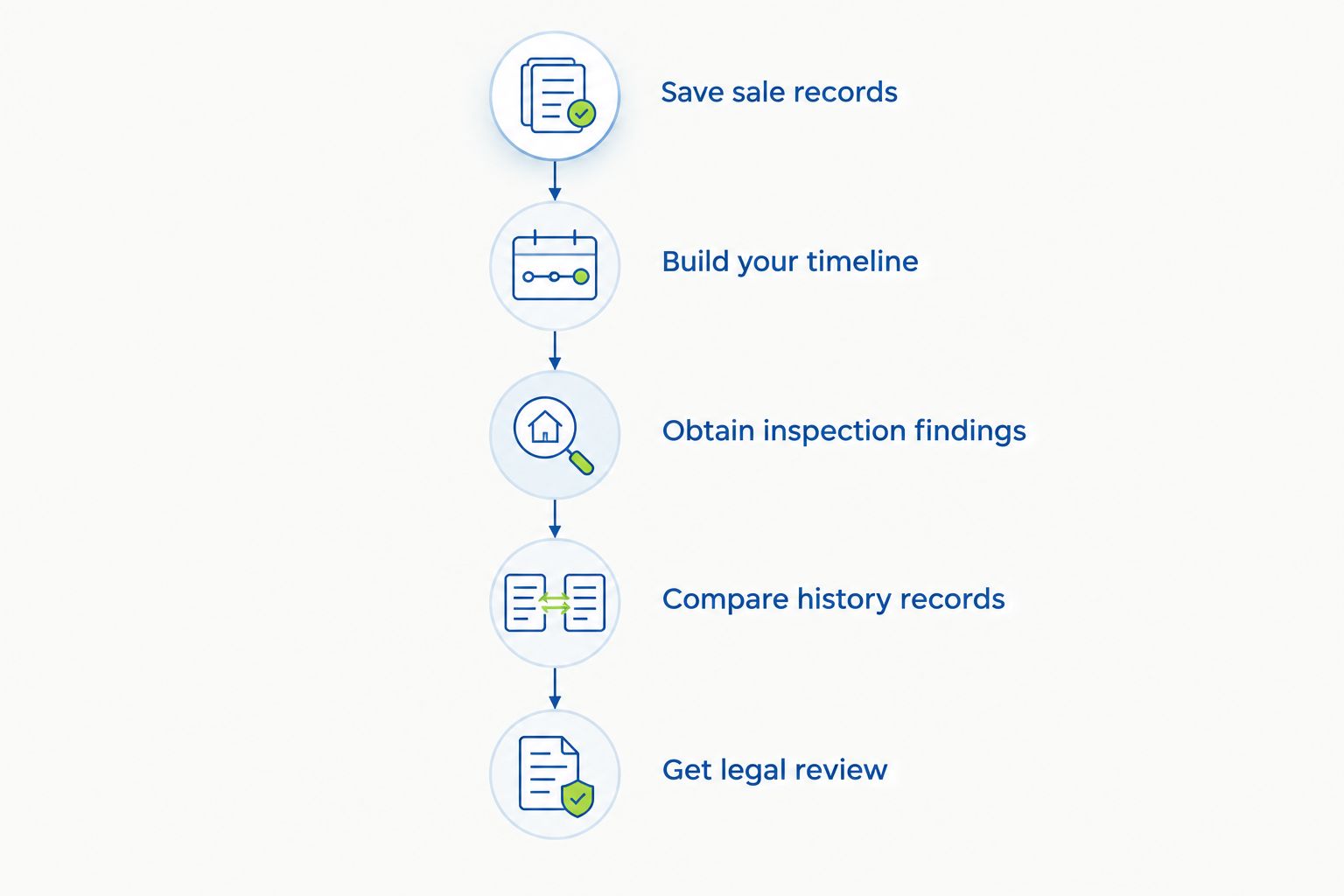
- Save sale records. Keep the advertisement, purchase agreement, financing documents, warranty materials, title disclosures, and messages. Save original files as well as readable copies.
- Build your timeline. Record the purchase date, statements you received, discovery date, inspections, repair visits, and dealer responses. Distinguish what you knew at purchase from what you learned later.
- Obtain inspection findings. Ask a qualified independent professional to document relevant damage, repairs, and safety concerns. Request observations and supporting photographs, not an unsupported legal conclusion that fraud occurred.
- Compare history records. Match the vehicle identification number across reports, title documents, and service records. Note conflicting entries without assuming which record is correct.
- Get legal review. Have the evidence, contract terms, deadlines, and potential notice requirements reviewed before filing or signing a release.
Keep communication factual. Describe the representation, identify the conflicting evidence, and preserve the response instead of making threats or exaggerating what you can prove.
If the vehicle has an unresolved safety concern, prioritize safe handling and professional inspection. Do not keep driving solely to collect more evidence, and do not discard replaced parts or authorize destructive work without considering preservation needs.
Is this dealer fraud, lemon law, or a contract dispute?
A false sales representation is not automatically a lemon law claim. Lemon law generally concerns qualifying warranty obligations and defects; dealer fraud concerns deceptive conduct connected to the sale.
| Legal path | Best suited to | Main strength | Main limitation |
|---|---|---|---|
| Fraud or misrepresentation claim | Buyers with evidence of a material false statement or actionable concealment | Addresses deception in the transaction | Requires proof of the applicable elements, including reliance and harm |
| Consumer-protection claim | Buyers whose facts fit a prohibited practice under an applicable statute | Addresses specified unlawful sales conduct | Coverage, notice requirements, remedies, and deadlines depend on the statute |
| Warranty or lemon law claim | Buyers with qualifying warranty and defect facts | Focuses on warranty obligations and repair history | Does not apply merely because vehicle history was misstated |
| Contract claim | Buyers whose written agreement contains an unfulfilled promise | Connects the dispute to agreed terms | Contract language, defenses, and available remedies control |
For a 2026 assessment, do not rely on a used-car label or an old summary of warranty eligibility. Vehicle status, warranty source, transaction documents, and current law require individual review.
Khachikyanlawfirm provides lemon law representation in Glendale. That practice is relevant when your history dispute also involves warranty or repair issues; ask whether the firm can address the specific sales-misrepresentation claims your documents support.
Discuss your vehicle dispute
Ask Khachikyanlawfirm about lemon law representation and the issues raised by your vehicle records.
Why car dealer misrepresentation claims vary
The same discovery can support very different cases. These factors change the legal analysis:
- The dealer’s actual words. A specific factual assurance differs from general sales praise. Preserve the wording rather than paraphrasing it more strongly.
- The records available before the sale. Earlier damage reports or inspection documents help establish what information existed and who received it.
- The disclosures you received. Signed disclosures can affect reliance and other issues, but their presence does not automatically defeat every claim.
- The reason the history mattered. Explain how the disputed fact affected your decision and connect that explanation to contemporaneous evidence.
- The resulting loss. A supported valuation or documented expense is stronger than an unsupported demand for compensation.
- The purchase agreement. Arbitration provisions, written promises, disclaimers, and other terms require review alongside the alleged deception.
An “as is” provision does not give a dealer permission to commit fraud. It still matters because warranty rights and fraud claims address different legal obligations.
How long do I have to sue a California dealer?
A California fraud claim generally has a 3-year limitations period under Code of Civil Procedure section 338(d), with accrual tied to discovery of the facts constituting the fraud. The discovery rule is not permission to wait: disputes arise over when you actually discovered, or reasonably should have discovered, those facts.
California’s Consumers Legal Remedies Act has a 3-year limitations provision under Civil Code section 1783. That does not make its accrual analysis or procedural requirements identical to a fraud claim.
For a 2026 filing decision, have counsel identify each potential cause of action separately. Other claims, contractual provisions, and case-specific circumstances can change the deadline analysis; a complaint to a regulator does not automatically preserve a civil lawsuit.
Do I have to notify the dealer before suing?
A Consumers Legal Remedies Act damages claim generally requires notice at least 30 days before filing the damages action under Civil Code section 1782. The statute sets requirements for the notice and its delivery, so a casual text or phone call is not a substitute for checking compliance.
Claims seeking injunctive relief follow different provisions. Have the notice, requested relief, and filing strategy reviewed together rather than assuming every dealer lawsuit has the same prerequisite.
Can I get a refund instead of keeping the car?
Rescission, which seeks to undo a transaction, is a potential remedy when the legal requirements are satisfied. It is not an automatic refund whenever a vehicle-history report reveals a problem.
Damages offer a different approach: compensation for losses supported by the applicable claim. Neither remedy guarantees that every payment or expense will be returned.
Do not stop loan payments, surrender the vehicle, or sign a settlement based only on the dealer’s verbal assurances. Financing obligations and ownership documents need separate attention, especially when a lender is involved.
FAQ
Can I sue if the dealer said the car had never been in an accident?
Yes, an inaccurate accident-history assurance can support a claim when the required elements are established. Preserve the statement, evidence contradicting it, and records showing how you relied on it and suffered harm.
Does a clean title prove the dealer told me the truth?
No, a clean title does not prove that a vehicle has never been damaged. Title status and accident history are different facts, so compare the dealer’s actual representation with the relevant records.
Can I sue a dealer if I bought the car as is?
An as-is sale does not automatically bar a fraud claim. The provision affects warranty issues, while a misrepresentation claim requires a separate analysis of the statement, reliance, and resulting harm.
Is a vehicle-history report enough to prove dealer fraud?
A vehicle-history report alone does not establish every element of dealer fraud. You still need evidence connecting the disputed history to an actionable representation or omission and your loss.
Should I stop making payments while I dispute the sale?
Do not assume a dealer dispute suspends your loan obligations. Get advice about the financing agreement before withholding payments or surrendering the vehicle.
Does an arbitration clause mean I cannot bring a claim?
An arbitration clause does not automatically erase your underlying claim. An enforceable clause can change where and how the dispute proceeds, so have the actual agreement reviewed.
Can Khachikyanlawfirm help with a vehicle-history dispute?
Khachikyanlawfirm provides lemon law representation in Glendale. Ask whether your history dispute also presents warranty issues and whether the firm can handle the particular misrepresentation claims involved.
One last thing
The report’s discovery date and the damage date answer different questions. Save evidence of both: when the underlying event occurred helps explain vehicle history, while when you discovered it helps document your timeline.
Before making a demand in 2026, write a factual summary matching each disputed statement to a supporting document. Keep the original records attached. That preparation helps a lawyer assess the claim without confusing suspicion, proof, and the remedy you want.
This article provides general California legal information, not legal advice about your transaction.