Yes, you can sue a California car dealership when the dealer’s own conduct supports a claim, such as misrepresenting the vehicle, concealing material facts, or breaching an applicable warranty. For a 2026 lemon law claim involving a manufacturer’s warranty, the manufacturer is generally the party responsible for replacement or restitution—not automatically the dealership that sold you the car.
- Can I sue a car dealership for selling me a lemon in California? Yes, when dealership conduct supports liability.
- California lemon law and dealer fraud address different conduct; identify the responsible party before filing.
- Repair records, warranty documents, and sales representations help distinguish a warranty claim from dealership misconduct.
- Khachikyanlawfirm provides lemon law representation for drivers seeking legal help in Glendale, California.
Can I sue a car dealership for selling me a lemon in California?
Yes, but a defective vehicle does not automatically make the selling dealership liable for a lemon law buyback. California’s Song-Beverly Consumer Warranty Act places important repair, replacement, and restitution duties on manufacturers. Dealers can face separate liability for their own warranties, misrepresentations, concealment, or other actionable conduct.
Start with your contract, warranty, and documents for a California lemon law claim. The evidence should explain both what went wrong with the vehicle and what each business did.
| Potential claim | Best for addressing | Evidence to preserve | Main limitation |
|---|---|---|---|
| Manufacturer warranty claim | Covered defects that remain unresolved after reasonable repair opportunities | Manufacturer warranty, repair orders, mileage, and days unavailable | A defect alone does not establish entitlement to replacement or restitution |
| Dealer fraud or misrepresentation claim | False statements or material concealment connected to the sale | Advertisements, messages, disclosures, inspection records, and sales paperwork | You must prove the required elements, including the connection to your loss |
| Dealer warranty claim | Failure to honor an applicable dealer warranty | Written warranty, contract, repair requests, and responses | Liability depends on the warranty and governing law |
These claims can overlap, but they are not interchangeable. Name the party responsible for the specific legal violation, not simply the business whose name appears on the sales contract.
Why this matters
A dealership handles the sale and often performs warranty repairs, so it feels like the obvious defendant. But an authorized dealer’s unsuccessful repair work can support a claim against the manufacturer without making the dealer responsible for the manufacturer’s statutory buyback obligation.
The distinction also changes your evidence. Repair history supports a warranty dispute; an advertisement claiming no accident history supports a different investigation. Your 2026 case assessment should separate the vehicle’s defects from the representations made when you bought it.
When a manufacturer warranty claim fits
California Civil Code section 1793.2(d) addresses replacement or restitution when a manufacturer cannot repair a qualifying vehicle to conform to applicable express warranties after a reasonable number of attempts. The defect must meet the relevant legal requirements; dissatisfaction alone is not enough.
For the statutory new-vehicle framework, substantial impairment of use, value, or safety matters. Recurring stalling, for example, raises a different issue from disliking a vehicle’s controls. Whether a particular condition qualifies depends on the evidence, warranty coverage, and repair history.
The benefit: a qualifying claim addresses the manufacturer’s failure to provide a vehicle that conforms to its warranty. The limitation: a repair visit does not automatically establish a right to a replacement or refund.
Preserve the complete repair order from every visit, including visits where the technician could not reproduce the concern. Ask for accurate descriptions of your complaint, the work performed, and the dates the vehicle entered and left the shop.
What do the 18-month and 18,000-mile rules mean?
California Civil Code section 1793.22(b) provides a rebuttable presumption tied to qualifying events within the first 18 months or 18,000 miles, whichever occurs first. It includes specified repair-attempt circumstances and more than 30 calendar days out of service for repairs, subject to statutory conditions and exceptions.
These figures describe a presumption—not a universal deadline for bringing every lemon law claim. A vehicle outside that window is not automatically disqualified, and a vehicle inside it is not automatically a lemon.
For a 2026 claim, have counsel assess the underlying repair history and applicable procedure rather than treating an internet checklist as the legal test. Notice requirements, the defect involved, and the circumstances of the repairs also matter.
When you can pursue the dealership directly
A dealership claim needs a legal basis tied to the dealer’s conduct. Discovering a defect after purchase does not, by itself, prove that the dealer knew about it or lied.
Examples that warrant investigation include:
- False sales statements: an advertisement or salesperson described a material vehicle condition inaccurately.
- Concealed information: the dealer withheld a material fact under circumstances creating a duty to disclose it.
- Dealer warranty failures: the dealer did not fulfill an applicable warranty obligation.
- Contract discrepancies: signed documents and the transaction you agreed to do not match.
Each theory has its own proof requirements and defenses. Preserve the actual advertisement or message rather than relying only on your recollection of a conversation.
The benefit: a dealer-focused claim addresses misconduct at the sale or a dealer’s own obligations. The limitation: an unresolved mechanical problem does not establish fraud, and not every disputed sales statement creates an actionable claim.
Do not label every repair problem as fraud in your demand. Describe the facts precisely: what was represented, who said it, what the documents show, and how the discrepancy harmed you.
What changes if you bought a used car?
A used vehicle does not automatically receive the same replacement-or-restitution treatment as a vehicle qualifying under California’s statutory new-motor-vehicle definition. In particular, a used car’s remaining manufacturer warranty does not, by itself, establish that it qualifies for that remedy.
Your purchase still deserves a separate assessment. Dealer warranties, applicable implied warranties, express warranty promises, and misrepresentation claims can create rights even when the statutory new-vehicle buyback framework does not apply.
For a used-car purchase evaluated in 2026, collect the Buyers Guide, sales agreement, warranty documents, service contract, and advertisements. A service contract and a manufacturer warranty are not the same thing; identify who promised what before choosing a claim.
Do not assume either that every used car qualifies or that every used-car buyer has no remedy. The transaction and the specific obligation control.
Why your legal options vary
Your claim depends on more than the number of trips to the repair shop. These factors determine which legal route deserves attention:
- Vehicle status: whether the vehicle qualifies under the statutory definition relevant to the remedy you seek.
- Warranty source: whether the manufacturer, dealer, or another business made the promise at issue.
- Defect and impact: what is wrong and how it affects the vehicle’s use, value, or safety.
- Repair opportunities: what was reported, who attempted repairs, and whether the condition continued.
- Sales evidence: what the dealer represented or disclosed before you committed to the purchase.
- Procedural requirements: which notices, filing rules, and contract provisions apply to the dispute.
A strong file connects these factors. A stack of invoices is useful; a readable chronology explaining the recurring problem is better.
What should I do before filing a lawsuit?
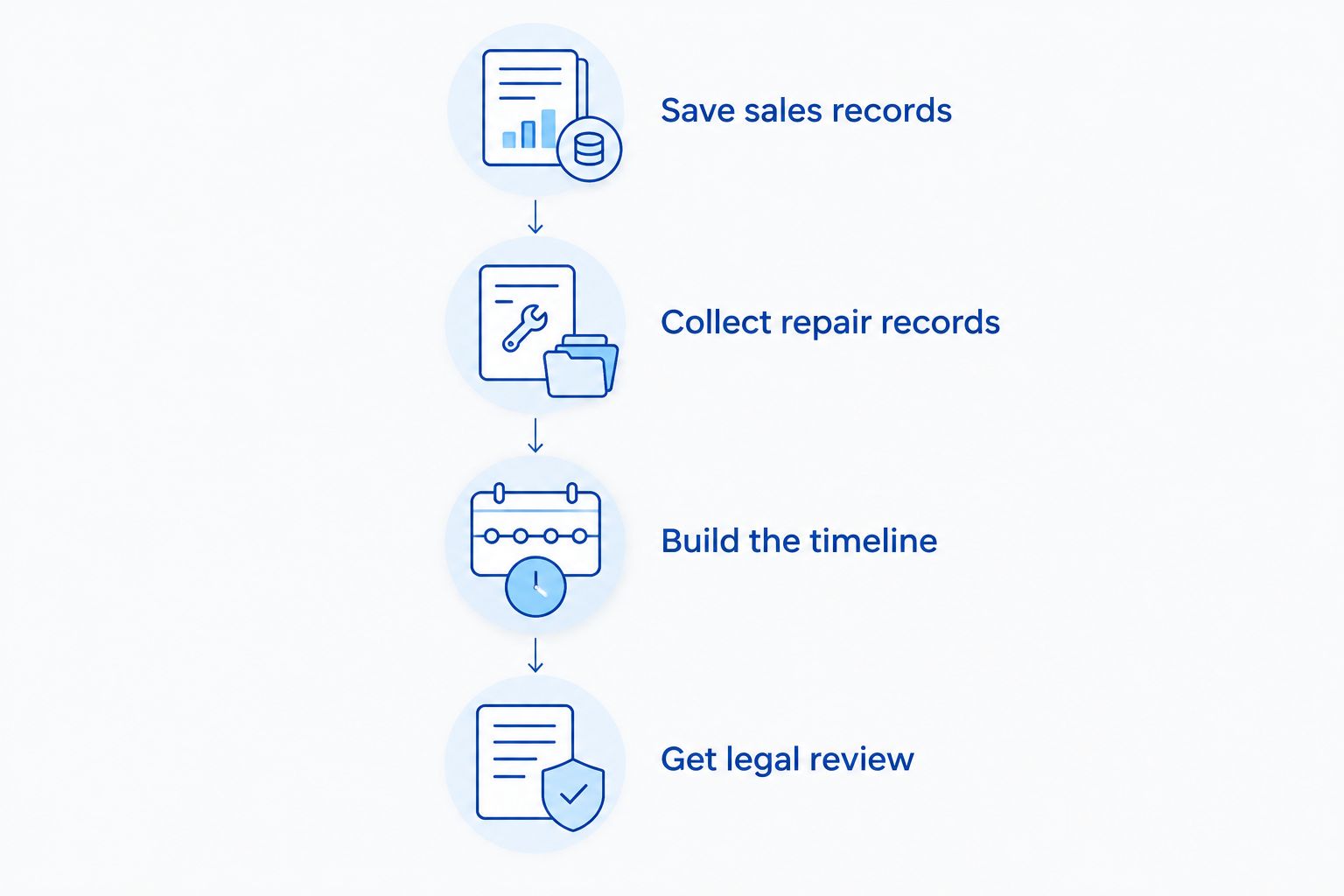
Build a record that lets an attorney distinguish a manufacturer warranty case from a dealer misconduct case. Follow these steps without delaying a legal review while you wait for perfect paperwork.
- Save sales records. Keep the signed contract, financing documents, Buyers Guide if applicable, advertisements, and messages. Preserve originals and readable copies.
- Collect repair records. Obtain complete orders showing your complaint, diagnosis, work performed, mileage, and entry and release dates. Request corrections when a document inaccurately describes what you reported.
- Build the timeline. List when symptoms began, when you reported them, and what happened after each repair. Separate dates you can document from details you remember.
- Get legal review. Ask which parties and legal theories fit, what deadlines apply, and whether any notice or dispute-resolution step is required.
The sequence matters because legal review works better with both sales and repair evidence. You do not need to decide the final cause of action before asking for help.
Avoid signing a release or accepting a proposed resolution without understanding which claims it ends. Do not assume that ongoing negotiations pause a filing deadline, and do not stop making required payments simply because you believe the vehicle is a lemon.
Khachikyanlawfirm is a fit for Glendale drivers seeking lemon law representation. You can contact Khachikyanlawfirm to discuss the vehicle, warranty, repair history, and dealership conduct; representation does not guarantee a particular result.
Discuss your vehicle claim
Ask about lemon law representation and which parties belong in your claim.
Do I have to let the dealership try another repair?
A reasonable opportunity to repair matters in a manufacturer warranty claim, but there is no universal repair count that resolves every case. The defect, its seriousness, the repair history, and the applicable statutory rules affect the analysis.
If the vehicle presents an immediate safety concern, do not drive it merely to create another repair record. Seek appropriate roadside or emergency assistance and document the condition without putting yourself at risk.
Can I sue both the dealer and the manufacturer?
You can pursue both when the facts support a valid claim against each. For example, a manufacturer warranty dispute and a separate claim about a dealer’s material misrepresentation concern different obligations.
Naming both is not automatically the better strategy. Each defendant needs a supported legal basis, and overlapping claims do not permit duplicate recovery for the same loss.
Does a dealership complaint protect my filing deadline?
A dealership complaint does not, by itself, stop a lawsuit deadline from running. Keep pursuing records and responses, but get the applicable deadline assessed separately.
For California vehicle disputes in 2026, do not assume one online filing deadline or notice procedure applies to every manufacturer and every theory of liability. Ask counsel to identify the rules for your purchase, defendants, and claims.
FAQ
Can I sue a California dealership even if the manufacturer made the car?
Yes, when the dealership’s own conduct supports a claim, such as an actionable misrepresentation or breach of an applicable dealer warranty. The manufacturer’s warranty obligations require a separate analysis.
Do I need to prove the dealer knew the car was defective?
Knowledge matters to some fraud theories, but it is not a universal requirement for every warranty claim. Your attorney should identify the elements of the specific claim rather than treating all vehicle disputes as fraud.
Does 30 days in the shop automatically make my car a lemon?
No, more than 30 calendar days out of service is part of a statutory presumption with additional conditions and exceptions. Warranty coverage, timing, and the reasons for the repairs still matter.
Can a used car with a remaining factory warranty qualify for a buyback?
A remaining factory warranty alone does not establish that a used vehicle qualifies for California’s statutory new-vehicle replacement-or-restitution remedy. Other warranty or dealer misconduct claims require separate review.
Should I stop paying my car loan while pursuing a lemon law case?
Do not stop required payments solely because you are pursuing a lemon law claim. A vehicle dispute does not automatically suspend your financing obligations.
What should I bring to a lemon law attorney in 2026?
Bring your sales contract, warranty documents, complete repair orders, advertisements, and communications with the dealer and manufacturer. Include a timeline of symptoms, repair visits, and periods when you could not use the vehicle.
Does Khachikyanlawfirm handle California lemon law representation?
Khachikyanlawfirm provides lemon law legal representation in Glendale, California. Ask the firm to assess your warranty records and whether the facts support claims against the manufacturer, dealership, or both.
One last thing
A repair order stating that the technician could not duplicate the problem is still worth preserving. It records that you reported a concern, even when it does not establish the cause or prove a failed repair.
Before your next visit, write down the conditions under which the symptom occurs and ask that your complaint appear accurately on the order. For your 2026 claim file, precision is more useful than calling the vehicle a lemon on every document.
This article provides general California legal information, not advice about your individual case.


