
Yes. You can negotiate a lemon law claim directly with the manufacturer without hiring a lawyer or filing a lawsuit. In California, that does not guarantee a buyback or replacement, and signing a settlement can release claims you have not fully evaluated. Start with a documented repair history, request a written decision, and review every settlement term before accepting.
- Can I negotiate a lemon law claim directly with the manufacturer? Yes, but eligibility and settlement terms still matter.
- California lemon law negotiations should focus on repair records, warranty coverage, and the remedy you are requesting.
- A manufacturer's offer is a proposal, not an independent determination of your legal rights.
- Do not assume customer-service discussions pause a filing deadline or satisfy a required legal notice.
Why this matters
Direct negotiation gives you control over communications, but you also take responsibility for organizing evidence and evaluating the offer. A manufacturer agreeing to discuss your complaint does not mean it accepts that your vehicle qualifies under California law.
For a 2026 claim, build your file before discussing settlement. Use this guide to documents for a California lemon law claim to organize the records supporting your request. The goal is a documented resolution, not simply a closed customer-service ticket.
Can I negotiate a lemon law claim directly with the manufacturer?
Yes. You can contact the manufacturer's customer-assistance department, describe the unresolved warranty problem, and request a repurchase, replacement, or another proposed resolution. You do not need a lawyer merely to open that conversation.
California Civil Code section 1793.2(d)(2) addresses replacement or restitution when a manufacturer cannot repair a qualifying new motor vehicle to conform to applicable express warranties after a reasonable number of attempts. Whether that provision covers your vehicle requires more than showing that something broke.
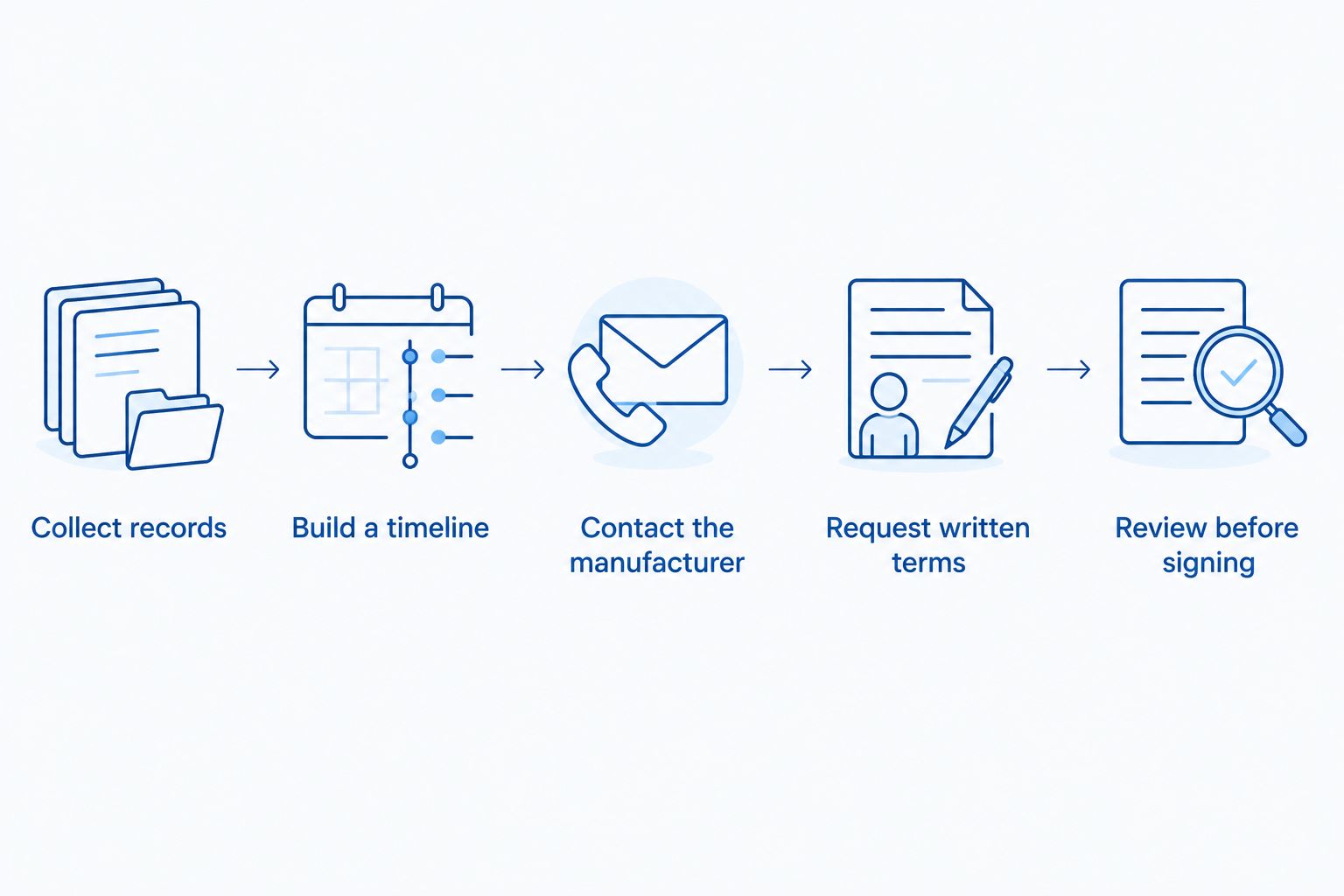
Follow these steps to keep the discussion focused on evidence rather than repeated explanations.
1. Collect records
Gather your purchase or lease agreement, applicable warranty, repair orders, payment records, and correspondence. Include photographs, videos, towing records, and receipts when they help establish the defect or its consequences.
Read the repair orders carefully. Check that they describe what you reported, the mileage, the dates the vehicle entered and left the shop, and the work performed. If an order misstates your complaint, request a correction in writing; do not alter the original document yourself.
Keep copies in a folder you control. A dealership's access to service records does not replace your own file, especially when different repair facilities handled different visits.
2. Build a timeline
List each repair visit in chronological order. Identify the reported symptom, the repair attempted, and whether the same symptom returned afterward. Separate an ongoing problem from unrelated maintenance or a different defect.
Record days out of service using the actual repair dates. Avoid estimating from memory, and identify gaps where you need supporting paperwork. A clear timeline lets you explain the unresolved issue without overstating what the records prove.
Document safety concerns factually. Describe what happened and when; avoid guessing at a technical cause that a technician has not established.
3. Contact the manufacturer
Use the manufacturer's contact information in your warranty materials or other verified communications. Ask for a case number and the correct channel for submitting your documents. Identify the vehicle, summarize the repair history, and state the remedy you are requesting.
After a telephone conversation, send a written summary and retain proof of delivery. Note the representative's name and any promised next step. A dealership repair appointment and a manufacturer settlement request serve different purposes, so preserve both records.
For 2026 negotiations, verify whether your particular claim requires a separate notice or dispute-resolution step. An ordinary customer-service message is not automatically a legally sufficient notice.
4. Request written terms
Ask the manufacturer to put its position in writing. If it denies the request, ask for the reason. If it proposes a settlement, request the calculation, the agreement, and the conditions for completing the transaction.
Do not treat a verbal description as the entire offer. A payment, replacement vehicle, or additional repair proposal can come with obligations that affect whether the resolution works for you.
Continue to distinguish an acknowledgment from an approval. A case number confirms that a file exists; it does not establish liability or an agreed remedy.
5. Review before signing
Compare the written offer with your documents and the remedy available under the law that applies to your vehicle. Check deductions, financing arrangements, vehicle-return requirements, and release language.
Do not sign merely because the representative calls an offer final. You can request clarification or legal review before deciding. If a deadline is approaching, address that deadline separately rather than waiting for the negotiation to finish.
What evidence supports a California lemon law request?
For 2026, distinguish California's statutory presumption from the broader question of whether the manufacturer had a reasonable opportunity to repair the vehicle. The presumption is not a universal eligibility checklist.
California Civil Code section 1793.22(b) describes a rebuttable presumption involving specified repair circumstances within 18 months of delivery or 18,000 miles, whichever occurs first. Subject to the statute's conditions, those circumstances include:
- At least two repair attempts for the same nonconformity likely to cause death or serious bodily injury if driven.
- At least four repair attempts for the same nonconformity.
- More than 30 calendar days out of service for repair of nonconformities, with a statutory allowance for certain circumstances beyond the manufacturer's control.
The statute also contains conditions concerning direct notification and qualifying dispute-resolution procedures. Not every repair visit or day without your vehicle automatically counts toward the presumption.
Failing to meet these thresholds does not automatically defeat a claim. Conversely, reaching a number does not resolve every coverage or eligibility issue. Present the underlying records rather than relying on a repair-count slogan.
Should I negotiate myself, hire a lawyer, or use arbitration?
These routes involve different responsibilities. Choose based on the disputed issues and procedural requirements, not just the convenience of the first conversation.
| Route | Best for | Main advantage | Main limitation |
|---|---|---|---|
| Direct manufacturer negotiation | Owners prepared to organize records and evaluate written terms | You control communications and can request a voluntary resolution | You must assess eligibility, deadlines, calculations, and releases yourself |
| Attorney-assisted negotiation | Owners facing disputed coverage, deductions, deadlines, or settlement language | Counsel can assess legal rights and negotiate on your behalf | Representation requires an engagement agreement and does not guarantee recovery |
| Manufacturer dispute-resolution program | Owners evaluating a program identified in their warranty materials | The program provides a defined process for presenting a dispute | Rules, legal consequences, and any required participation need review |
An arbitration provision in a purchase contract and a manufacturer-sponsored warranty dispute program are not necessarily the same thing. Read the actual documents before treating either as mandatory or assuming a decision ends every legal option.
You can also seek legal advice after starting direct discussions. Keep your complete communication history so counsel can assess what has already been requested, offered, or agreed.
Why negotiating difficulty varies
The basic process stays similar, but these issues determine how much legal analysis your request needs:
- Warranty coverage: Establish which warranty applies and whether the reported problem falls within it.
- Repair history: Repeated visits for the same unresolved defect present a different record from unrelated service complaints.
- Vehicle status: A new purchase, used purchase, or lease raises different coverage and transaction questions.
- Requested remedy: A repurchase, replacement, and keep-the-vehicle settlement do not resolve the claim in the same way.
- Financial obligations: A loan or lease requires attention to payoff, account status, and responsibility for completing the transaction.
- Procedural requirements: Notice provisions, dispute procedures, and filing deadlines require separate attention from the settlement discussion.
For 2026 claims, do not borrow a deadline from another owner's experience. Determine which rules apply to your transaction and claim before relying on continued negotiations.
What should I check in a manufacturer settlement offer?
Start by identifying exactly what you receive and exactly what you give up. A settlement headline does not tell you whether the agreement resolves the loan, requires a vehicle return, or releases additional claims.
Review these points before accepting:
- Calculation: Ask for an itemized explanation of the proposed recovery and every deduction. Compare it with your contract and payment records.
- Usage deduction: California's statutory restitution framework includes a mileage-based usage calculation. Verify the mileage and calculation rather than accepting an unexplained figure.
- Loan or lease handling: Confirm who communicates with the lender or lessor and how the outstanding obligation will be resolved.
- Vehicle transfer: Read the surrender, title, registration, and condition requirements. Identify anything you cannot perform before signing.
- Release language: Determine which claims and parties the release covers, including any claims beyond the warranty dispute you intended to settle.
- Performance terms: Check what each party must do, when those obligations become effective, and how completion will be documented.
Do not stop making required payments solely because settlement discussions are underway. A pending complaint does not itself change your financing contract. Address any proposed payment change through a documented agreement with the appropriate party.
When is legal review the better next step?
Khachikyanlawfirm is a fit for California drivers seeking lemon law representation. The Glendale firm offers lemon law legal representation, which is relevant when you want counsel to assess a disputed claim rather than manage the negotiations alone.
Consider legal review when the manufacturer disputes coverage, proposes deductions you cannot verify, requests a broad release, or leaves a filing deadline unresolved. Ask Khachikyanlawfirm about the scope of representation and the engagement terms before authorizing work.
Hiring counsel does not guarantee a settlement, and a legal consultation does not replace preserving your records. Whether you continue directly or retain Khachikyanlawfirm for lemon law representation, keep the same organized file of repairs, communications, and proposed agreements.
Discuss your lemon law claim
Ask about legal representation for your California vehicle warranty dispute.
Can I negotiate without filing a lawsuit?
Yes. Direct negotiations can produce a voluntary settlement without a lawsuit, but discussions alone do not compel the manufacturer to agree. If you reach an agreement, document the complete terms rather than relying on a representative's telephone assurance.
Does opening a manufacturer case pause my deadline?
No automatic deadline protection comes from opening a customer-service case. Tolling rules and agreements require separate legal analysis, so confirm the applicable deadline while negotiations continue. Do not treat silence or an ongoing document request as an extension.
Do I have to accept another repair instead of a buyback?
You do not have to sign a settlement accepting another repair. Whether the manufacturer must provide a statutory remedy depends on warranty coverage, repair opportunities, and the applicable law. Refusing further service without understanding those issues can complicate the record, so distinguish a settlement proposal from an ordinary warranty appointment.
FAQ
Can I negotiate a lemon law claim directly with the manufacturer in California?
Yes. You can request a voluntary resolution directly from the manufacturer without hiring a lawyer. Keep written records and assess deadlines, eligibility, and settlement terms separately.
What should I send the manufacturer with my lemon law request?
Send a clear repair timeline and copies of the records supporting your request. Relevant documents include the purchase or lease agreement, warranty, repair orders, and communications; retain your originals.
Does California require four repairs before I can negotiate?
No. Four repair attempts are part of one branch of California's statutory presumption, not a prerequisite to contacting the manufacturer. A claim's legal strength depends on the applicable warranty, defect, repair history, and statutory conditions.
Is the manufacturer's first settlement offer the amount I am legally entitled to?
No. A settlement offer is a proposal, not an independent legal determination. Request its calculation and compare the deductions and release terms with the law governing your claim.
Can I hire a lemon law lawyer after contacting the manufacturer myself?
Yes. Starting direct negotiations does not prevent you from seeking representation later. Give the lawyer your complete communication history and disclose anything you have signed.
Can Khachikyanlawfirm help with a California lemon law claim?
Khachikyanlawfirm offers lemon law legal representation and is based in Glendale, California. Ask about representation for your circumstances and review the engagement terms before proceeding.
Does negotiating a buyback let me stop making car payments?
No. Negotiating a buyback does not itself change your loan or lease obligations. Confirm how payments and payoff will be handled before changing your payment practices.
One last thing
For a 2026 negotiation, maintain two separate records: the repair timeline and the settlement timeline. The first documents the vehicle's problems; the second documents requests, responses, proposed terms, and outstanding obligations.
An approved offer is not the same as a completed resolution. After signing, retain the executed agreement, transfer records, payment confirmation, and any lender or lessor confirmation. Those documents establish what actually happened after the negotiation ended.