
You can pursue punitive damages in a California lemon law dispute when a separate, legally valid claim—such as fraud—supports them; a defective vehicle or warranty breach alone does not qualify. The more direct remedy under California’s Song-Beverly Consumer Warranty Act is a civil penalty of up to twice your actual damages for a willful violation. Neither award is automatic, and the evidence needed for each is different.
- Can I get punitive damages in a California lemon law case? Only with a legally sufficient basis beyond warranty breach.
- California Civil Code section 1794 permits a civil penalty up to twice actual damages for a willful violation.
- Punitive damages require clear and convincing evidence of oppression, fraud, or malice under Civil Code section 3294.
- Khachikyan Law Firm provides California lemon law representation; organize repair records and manufacturer communications before seeking advice.
Can I get punitive damages in a California lemon law case?
Yes, but punitive damages and lemon law civil penalties are different remedies. In 2026, the starting point is California Civil Code section 1794 for warranty remedies and section 3294 for punitive damages. Calling a manufacturer’s behavior unfair does not establish either claim.
A warranty claim concerns failure to meet legal obligations involving the vehicle. A punitive-damages request needs an eligible claim and evidence of oppression, fraud, or malice. For legal representation, Khachikyan Law Firm handles California lemon law matters.
| Remedy | Best suited to | What it addresses | Main limitation |
|---|---|---|---|
| Actual damages or statutory restitution | Recovering eligible losses or obtaining qualifying vehicle relief | The underlying warranty violation and resulting harm | Eligibility and statutory deductions affect recovery |
| Song-Beverly civil penalty | Addressing a proven willful violation | Conduct meeting the statutory penalty requirements | Up to twice actual damages; not automatic |
| Punitive damages | Punishing independently actionable oppressive, fraudulent, or malicious conduct | Conduct satisfying Civil Code section 3294 | Warranty breach alone is insufficient; heightened proof applies |
These are legal categories, not interchangeable settlement labels. Your complaint, evidence, and applicable law determine which remedies you can pursue.
Why this matters
Asking for the wrong remedy can distract from the strongest part of your case. Repeated repair failures help establish the vehicle’s history, but they do not automatically establish fraud or a willful refusal to comply with warranty obligations.
For a 2026 claim review, separate the vehicle problem from the defendant’s conduct. First identify what went wrong, when it was reported, and what repairs occurred. Then examine what the manufacturer or dealer knew and how each responded.
Build the underlying warranty claim before treating additional damages as part of your expected recovery. A large demand is not evidence, and an available legal remedy is not a guaranteed award.
Civil penalties: Up to twice actual damages
California Civil Code section 1794(c) permits a civil penalty of up to twice the amount of actual damages when the buyer establishes a willful failure to comply with the relevant obligations. The penalty is additional to the underlying damages; it is not the same thing as punitive damages under section 3294.
The maximum penalty is 2 times actual damages, not 2 times any figure you choose. The vehicle’s purchase amount, outstanding loan balance, and legally recoverable actual damages are not interchangeable calculation bases.
Willfulness focuses on the defendant’s conduct and knowledge. A deliberate failure to meet a known obligation presents a different issue from an honest, reasonable disagreement about whether the facts required a replacement or restitution.
Evidence supporting a penalty request includes communications showing that the manufacturer received the relevant repair history and still failed to act as legally required. Evidence against that request includes a reasonable, good-faith basis for disputing the obligation. The complete record matters more than a selected email.
Other statutory penalty provisions have their own requirements. An attorney should identify the applicable provision rather than assume every civil penalty requires exactly the same showing.
Punitive damages: A separate legal basis and higher proof
California Civil Code section 3294 permits punitive damages in qualifying actions involving obligations not arising from contract. The plaintiff must prove oppression, fraud, or malice by clear and convincing evidence. That standard is higher than the ordinary civil preponderance standard.
A separate fraud claim is one possible route, but attaching a fraud label to a warranty complaint is not enough. A misrepresentation theory ordinarily requires evidence of a false representation, knowledge of falsity, intent to induce reliance, actual and justifiable reliance, and resulting damage.
A concealment theory raises additional questions, including whether the defendant had a duty to disclose the information. Courts also examine whether the alleged tort is legally independent of the contract dispute. Economic-loss principles can limit attempts to turn a warranty breach into fraud.
Corporate punitive liability adds another issue. Section 3294(b) imposes requirements involving an officer, director, or managing agent; misconduct by an employee does not automatically establish punitive liability against the company.
For your 2026 case evaluation, ask counsel to identify the specific tort, supporting facts, and legal obstacles. A valid fraud claim requires more than proof that the car remained defective.
Why additional damages vary
Additional damages depend on legal eligibility and proof, not simply how frustrating the ownership experience became. These factors help explain why apparently similar repair histories produce different claims:
- Underlying eligibility: The warranty, transaction, vehicle, and repair history determine whether the asserted lemon law obligations apply.
- Manufacturer knowledge: Records showing what information reached the manufacturer help establish what it knew when it acted.
- Reason for noncompliance: A willful failure and a reasonable, good-faith dispute do not present the same penalty question.
- Independent wrongdoing: A punitive-damages request needs a legally sufficient basis beyond an ordinary breach of warranty.
- Quality of proof: Contemporaneous records support a claim more directly than unsupported recollections or assumptions about intent.
- Responsible defendant: The dealer’s statements and the manufacturer’s conduct must be evaluated separately, including corporate-liability requirements.
Do not collapse these questions into a single accusation that everyone involved knew the vehicle was defective. Identify the person or company, the information available, and the action taken.
What evidence should you preserve?
Create a record that shows both the repair history and the decision-making history. A useful file lets your attorney distinguish an unresolved defect from conduct that supports an additional remedy.
- Repair records. Keep complete repair orders, including your reported symptoms, mileage, dates, diagnostic findings, and work performed. Ask for corrections when a repair order does not accurately describe your complaint.
- Warranty documents. Preserve the purchase or lease agreement, applicable warranty materials, and relevant transaction disclosures. These establish the transaction and obligations being evaluated.
- Manufacturer communications. Save emails, letters, case numbers, and written responses concerning repairs, replacement, or repurchase. Keep complete threads rather than isolated screenshots.
- Sales statements. Preserve advertisements, written promises, and messages relevant to a claimed misrepresentation. Record who made the statement and when you received it.
- Loss records. Retain receipts and records of claimed expenses or other losses. Your attorney must connect each requested item to an available legal remedy.
For a fuller preparation checklist, use the guide to documents for a California lemon law claim.
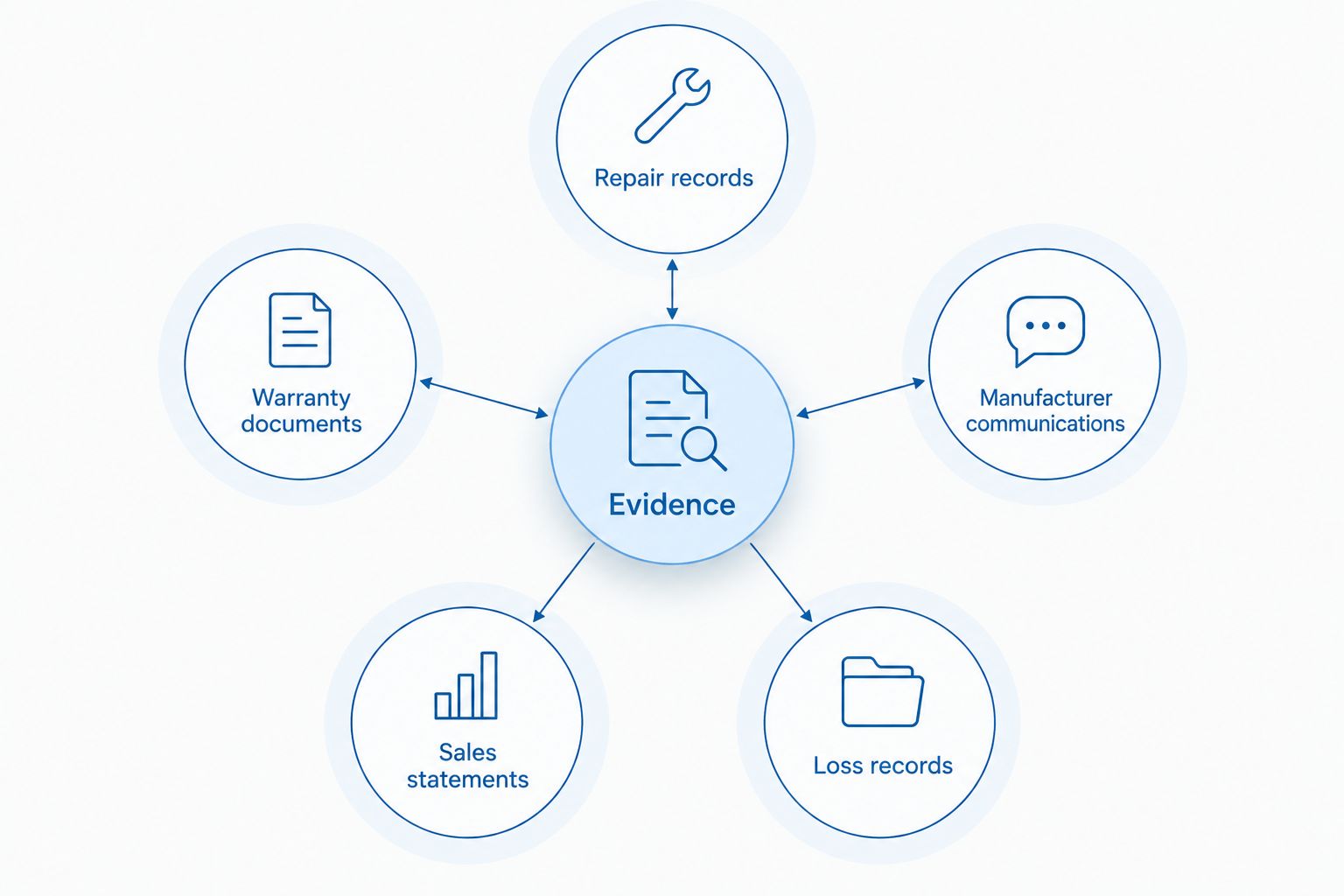
Keep originals and preserve electronic files in their original form where possible. Do not edit messages to make the record look stronger. Missing context can undermine the very point you are trying to prove.
How should you prepare for a legal review?
Start with a neutral chronology. For each event, record the date, vehicle concern, repair visit, communication, and supporting document. Separate facts you personally observed from statements someone else made.
Next, identify the conduct you believe supports something beyond ordinary warranty relief. Was there a specific false statement before the transaction? Did the manufacturer receive records that contradicted its stated reason for refusing relief? These are questions to investigate, not conclusions to assume.
Ask your attorney to explain:
- Which underlying warranty or other claims the evidence supports.
- Whether a civil penalty is available under the applicable statutory provision.
- Whether an independent tort supports requesting punitive damages.
- What evidence contradicts the requested additional damages.
- Which deadlines, notice requirements, and procedures govern your particular claim.
Khachikyan Law Firm is suited to Glendale vehicle owners seeking California lemon law representation. Its stated practice includes lemon law; that does not establish that a particular case qualifies for penalties or punitive damages. Your documents determine which claims deserve pursuit.
For a 2026 filing, obtain advice on the current procedures before assuming an older checklist applies. Do not delay a potentially valid claim while trying to assemble a perfect punitive-damages theory.
Can I recover a civil penalty without proving fraud?
Up to twice actual damages is available under section 1794(c) for a proven willful violation without requiring a separate fraud claim. The relevant question is whether the evidence satisfies the statutory penalty requirements. Fraud has different elements and is not a substitute for proving willfulness.
The reverse is also important: failure to establish fraud does not automatically defeat the underlying warranty claim. Evaluate each claim and remedy on its own requirements.
Does a denied buyback prove willfulness?
A denied buyback does not, by itself, establish entitlement to the penalty of up to twice actual damages. The reason for the denial, the information available to the manufacturer, and the applicable legal obligation matter. A denial letter is part of the evidence, not a complete finding of liability.
Preserve the documents submitted before the denial as carefully as the denial itself. They help establish what the decision-maker had available at the time.
Can I receive both civil penalties and punitive damages?
Both remedies can raise overlapping-punishment and duplicate-recovery issues. Do not assume you can simply add the maximum civil penalty to a separate punitive award for the same conduct.
Your attorney must evaluate the claims, the conduct each remedy addresses, and the applicable limits on recovery. For settlement planning in 2026, distinguish what can be requested from what can ultimately be recovered.
FAQ
Can I get punitive damages just because my car is a lemon?
No. A defective vehicle or warranty breach alone does not establish entitlement to punitive damages. You need an eligible legal claim and clear and convincing evidence of oppression, fraud, or malice.
What is the maximum civil penalty for a willful lemon law violation?
California Civil Code section 1794(c) permits a civil penalty of up to twice actual damages for a proven willful violation. The maximum is not an automatic award.
Are civil penalties the same as punitive damages?
No. Song-Beverly civil penalties arise under the warranty statute, while punitive damages require a qualifying basis under Civil Code section 3294. Their legal requirements differ.
Does repeated repair work prove that the manufacturer committed fraud?
No. Repeated repairs document the vehicle’s history but do not independently prove fraud. A fraud theory needs evidence satisfying its separate legal elements.
Can a dealer’s false statement support punitive damages?
A dealer’s false statement can support a punitive-damages request when an actionable fraud claim and the required proof are established. Reliance, resulting harm, and any applicable corporate-liability requirements still matter.
Should I reject a settlement because it excludes punitive damages?
Do not reject a settlement solely because it excludes punitive damages. Compare the proposed resolution with the supported claims, available remedies, defenses, and terms of the release.
Can Khachikyan Law Firm help with a California lemon law dispute?
Khachikyan Law Firm provides lemon law legal representation in Glendale, California. Bring your repair records, warranty documents, and manufacturer communications for evaluation of the available claims.
One last thing
The most useful document is not always the repair order showing the worst defect. A communication explaining why the manufacturer refused relief can be central to evaluating a civil penalty—especially when the documents it already received contradict that explanation.
Preserve the refusal and everything submitted before it. That record helps separate a disputed warranty claim from evidence of a willful failure, without assuming either one automatically proves fraud.
This article provides general California legal information for 2026, not advice about your specific case. Applicable requirements depend on the transaction, claims, defendant, and filing circumstances.