You can pursue a warranty claim on a used RV in California, but buying one with remaining factory coverage does not automatically qualify you for a manufacturer lemon law buyback. In 2026, the answer depends on who issued the warranty, what it covers, whether the RV received a qualifying new warranty at your purchase, and which components failed. Start with the sales contract and warranty—not the number of repair visits.
- Can I file a lemon law claim on a used RV in California? Not automatically.
- Remaining factory coverage alone does not establish California manufacturer buyback rights for a used RV.
- Motorhome chassis defects and living-area defects require different warranty analysis.
- Khachikyan Law Firm provides lemon law legal representation; warranty documents determine which claims fit.
Can I file a lemon law claim on a used RV in California?
Yes, a used RV can support a legal claim, but not every warranty dispute qualifies for California's manufacturer replacement-or-refund remedy. The California Supreme Court's decision in Rodriguez v. FCA US, LLC distinguishes a used vehicle carrying the balance of an existing manufacturer's warranty from a vehicle sold with a qualifying new warranty.
That distinction is central to lemon law for used car buyers in California. For an RV, you must also identify whether the problem concerns the motorhome's vehicle components, its living quarters, or a towable trailer.
| Purchase or warranty situation | Best for evaluating | Main limitation |
|---|---|---|
| Remaining original factory warranty | A manufacturer's continuing repair obligations | Remaining coverage alone does not create new-motor-vehicle buyback eligibility |
| Qualifying new manufacturer warranty issued with the sale | Possible manufacturer replacement-or-refund rights | The actual warranty and sale must satisfy the statute |
| Dealer-issued express warranty | The selling dealer's warranty obligations | Dealer obligations differ from manufacturer buyback obligations |
| Separately purchased service contract | Contractual repair benefits | A service contract is not automatically a manufacturer's warranty |
| Private-party or as-is purchase | Contract terms, disclosures, and any surviving warranty | Standard dealer-sale warranty protections do not automatically apply |
This table identifies routes to investigate, not guaranteed outcomes. A repair invoice proves that work occurred; it does not establish which defendant owes which remedy.
Why this matters
A used RV often comes with several documents that sound interchangeable: a factory warranty booklet, a dealer warranty, a service contract, and an inspection report. They do different jobs. Calling all of them a warranty can send your claim to the wrong company.
For a 2026 claim assessment, separate the promise to repair from the legal right to demand replacement or restitution. A manufacturer can still owe covered repairs even when the purchase does not satisfy California's new-motor-vehicle buyback rules.
The distinction also affects your evidence. A denied engine repair, an excluded refrigerator repair, and an undisclosed accident history require different documents and different legal arguments.
Remaining factory warranty: repair rights are not automatic buyback rights
A used RV's original manufacturer warranty can remain relevant after resale, subject to its terms and transfer requirements. That gives you a reason to request covered repairs. It does not, by itself, make your used purchase a new motor vehicle under California's replacement-or-refund provision.
In Rodriguez v. FCA US, LLC, the California Supreme Court rejected the argument that an ordinary used vehicle becomes a qualifying new motor vehicle simply because its original manufacturer's warranty has not expired. Do not build your claim solely around the phrase still under factory warranty.
Your next move is specific: locate the warranty's original start date, coverage limits, transfer provisions, and named warrantor. Compare those terms with the purchase date and the first documented complaint.
The benefit of this route is an identifiable repair promise. The limitation is that enforcing that promise and obtaining a statutory buyback are separate questions.
A new warranty at purchase: inspect the actual promise
A genuinely new manufacturer warranty issued in connection with the sale requires separate analysis. California's statutory definition includes certain vehicles sold with a manufacturer's new-car warranty, but a seller's description does not settle whether a particular transaction qualifies.
Ask for the warranty itself—not a sales worksheet saying certified, protected, or extended coverage. Identify who issued it, when its obligations began, and whether it is a warranty or a service contract.
For a used RV purchased in 2026, preserve the advertisement and every warranty representation made during the sale. Those records help distinguish what the seller promised from what the signed documents actually provide.
A newly purchased service contract is not the same thing as a qualifying new manufacturer warranty. Treating those documents as interchangeable creates an avoidable eligibility mistake.
Dealer warranty: focus on the dealer's obligations
California Civil Code section 1795.5 addresses used consumer goods sold with an express warranty. Depending on the sale and warranty, the distributor or retail seller providing that warranty can carry obligations that differ from those of the original manufacturer.
This makes a written dealer warranty important even when a manufacturer buyback claim does not fit. Preserve the dealer's coverage promises, exclusions, repair instructions, and responses to your complaints.
The advantage is that the dealer's own promise creates a concrete issue to evaluate. The limitation is that you cannot simply transfer every rule governing new-vehicle manufacturer claims to the used-RV dealer.
An as-is clause also needs context. It does not answer every question about an express promise, an actionable misrepresentation, or a warranty disclaimer's enforceability.
Motorhome chassis and living quarters need separate analysis
California's special motorhome definition includes the chassis, chassis cab, and propulsion components, but excludes portions designed, used, or maintained primarily for human habitation. That distinction matters when you identify the defective system and the remedy requested.
An engine or transmission complaint raises different issues from a leaking shower or failed refrigerator. Living-area problems are not automatically without a remedy; they require analysis under the applicable warranty and other consumer-protection rules rather than an assumption that the motor-vehicle buyback provision covers everything.
A towable travel trailer or fifth-wheel also requires a different analysis from a motorhome. Do not apply motorhome propulsion rules to a vehicle that has no propulsion system.
For a 2026 review, describe the actual defect rather than writing only RV problems. Record where the failure occurred, which business inspected it, and which warranty that business used to approve or deny repairs.
Why used RV claim eligibility varies
The strongest assessment connects the transaction, warranty, defect, and repair history. These factors drive that assessment:
- Seller identity: A dealer sale and a private-party sale do not create identical obligations.
- Warranty issuer: The manufacturer, selling dealer, and service-contract provider are not interchangeable defendants.
- Warranty timing: Remaining original coverage differs from a qualifying new warranty issued with the sale.
- RV type: A motorhome, travel trailer, and fifth-wheel require different statutory analysis.
- Failed component: Chassis and propulsion defects differ from living-area defects under the motorhome definition.
- Repair evidence: Written complaints, repair findings, and coverage decisions establish what happened and who received notice.
A serious defect alone does not resolve these issues. Neither does an expensive repair. Match the failure to an enforceable obligation before choosing a claim.
What should I do before filing a used RV claim?
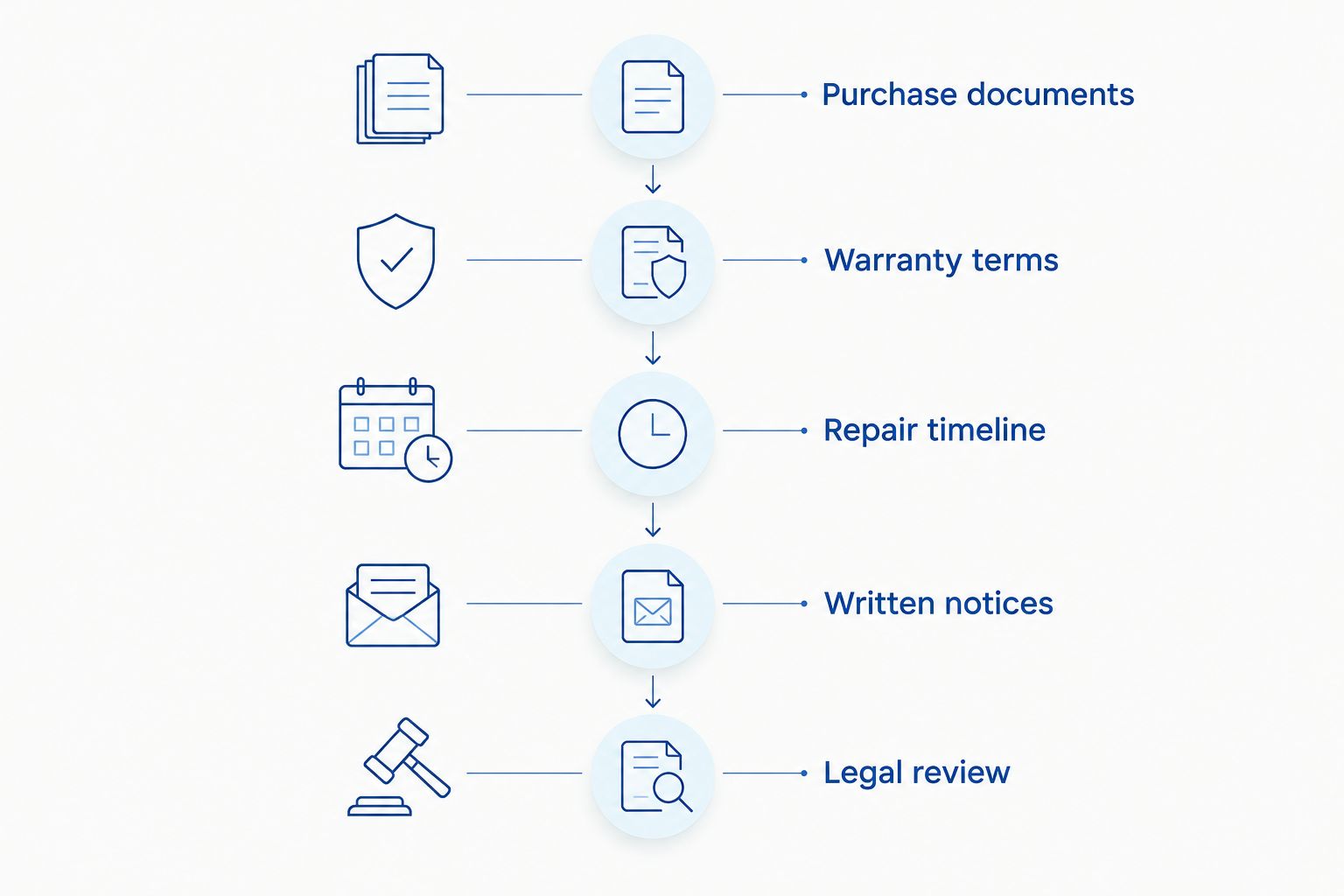
Build a file that lets a lawyer trace the purchase and each repair without reconstructing events from memory. Keep original documents and make a separate working copy.
- Purchase documents: Collect the signed sales contract, buyer disclosures, advertisements, and any inspection representations. Identify the seller's legal name.
- Warranty terms: Gather the manufacturer's warranty, dealer warranty, service contract, and transfer paperwork. Keep these documents separate.
- Repair timeline: List each complaint, date, mileage, repair facility, diagnosis, and return date. Record whether the same symptom returned.
- Written notices: Save emails, messages, claim numbers, coverage denials, and requests for further repair. Follow applicable notice requirements rather than assuming a phone call satisfies them.
- Legal review: Have the transaction and warranty assessed before demanding a specific statutory remedy or signing a release.
A timeline should distinguish time awaiting authorization from time undergoing repair. Keep the source documents behind each entry; your summary should point to evidence, not replace it.
Khachikyan Law Firm is for California buyers seeking lemon law legal representation. Bring the complete warranty file, not just the latest repair bill; an assessment must account for both potential claims and limits on recovery.
You can contact Khachikyan Law Firm about legal representation. Do not assume any firm can promise a buyback before reviewing the transaction and repair records.
Get your warranty claim assessed
Discuss your used RV purchase, warranty terms, and repair history.
Do I need four repair attempts before I can file?
Four repair attempts are not a universal filing requirement. California's statutory presumption uses specific thresholds for qualifying new motor vehicles; it does not make an ordinary used RV eligible simply because the repair count is high.
For qualifying vehicles, the presumption generally concerns problems arising within 18 months or 18,000 miles, whichever occurs first. Its alternatives include at least 2 repair attempts for certain serious safety defects, at least 4 repair attempts for the same nonconformity, or more than 30 calendar days out of service for repairs, subject to statutory conditions and exceptions.
These figures describe a rebuttable presumption, not a universal eligibility checklist. In a 2026 used-RV assessment, resolve the warranty and vehicle-status questions before applying those thresholds.
Even outside the presumption, the relevant legal standard can require a reasonable opportunity to repair. Do not keep driving an unsafe RV merely to accumulate repair visits.
Can I still have a claim if the manufacturer buyback rule does not apply?
A manufacturer buyback is not the only possible remedy. Depending on the documents and conduct, an attorney can assess express-warranty enforcement, applicable implied warranties, federal Magnuson-Moss Warranty Act claims, contract claims, or misrepresentation claims.
Each route has limits. Federal warranty law does not erase the warranty's coverage requirements, and a disclosure dispute needs evidence of what the seller represented or concealed.
Describe your objective clearly: repair, contract enforcement, rescission where available, or another legally supported remedy. Choosing the label lemon law first can obscure the claim your evidence actually supports.
Can I file after the RV warranty expires?
Warranty expiration does not automatically erase an earlier breach, but it does not extend the filing deadline either. Preserve evidence showing when the defect appeared, when you requested covered repairs, and how the warrantor responded.
Do not assume the deadline starts when you personally decide the RV is a lemon. Accrual rules, the claim selected, and applicable procedural requirements require individual review. Waiting for another repair appointment is not a substitute for checking the deadline.
FAQ
Can I file a lemon law claim on a used RV in California in 2026?
A used RV can support a warranty or consumer claim, but manufacturer buyback eligibility is not automatic. Remaining original factory coverage alone does not satisfy the new-motor-vehicle requirement addressed in Rodriguez v. FCA US, LLC.
Does a used RV qualify if the factory warranty transferred to me?
A transferred factory warranty can provide repair rights without creating manufacturer buyback eligibility. Review the warranty's transfer terms, covered components, and the circumstances of the used sale.
Does California lemon law cover an RV refrigerator or roof leak?
Living-area defects require separate warranty analysis because California's special motorhome definition excludes portions primarily used for human habitation. An applicable coach, component, or dealer warranty can still matter.
Is an extended service contract the same as a new manufacturer warranty?
No, a service contract is not automatically a new manufacturer warranty. Identify the provider and read the actual agreement before treating it as evidence of statutory buyback eligibility.
Can I make a claim against the dealer instead of the manufacturer?
A dealer-issued express warranty or actionable sales misconduct can support a separate claim against the dealer. The available remedy depends on the sale documents, warranty obligations, and evidence.
Do I have to wait for four repairs before contacting a lawyer?
No, four repairs are not a universal prerequisite to seeking legal advice or asserting every warranty claim. Eligibility, notice requirements, and a reasonable repair opportunity require separate analysis.
Can Khachikyan Law Firm help with a California lemon law matter?
Khachikyan Law Firm provides lemon law legal representation in Glendale, California. Present the purchase agreement, all warranties, and the complete repair history for an assessment of your situation.
One last thing
A completed repair invoice can still document an unresolved defect. Check whether its customer-complaint section accurately describes the symptom, even when the technician reports no problem found.
Ask the repair facility to correct an inaccurate description promptly. Keep photographs, warning messages, and written follow-up showing that the symptom continued; a stack of invoices is less useful when none identifies the complaint you actually made.
This article provides general California legal information for 2026, not advice about your particular purchase or filing deadline.


