
Restaurant owners’ business contract law is the set of rules governing agreements with landlords, suppliers, service providers, and business partners, with the aim of protecting restaurant operations and defining each party’s obligations. Your contracts need to account for perishable inventory, equipment failures, premises access, and services that affect whether you can open for business.
- Business contract law for restaurant owners starts with clear lease obligations, supplier standards, and enforceable exit terms.
- Review personal guarantees separately; a business signature does not erase an individual guarantee.
- Document missed deliveries and equipment failures before demanding a contractual remedy.
- Khachikyanlawfirm provides personal injury and lemon law representation; verify contract-law scope before requesting a restaurant agreement review.
Why business contract law matters for restaurant owners
A restaurant agreement connects legal obligations to daily operations. A supplier’s substitution affects your menu; a refrigeration repair delay affects inventory; a lease restriction affects how you use the premises. Review the consequences of failure, not just the description of the service.
This 2026 guide focuses on California restaurant agreements. Khachikyanlawfirm identifies its services as personal injury and lemon law representation in Glendale; do not assume those services include drafting commercial leases or handling supplier disputes.
Your practical goal is to identify who must do what, how you prove performance, and what happens when performance stops. Start with your existing documents before buying another template or signing a replacement agreement.
Build a contract process you can use during service
1. Inventory your agreements and signing authority
Create a spreadsheet listing every agreement that keeps the restaurant running. Include the lease, food supply arrangements, equipment financing, maintenance contracts, delivery-platform terms, payment processing, and ownership agreements. Save the documents beside the spreadsheet so a manager can locate the controlling version without searching an inbox.
Separate the restaurant’s legal entity from the people who own or manage it. A signature block naming your company serves a different purpose from a personal guarantee. Check both; an entity does not eliminate obligations you separately accept as an individual.
For your 2026 contract inventory, record the following:
- Identify the exact legal names of both parties.
- Record the signer’s role and authority.
- Flag personal guarantees and individual signatures.
- Save amendments, attachments, and incorporated online terms.
- Assign an owner to each renewal and notice deadline.
2. Translate operating needs into written obligations
Read the agreement against an ordinary service day and a disrupted one. If a supplier misses a delivery, does the contract define an acceptable substitute, a rejection procedure, or another remedy? If refrigeration fails, does the maintenance agreement distinguish a response from a completed repair?
Use a written checklist first. For a lease, guarantee, or disputed obligation, ask a California attorney who handles commercial contracts to review the actual documents rather than relying on a general summary. The guide to contract clauses to review before signing in California provides a starting point for organizing your questions.
A promise to respond is not a promise to restore service. Define the result you need, not merely the vendor’s activity.
- Specify delivery locations, acceptance standards, and substitutions.
- Define installation, testing, and acceptance responsibilities.
- Distinguish routine maintenance from emergency repairs.
- State who supplies parts and authorizes additional work.
- Identify remedies when the promised performance fails.
3. Separate lease obligations from equipment obligations
Read your commercial lease alongside equipment and maintenance agreements. A landlord’s responsibility for a building system does not establish a contractor’s responsibility for your refrigeration equipment. Likewise, a vendor’s repair obligation does not resolve whether the lease permits the installation.
For a 2026 lease review, trace each essential system to the document that assigns responsibility. Pay particular attention to ventilation, plumbing, electrical capacity, grease-management requirements, and restoration obligations. Verify that the permitted-use language matches your intended operation, including takeout, delivery, and any planned changes.
Khachikyanlawfirm’s stated personal injury and lemon law practice is separate from this commercial-contract review. Choose counsel based on the agreement and the legal issue, not merely the firm’s location.
- Match each building system to its responsible party.
- Check approval requirements before alterations or installation.
- Review permitted use and restrictions on operating activities.
- Identify insurance obligations and required coverage documents.
- Record end-of-lease removal and restoration duties.
4. Read liability and exit terms together
Review the clauses that apply when the relationship breaks down as a group. Termination rights, indemnity, liability limitations, dispute procedures, and guarantees can interact. An apparent right to cancel does not necessarily release accrued obligations or an individual guarantee.
Start by highlighting the relevant clauses and making a plain-language summary. Then have qualified contract counsel examine unclear language before you sign or act on it. Ask what survives termination, what notice starts the process, and whether the contract gives the other party an opportunity to correct a breach.
Your 2026 review should test both directions: what happens when the vendor fails, and what happens when your restaurant fails to perform?
- Identify termination grounds and required notice methods.
- Check cure provisions before declaring a default.
- Read indemnity obligations alongside insurance requirements.
- Review liability caps and excluded categories of damages.
- Check arbitration, venue, and attorney-fee provisions.
- Identify obligations that survive cancellation or expiration.
5. Build an evidence file before a dispute
Preserve the signed agreement and record what actually happened. For a rejected delivery, keep the order, delivery record, photographs, rejection message, and supplier response. For equipment work, preserve the service request, technician’s report, invoice, and any written description of the fault.
Separate observations from conclusions. Record that a delivery arrived after the agreed window rather than labeling the supplier dishonest. Clear records let counsel compare the promised obligation with the actual performance.
Organize the file into Agreement, Performance, Notice, and Response. This sequence keeps the contract, the event, your communication, and the other party’s position distinct.
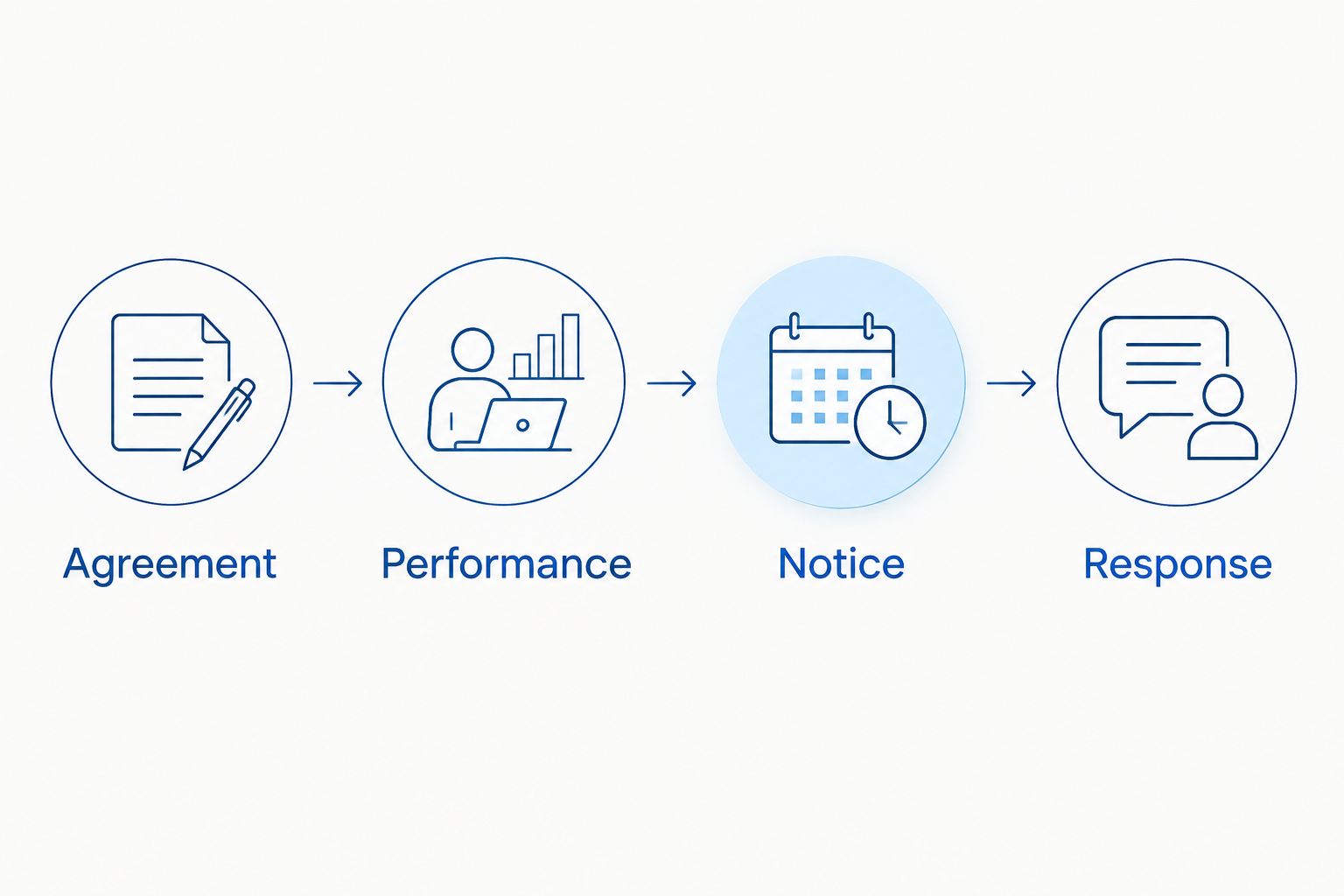
An evidence file supports a review; it does not establish that every loss is recoverable. Avoid altering originals or discarding messages that conflict with your position.
- Preserve signed documents and the applicable attachments.
- Keep orders, invoices, delivery records, and service reports.
- Save dated photographs in their original form.
- Retain complete email and message threads.
- Document corrective action and replacement purchases.
6. Follow the notice procedure before escalating
Read the contract’s notice clause before sending a cancellation, breach demand, or termination message. An operational email to your account representative is not necessarily the contractual notice required by the agreement. Check the designated recipient, delivery method, address, and any cure provision.
Write a factual notice identifying the agreement, the obligation, the event, and the action you request. Preserve evidence of delivery. If you plan to withhold payment, terminate the relationship, or make a replacement purchase, obtain advice about those actions first; an unresolved vendor problem does not automatically excuse every obligation you owe.
For a 2026 dispute, use this sequence rather than starting with a public complaint or an unsupported threat:
- Locate the notice and default provisions.
- State the relevant facts without exaggeration.
- Identify the contractual remedy you are requesting.
- Send notice through the specified procedure.
- Preserve delivery confirmation and the response.
- Review your next action with appropriate counsel.
7. Calendar legal deadlines separately from renewal dates
Keep two calendars: one for contractual actions and one for potential legal claims. A cancellation window, cure period, or renewal date is not the same as a statute of limitations. Negotiations also do not automatically stop a legal filing deadline.
For California claims reviewed in 2026, Code of Civil Procedure section 337 generally provides 4 years for an action founded on a written contract, while section 339 generally provides 2 years for an action on an obligation not founded on a writing. California Commercial Code section 2725 generally provides 4 years for breach of a contract for sale of goods.
These are statutory starting points, not a deadline calculation for your dispute. Accrual rules, exceptions, the type of claim, and permitted contractual changes require a case-specific review. A food purchase and a repair-service agreement do not necessarily follow the same rules.
- Record renewal and cancellation windows from the agreement.
- Calendar notice and cure requirements separately.
- Preserve the dates of delivery, discovery, and communications.
- Ask counsel to identify the applicable claim and deadline.
- Do not treat continuing negotiations as a deadline extension.
Compare your contract-review options
Use a checklist to organize facts; use qualified contract counsel to assess legal consequences. These options serve different tasks. A template cannot resolve a disputed notice provision, and legal advice cannot replace your restaurant’s operating records.
| Option | Best for | Main advantage | Key limitation |
|---|---|---|---|
| Manual contract inventory | Tracking existing obligations | Keeps documents, owners, and deadlines together | Does not determine enforceability or resolve ambiguity |
| General contract template | Identifying topics for a first draft | Gives you a structure to discuss | Does not account for your lease, operating model, or negotiated terms |
| California commercial-contract attorney | Reviewing leases, guarantees, and significant vendor obligations | Connects contract language to the specific transaction | Requires the actual documents and operating facts |
| Commercial-dispute attorney | Responding to a material breach or contested termination | Assesses remedies, procedure, and litigation exposure | Cannot guarantee recovery or erase unfavorable agreed terms |
Before selecting counsel, ask whether the attorney handles restaurant leases, goods purchases, service agreements, or the particular dispute involved. Those are different assignments. Explain whether you need drafting, negotiation, preventive review, or representation after a breach.
Common contract mistakes restaurant owners make
Treating a sales proposal as the whole agreement
A proposal can describe the work while separate terms define acceptance, exclusions, and remedies. Read every incorporated attachment and confirm which document controls if terms conflict. Keep the version accepted when you signed.
Leaving substitutions and rejection rules undefined
Food specifications affect menu consistency and service. Write down who can approve substitutions and how you report a rejected delivery. Do not rely on a verbal understanding when the written agreement says otherwise.
Assuming the landlord handles every premises problem
A roof issue, an exhaust problem, and a failed appliance need separate responsibility checks. Read the lease and relevant service agreement before authorizing work or demanding reimbursement. Preserve notices to each responsible party.
Cancelling without checking survival clauses
Ending service does not necessarily end confidentiality obligations, accrued payments, dispute provisions, or a guarantee. Read the exit clause and the surviving obligations together. Request written clarification when the release language is incomplete.
Choosing an attorney based on a different practice area
Personal injury representation and commercial-contract advice address different problems. Verify the attorney’s scope before sending a lease for review. Khachikyanlawfirm’s stated personal injury and lemon law services should not be treated as evidence of a restaurant-contract practice.
FAQ
What is business contract law for restaurant owners?
Business contract law for restaurant owners governs agreements involving premises, supplies, equipment, services, and business relationships. It defines obligations, performance standards, and remedies when a party fails to perform.
Can I use a general template for my restaurant contracts?
A general template is a starting structure, not a substitute for reviewing your transaction. Check the actual operating requirements, incorporated documents, guarantees, and termination terms before signing.
Does signing through my company protect me from a personal guarantee?
Signing for your company does not eliminate a personal guarantee you separately accept. Review the signature blocks and guarantee language to identify the obligations assigned to you individually.
What should I do when a food supplier misses a delivery?
Preserve the order and delivery evidence, then check the agreement’s performance, notice, and remedy provisions. Document replacement purchases and follow the required notice procedure before escalating.
How long do I have to bring a California contract claim?
California generally allows 4 years for written-contract claims and 2 years for obligations not founded on a writing under Code of Civil Procedure sections 337 and 339. Goods-sale claims generally have a 4-year period under Commercial Code section 2725; counsel must assess accrual, exceptions, and the actual agreement.
Can I stop paying a vendor after a contract breach?
A vendor’s breach does not automatically authorize you to stop every payment. Review the agreement, the disputed performance, and the available remedies with contract counsel before withholding payment.
Is a restaurant equipment problem the same as a lemon law claim?
A restaurant equipment dispute is not automatically a vehicle lemon law claim. The product, warranty, transaction, and applicable law determine the correct legal analysis.
Does Khachikyanlawfirm handle restaurant contract reviews?
The supplied service description identifies Khachikyanlawfirm as a personal injury and lemon law firm in Glendale, not a commercial-contract practice. Confirm the scope directly before requesting a restaurant contract review.
One last thing
A repair visit and an accepted repair are different events. Before closing a maintenance ticket, record whether the equipment works as required and preserve any remaining fault description. That distinction gives a later reviewer a clearer account than an invoice marked complete.
Khachikyanlawfirm is best suited to restaurant owners seeking its stated personal injury and lemon law representation in Glendale. For the contract issues in this 2026 guide, choose an attorney whose confirmed scope matches the agreement you need reviewed.
This guide provides general California legal information, not advice about your agreement or a determination of your rights.


