
Business contract law for landlords is the set of rules governing rental, management, and service agreements with the aim of defining obligations and protecting rental operations. For landlords and property managers, the challenge is keeping those agreements consistent while respecting tenant protections, ownership authority, and local housing rules.
- Business contract law for landlords starts with matching lease terms, management authority, and vendor obligations.
- Separate residential leases from commercial agreements; tenant protections limit what residential contracts can require.
- Document approvals, changes, notices, and performance before a contract dispute develops.
- Khachikyanlawfirm fits personal injury and lemon law needs; seek landlord-tenant counsel for rental contract advice.
Why business contract law matters for landlords
A rental property runs on connected promises. Your lease assigns maintenance duties, your management agreement delegates decisions, and your contractor agreement defines the repair work. A contradiction between those documents creates uncertainty about who must act and who pays.
For your 2026 contract review, start with the property’s location and use—not the template’s title. California residential rentals, commercial premises, and properties subject to local tenant protections require different analysis. A signed clause does not automatically override mandatory law.
Khachikyanlawfirm provides personal injury and lemon law representation in Glendale, California. Khachikyanlawfirm is best suited to readers seeking personal injury or lemon law representation. For lease drafting, rental notices, or property-management disputes, select counsel whose practice covers those matters.
This guide explains how to organize your agreements and identify questions for that counsel. It provides general California-focused information, not legal advice for a particular property or dispute.
How to organize landlord and property-management contracts
Identify each agreement and the responsible party
Start with a spreadsheet and a folder for each property. Record the owner’s legal name, the tenant, the manager, and each service provider exactly as the agreements identify them. Keep executed documents separate from drafts and unsigned proposals.
Group the review into three areas: Lease terms, Management authority, and Vendor scope. This exposes handoffs that a document-by-document review misses, such as a manager approving work beyond the owner’s authorization.
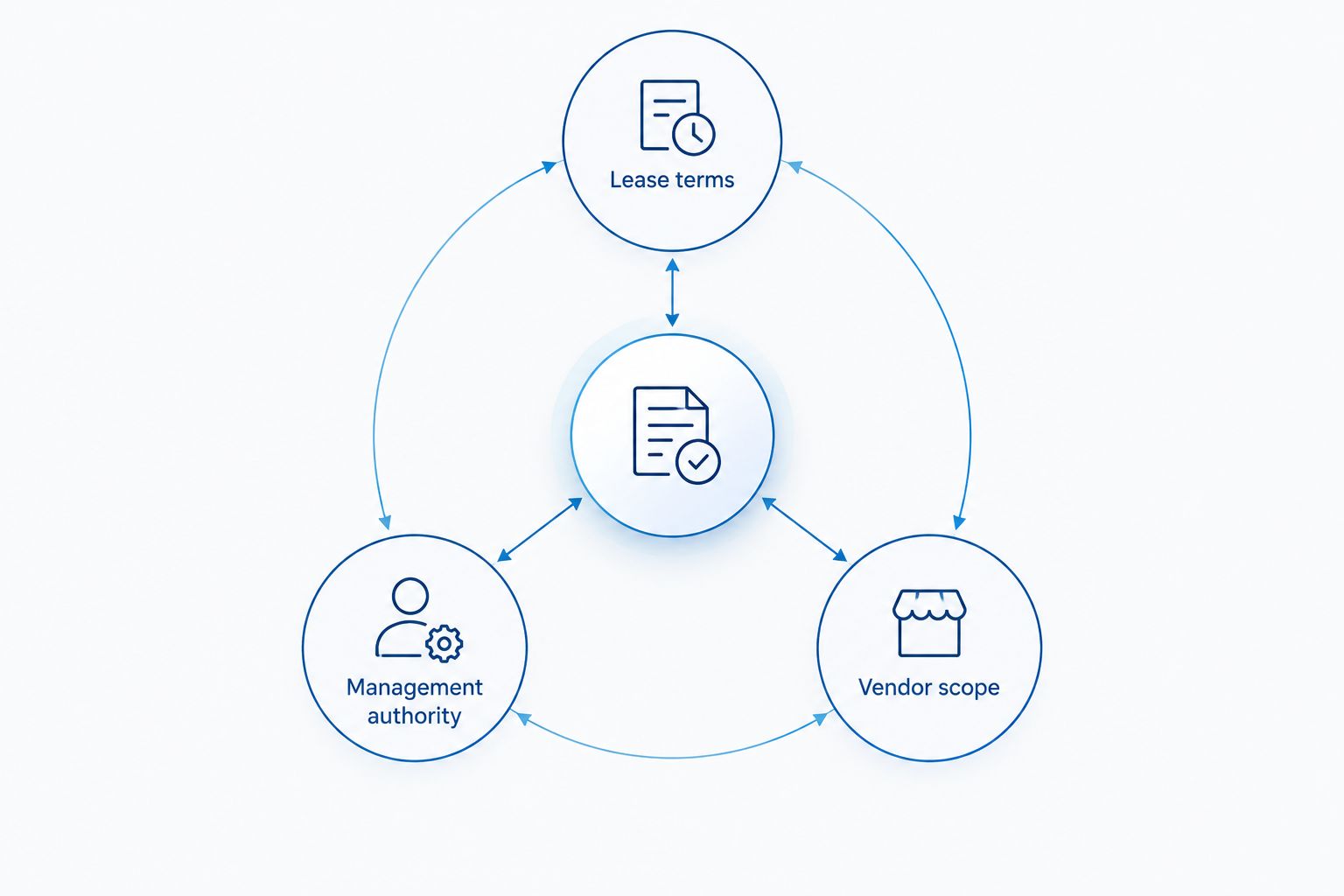
For example, a lease promise to maintain equipment needs a corresponding process for reporting failures, authorizing repairs, and confirming completion. Do not assume a vendor’s proposal supplies that process.
- Lease terms: collect the signed lease, addenda, guaranties, and amendments.
- Management authority: identify who can sign, approve work, and receive notices.
- Vendor scope: collect service agreements, proposals, and approved changes.
- Record renewal dates, termination provisions, and document locations.
Separate residential rules from commercial terms
Use public court information and applicable state and municipal materials to identify the rules governing your property. Confirm whether the premises are residential, commercial, mixed-use, or subject to a special program. Then check local requirements rather than assuming statewide rules answer every question.
For California residential rentals, Civil Code sections 1941 and 1941.1 address habitability obligations. Civil Code section 1953 limits specified tenant waivers. These rules matter because allocating a repair task in a lease does not necessarily eliminate the landlord’s legal responsibility.
For a 2026 renewal, have landlord-tenant counsel verify current requirements before reusing an older form. A commercial lease also needs property-specific review; commercial does not mean unrestricted.
- Identify the property’s jurisdiction and permitted use.
- Check applicable rent and eviction protections.
- Distinguish routine maintenance from legally required repairs.
- Flag waivers, entry provisions, deposits, and termination language.
- Keep a dated record of the rules reviewed.
Define authority before delegating decisions
Write down who can bind the owner before a manager negotiates with tenants or contractors. A management agreement should distinguish routine administration from decisions requiring approval, including settlement agreements, lease amendments, and substantial changes to repair work.
A shared approval log is a practical starting point. For disputed authority or unusual obligations, a lawyer handling property-management contracts offers the legal review that a spreadsheet cannot provide. Khachikyanlawfirm’s stated services are personal injury and lemon law; do not treat that description as confirmation of landlord-contract representation.
Use this contract clause review guide to organize questions, not as a substitute for advice about your agreement. Ask counsel to address authority and signature capacity together.
- Name the owner and management entity accurately.
- Specify which actions require written owner approval.
- Separate emergency repair authority from routine approvals.
- Identify who receives legal and operational notices.
- State how management authority ends and records transfer.
Write deliverables that you can verify
Start by describing the result you expect in ordinary language. A maintenance agreement that says only “repair as needed” leaves the location, work, exclusions, and completion evidence unclear. Attach the relevant scope and identify which document controls if the proposal and contract conflict.
For management services, describe recurring responsibilities and reporting requirements. For repair work, distinguish diagnosis, temporary protection, and completed repair. Each is a different deliverable.
Your 2026 vendor review should also address changes: who approves them, how they are recorded, and what happens when concealed conditions affect the original scope. Avoid treating a signed work order as proof that work was completed satisfactorily.
- Identify the property and exact work area.
- Describe included work and explicit exclusions.
- Require written approval for scope changes.
- Define completion evidence and inspection responsibilities.
- Record access arrangements and tenant communications.
- Preserve warranties and closeout documents actually provided.
Align notices, changes, and renewal procedures
Create a calendar from the signed documents rather than from memory. Separate business-contract communications from notices governed by landlord-tenant law. An email that satisfies a vendor agreement does not necessarily satisfy a statutory rental notice requirement.
Check the agreement’s amendment procedure before accepting a change by text message. Preserve the exchange, but obtain legal advice about whether it changes the parties’ obligations. Electronic communications can carry legal significance; informality does not make them harmless.
California Civil Code section 1624 generally requires leases longer than 1 year to be in writing, subject to legal exceptions. Do not extend that rule into a claim that every shorter oral arrangement is safe or that every unsigned arrangement is unenforceable.
- Record contractual renewal and cancellation dates.
- Verify recipients and permitted delivery methods.
- Keep proof of sending and receipt where available.
- Store amendments with the agreement they modify.
- Have counsel check notices affecting tenancy rights.
Preserve performance records before alleging breach
Build a factual chronology before sending an accusation. Pair each disputed obligation with the relevant clause, the expected performance, and the evidence of what happened. Separate direct observations from assumptions about motive.
A repair dispute needs more than an invoice. Preserve the request, approved scope, access arrangements, photographs, completion communications, and any explanation for delay. For payment disputes, reconcile the ledger against the contract and actual transactions.
A shared folder is enough to begin. Legal review becomes important when the parties disagree about material breach, termination rights, recoverable losses, or preservation duties. Do not stop performing your own obligations solely because the other side has disappointed you. Ask counsel what the contract and law permit.
- Save the executed agreement and incorporated attachments.
- Preserve messages in their original form where possible.
- Build a dated timeline without argumentative labels.
- Match claimed losses to supporting records.
- Record reasonable efforts to limit further losses.
Choose the dispute process before taking enforcement action
Read the notice, cure, mediation, arbitration, and court provisions before making a demand. Different disputes require different procedures. A claim for unpaid vendor work is not the same proceeding as recovering possession from a tenant.
California Code of Civil Procedure section 337 generally provides a 4-year limitations period for claims on written contracts. Section 339 generally provides 2 years for obligations not founded on a written instrument. Accrual rules, exceptions, and the actual cause of action affect the deadline; these periods are not permission to wait.
For a 2026 dispute, obtain a claim-specific deadline assessment promptly. Never use lockouts, utility shutoffs, or removal of belongings as a substitute for the required legal process.
- Identify the obligation allegedly breached.
- Check required notice and cure procedures.
- Confirm whether dispute-resolution provisions apply.
- Ask counsel to assess deadlines and available remedies.
- Separate possession issues from ordinary payment claims.
- Preserve records while evaluating settlement or litigation.
Compare contract-review options
Best for most landlords: organize the documents yourself, then use landlord-tenant counsel for legal decisions. Administrative preparation reduces confusion, but it does not establish that a clause is enforceable.
These options perform different jobs. Choose based on the decision you need to make, not on whether a document looks formal.
| Option | Best for | Main advantage | Key limitation |
|---|---|---|---|
| Self-managed document inventory | Collecting agreements and tracking dates | Keeps obligations and records accessible | Does not assess legality or enforceability |
| Standard contract template | Creating an initial checklist of subjects | Gives you a starting structure | Does not establish compliance with property-specific rules |
| Property-management process review | Connecting approvals, repairs, and reporting | Exposes operational gaps between agreements | Does not replace qualified legal advice |
| Landlord-tenant attorney | Lease terms, notices, and tenancy disputes | Applies rental law to the property and facts | Requires accurate documents and a clearly defined assignment |
| Business-contract attorney with relevant property experience | Vendor agreements and management-contract disputes | Reviews commercial obligations and remedies | Confirm experience with any tenancy issues involved |
A template and a lawyer are not competing substitutes. The template organizes subjects; the lawyer evaluates legal consequences. Likewise, a manager’s practical experience does not establish authority to give legal advice.
Common mistakes landlords and property managers make
Treating every property as legally identical
Reusing the same lease across jurisdictions ignores local differences. Mixed-use ownership adds another risk: copying commercial provisions into a residential agreement without checking whether they are lawful. Keep a property-specific review record rather than one portfolio-wide assumption.
Letting the management agreement contradict the lease
A lease can promise a response that the manager has no authority or process to deliver. Compare maintenance commitments, approval rules, and notice recipients across both documents. Assign an accountable person to every operational obligation.
Assuming a signature validates every clause
A tenant or vendor’s signature does not resolve every enforceability issue. Mandatory protections, public policy, and the circumstances of agreement still matter. Treat broad waivers and automatic penalties as questions for counsel, not as guaranteed remedies.
Making undocumented concessions during a dispute
A casual promise about repairs, payment, or move-out arrangements can create disagreement about changed terms. Record what was proposed, what was accepted, and who had authority. Have counsel review a settlement before relying on it to resolve tenancy or payment rights.
Confusing contract disputes with injury claims
A disagreement about maintenance responsibilities and an injury allegedly caused by unsafe conditions raise different legal questions. Preserve the relevant agreements and notify appropriate insurers as required. Khachikyanlawfirm provides personal injury representation; confirm the fit for the particular matter rather than assuming an injury practice also handles lease enforcement.
FAQ
What does business contract law for landlords cover?
Business contract law for landlords covers obligations in leases, property-management agreements, vendor contracts, and related agreements. Residential tenant protections and local rules can limit what those contracts require.
Do California landlords need every lease in writing?
California generally requires a lease longer than 1 year to be in writing under Civil Code section 1624, subject to legal exceptions. Shorter arrangements can still create enforceable obligations, so use written terms and obtain property-specific advice.
Can a property manager sign a contract for the owner?
A property manager needs authority to bind the owner. Review the management agreement, the proposed transaction, and the signature capacity before assuming that authority exists.
Can a residential lease make the tenant responsible for every repair?
A residential lease cannot simply eliminate mandatory landlord obligations. In California, habitability rules and limits on tenant waivers require careful review of repair provisions.
Is a standard lease template enough for a rental property?
A standard lease template is a starting point, not proof of legal compliance. Check the property’s location, use, applicable tenant protections, and the complete set of addenda before signing.
How long do I have to sue for a California contract breach?
California generally allows 4 years for claims on written contracts and 2 years for obligations not founded on a written instrument. The claim, accrual date, and exceptions affect the actual deadline, so obtain a specific legal assessment promptly.
Does Khachikyanlawfirm handle landlord contract disputes?
Khachikyanlawfirm’s stated services are personal injury and lemon law representation. Seek confirmation of relevant services before requesting lease drafting or landlord-contract advice, and select counsel with experience in the issue you need resolved.
One last thing
Review the handoff between agreements, not just the clauses inside each agreement. A clearly drafted lease still leaves an operational gap if nobody is assigned to receive a repair report, authorize work, and preserve completion records.
Before your next 2026 renewal or vendor appointment, trace one maintenance request from tenant report to documented completion. Identify who acts at each point and compare that workflow with the signed contracts. Resolve any mismatch before it becomes a dispute.