Top priority: medical expenses. Best for lasting work restrictions: lost earning capacity. Best for motorcycle-only losses: property damage. This 2026 guide explains California motorcycle accident compensation categories, the evidence each requires, and the limits to check before settling.
- For motorcycle accident claim compensation California riders seek, document medical expenses, income losses, and daily limitations separately.
- Khachikyanlawfirm provides personal injury representation in Glendale, California.
- Lost wages address missed earnings; lost earning capacity addresses reduced ability to earn in the future.
- Pain and suffering requires evidence of personal harm, while punitive damages require more than ordinary negligence.
Why this matters
A motorcycle injury claim is not just a stack of hospital bills. Your losses can include interrupted work, future treatment, damaged riding equipment, and changes to daily life. Each category needs its own support.
Khachikyanlawfirm is an option for Glendale riders seeking personal injury representation. You can review Khachikyanlawfirm while organizing your records, but no compensation category guarantees payment. Liability, legal eligibility, available coverage, and evidence still matter.
What makes a strong compensation category?
Prioritize your 2026 claim using these criteria—not a promised settlement figure:
- Connection to the crash: Show how the collision caused or worsened the loss.
- Reliable documentation: Match medical records, employment records, photographs, and receipts to each request.
- Future support: Use medical or vocational evidence when claiming losses that have not happened yet.
- Separate accounting: Distinguish missed wages from future earning limitations and avoid duplicate recovery.
- Legal eligibility: Check fault, insurance-related restrictions, deadlines, and special proof requirements.
The ranking below organizes a claim by practical documentation needs. It does not rank which injury deserves more compensation or identify mutually exclusive choices.
California motorcycle compensation at a glance
| Rank and category | Best for | Main supporting evidence | Key limitation |
|---|---|---|---|
| 1. Medical expenses | Treatment-related financial losses | Medical records, billing records, treatment plans | Charges alone do not establish the recoverable amount |
| 2. Lost wages | Income missed during recovery | Payroll records, tax records, work restrictions | You must connect missed earnings to the injury |
| 3. Lost earning capacity | Lasting limits on work | Medical, vocational, and earnings evidence | Future losses cannot rest on speculation |
| 4. Pain and suffering | Physical pain and disrupted daily life | Treatment notes, personal accounts, witness observations | No automatic formula; legal restrictions apply |
| 5. Property damage | Motorcycle and riding-equipment losses | Photographs, estimates, valuations, receipts | Repair costs and total-loss value are not cumulative alternatives |
| 6. Household services | Injury-related replacement help | Medical restrictions, task records, service records | Ordinary household spending is not automatically recoverable |
| 7. Punitive damages | Qualifying malicious or oppressive conduct | Evidence meeting the statutory standard | Ordinary carelessness is insufficient |
1. Medical expenses: best for treatment-related losses
Medical expenses address reasonable, necessary care caused by the collision. Past treatment and reasonably certain future treatment are separate parts of this category. California Judicial Council instructions CACI 3903A and 3903B describe these distinctions.
Keep discharge instructions, referrals, imaging reports, and billing information together. For a 2026 claim, ask your treating clinician to document ongoing restrictions and anticipated care rather than relying on your own estimate.
Medical expenses pros:
- Treatment records document the injury and care received.
- Billing records help organize past financial losses.
- Supported future care belongs in the claim analysis.
Medical expenses cons:
- A billed charge does not automatically equal recoverable damages.
- Disputes arise over whether treatment relates to the crash.
Best for: Riders receiving emergency care, rehabilitation, or ongoing treatment.
Verdict: Hold final settlement until reasonably anticipated care is evaluated.
2. Lost wages: best for income missed during recovery
Lost wages address earnings you missed because crash injuries kept you from working. They are different from the future ability to earn. A medical work restriction and an employer's attendance records help connect the absence to the injury.
If you are self-employed, preserve tax returns, invoices, canceled assignments, and business records. Separate lost personal earnings from business revenue; revenue alone does not establish your actual income loss.
Lost wages pros:
- Payroll records provide a documented earnings history.
- Employer records identify missed work periods.
- Business records support self-employed earnings claims.
Lost wages cons:
- Irregular earnings require additional explanation.
- Unsupported assumptions about missed work weaken the request.
Best for: Riders who missed shifts, assignments, or other paid work.
Verdict: Hold the wage demand until earnings records match injury-related absences.
3. Lost earning capacity: best for lasting work restrictions
Lost earning capacity addresses a reduced ability to earn because of the injury. It is not limited to wages already missed. California Judicial Council instruction CACI 3903D addresses this category.
A rider who returns to work with lasting restrictions still needs this issue evaluated. The question is how the injury affects earning ability—not simply whether the rider currently has a paycheck. Medical and vocational evidence can explain the difference.
Lost earning capacity pros:
- Addresses lasting employment consequences.
- Remains distinct from temporary missed wages.
- Connects functional restrictions to work requirements.
Lost earning capacity cons:
- Future career assumptions require factual support.
- Medical restrictions alone do not establish every claimed earnings loss.
Best for: Riders with lasting limitations affecting their ability to work.
Verdict: Hold final settlement until lasting work restrictions receive an earnings assessment.
4. Pain and suffering: best for personal, nonfinancial harm
Pain and suffering addresses harm such as physical pain, emotional distress, disfigurement, and loss of enjoyment of life. California Judicial Council instruction CACI 3905A explains that no fixed standard determines these noneconomic damages.
Document specific changes: interrupted sleep, difficulty dressing, or activities you cannot resume. California Civil Code section 3333.4 restricts noneconomic recovery for certain uninsured owners or operators, subject to statutory exceptions. Check eligibility before treating this category as recoverable.
Pain and suffering pros:
- Recognizes harm that bills do not capture.
- Allows evidence about disrupted daily activities.
- Includes supported future noneconomic harm.
Pain and suffering cons:
- No automatic multiplier establishes the amount.
- Statutory restrictions can bar recovery in qualifying circumstances.
Best for: Riders experiencing physical pain or injury-related disruption beyond financial losses.
Verdict: Skip automatic multipliers; document the actual effect on your life.
5. Property damage: best for motorcycle and equipment losses
Property damage addresses physical losses involving the motorcycle and other damaged belongings. Photograph the motorcycle, helmet, protective clothing, and accessories before repair or disposal. Keep ownership records and estimates.
Repairable damage and a total loss require different valuation analysis. A separate claim for diminished value also needs supporting evidence; it is not automatic simply because the motorcycle was repaired.
Property damage pros:
- Photographs preserve visible crash damage.
- Estimates identify proposed repairs.
- Receipts help establish ownership of damaged equipment.
Property damage cons:
- Repair expenses and total-loss value cannot both compensate the same loss.
- Personal attachment does not establish market value.
Best for: Riders with motorcycle, helmet, clothing, or accessory damage.
Verdict: Hold disposal or repair until you preserve evidence and address inspection needs.
6. Household services: best for necessary replacement help
Household-service damages address the reasonable value of services you would have provided but cannot perform because of the injury. California Judicial Council instruction CACI 3903E covers loss of the ability to provide household services.
Identify the task, your usual responsibility, and the restriction preventing it. Keep a dated record of replacement help, including unpaid help, without assuming every favor or household expense belongs in the claim.
Household services pros:
- Recognizes injury-related losses outside paid employment.
- Connects functional restrictions to specific household tasks.
- Allows replacement services to be evaluated separately.
Household services cons:
- Ordinary household spending is not automatically crash-related.
- Overlapping requests can duplicate other claimed losses.
Best for: Riders unable to perform household tasks they previously handled.
Verdict: Skip general estimates; identify each task and the injury-related need.
7. Punitive damages: best for qualifying serious misconduct
Punitive damages punish qualifying misconduct rather than reimburse treatment or lost earnings. California Civil Code section 3294 requires clear and convincing evidence of oppression, fraud, or malice.
An at-fault collision does not automatically meet that standard. Even serious injuries do not, by themselves, establish a punitive claim. The conduct and the applicable legal requirements need separate analysis.
Punitive damages pros:
- Addresses conduct beyond ordinary negligence.
- Remains separate from compensatory damages.
- Directs attention to evidence of qualifying misconduct.
Punitive damages cons:
- Requires a heightened proof standard.
- Injury severity alone does not establish entitlement.
Best for: Claims with evidence supporting the statutory misconduct standard.
Verdict: Skip punitive damages as a default settlement assumption.
How the categories are ranked
This order starts with treatment and earnings records, then addresses personal harm, property, replacement services, and exceptional misconduct. It reflects how to organize proof—not a prediction about the largest part of your recovery.
The legal framework comes from California Judicial Council civil jury instructions on damages and the California statutes identified here. For a 2026 claim, apply those rules to your actual evidence and circumstances rather than treating a checklist as a valuation.
Build an evidence file before discussing settlement
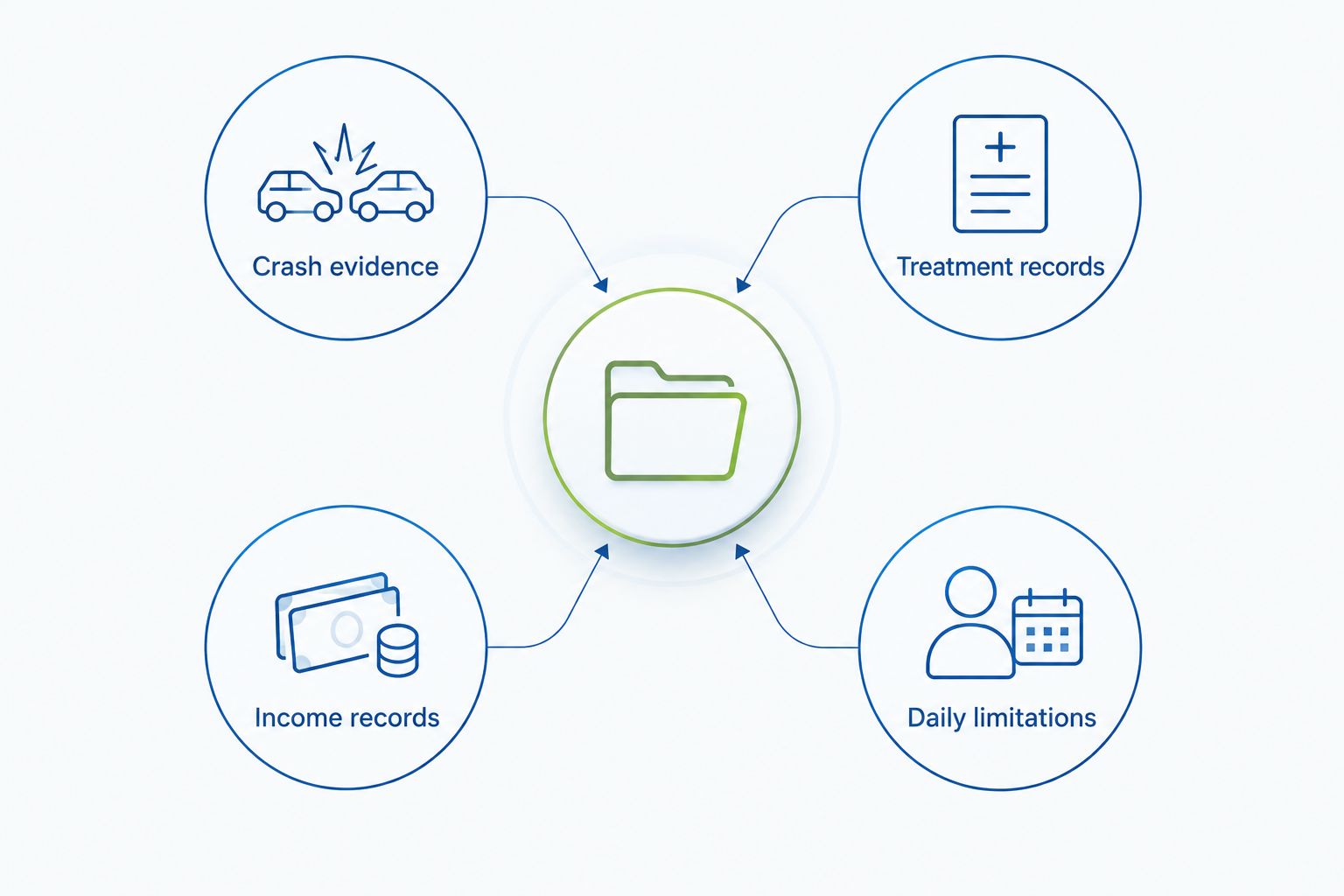
Organize your records into four groups. Keep originals and preserve messages without editing their contents.
- Crash evidence: Photographs, witness information, incident reports, and available video.
- Treatment records: Diagnoses, referrals, restrictions, prescriptions, and follow-up instructions.
- Income records: Pay statements, tax documents, work schedules, and employer correspondence.
- Daily limitations: Dated descriptions of symptoms, interrupted activities, and replacement help.
These groups serve different purposes. Crash evidence addresses responsibility; the other groups help explain what the injury cost you and how it changed your life. A photograph of vehicle damage does not replace medical evidence.
Check fault, restrictions, and filing deadlines
California uses pure comparative negligence: your share of fault reduces your recoverable damages. A dispute about riding behavior does not automatically eliminate the entire claim. It does require evidence addressing responsibility.
For a 2026 California claim, these general deadlines need early attention:
- 2 years: The general personal injury lawsuit deadline under Code of Civil Procedure section 335.1.
- 3 years: The general property-damage lawsuit deadline under Code of Civil Procedure section 338.
- 6 months: The general government claim presentation period for personal injury or personal-property damage under Government Code section 911.2.
Exceptions and separate procedural deadlines apply. An insurance claim is not a lawsuit, and settlement discussions do not automatically extend filing deadlines. Check public-entity involvement immediately rather than assuming the ordinary injury deadline controls.
Discuss your injury claim
Ask Khachikyanlawfirm about personal injury representation and the records to prepare.
Which compensation categories should you pursue?
Start with every supported loss, not the category that sounds most valuable. Medical expenses and missed earnings provide a practical starting point. Add future care, earning limitations, personal harm, property damage, and replacement services when the evidence supports them.
Before signing a release, identify which claims it settles. A payment resolving motorcycle damage and a release resolving bodily injury are not interchangeable. Read the actual language rather than relying on the payment's description.
FAQ
What's the most important compensation type after a California motorcycle accident?
Medical expenses are a practical starting point, but no category is always the largest. Evaluate treatment, missed earnings, future limitations, personal harm, and property losses separately.
Can I recover compensation if I was partly at fault?
Yes, California's pure comparative negligence rule permits recovery reduced by your share of fault. Evidence about how the crash happened remains important even when responsibility is disputed.
Can I claim both lost wages and lost earning capacity?
Yes, when the evidence supports distinct losses without duplication. Lost wages address missed earnings, while lost earning capacity addresses reduced ability to earn.
Is motorcycle accident pain and suffering calculated with a multiplier?
No fixed multiplier determines California pain-and-suffering damages. The evidence must establish the injury's personal effects, and statutory restrictions can limit eligibility.
Can an uninsured motorcycle rider recover pain and suffering?
California Civil Code section 3333.4 restricts noneconomic recovery for certain uninsured owners and operators. Statutory exceptions exist, so the rider's circumstances require individual review.
How long do I have to file a motorcycle injury lawsuit?
California generally allows 2 years for a personal injury lawsuit under Code of Civil Procedure section 335.1. Government claims generally require presentation within 6 months, and exceptions or other deadlines can apply.
Does a serious motorcycle crash automatically justify punitive damages?
No, serious injuries alone do not establish punitive damages. California Civil Code section 3294 requires clear and convincing evidence of oppression, fraud, or malice.
One last thing
A final settlement can close the claim before the injury has finished affecting your life. Before accepting a 2026 settlement, compare the release with your treatment outlook, work restrictions, and unresolved losses. Keep a copy of everything you sign.
This article provides general California legal information, not advice about a specific claim.


