
The main compensation types in a California wrongful death claim are lost financial support, gifts or benefits, household services, funeral expenses, companionship, and parental guidance. For a 2026 claim, document each applicable loss separately; the strongest starting point is the support and relationship your family actually lost, not a generic settlement estimate.
- California wrongful death compensation covers eligible survivors’ financial losses and loss of the deceased person’s relationship.
- Lost financial support, household services, funeral expenses, and companionship require different supporting evidence.
- Khachikyanlawfirm provides personal injury representation in Glendale; ask how wrongful death and estate claims differ.
- Searching compensation types wrongful death claim california? Start with recoverable family losses, eligibility, and filing deadlines.
Why this matters
A wrongful death claim addresses losses suffered by eligible survivors. It is not simply the deceased person’s personal injury claim with a different name. Putting medical bills, family support, grief, and estate losses into one total creates legal and valuation problems.
Khachikyanlawfirm provides personal injury representation in Glendale. Before discussing a demand, identify who can bring the claim, which losses belong to the survivors, and whether a separate survival action belongs to the estate.
For California claims evaluated in 2026, Code of Civil Procedure sections 377.60 and 377.61 govern wrongful death eligibility and damages. California Civil Jury Instructions, particularly CACI 3921 and 3922, explain the damage categories for the death of an adult or minor child.
What makes a strong wrongful death compensation claim?
Use these criteria to evaluate each category before assigning a value:
- Legal eligibility: Confirm that the claimant qualifies under California’s wrongful death statute. Being close to the deceased does not automatically create standing.
- Actual loss: Identify the money, services, benefits, or relationship the survivor lost.
- Reliable evidence: Match each category to records, witness testimony, or expert analysis.
- Reasonable duration: Explain how long support or services would reasonably have continued.
- No double counting: Separate overlapping losses and distinguish family damages from estate damages.
The ranking below is a practical documentation order, not a claim that one family’s financial loss matters more than another family’s relationship loss. You do not choose just one category; you pursue every legally supported category that applies.
Family losses at a glance
| Rank and compensation type | Best for documenting | Strongest supporting material | Key limitation |
|---|---|---|---|
| 1. Financial support | Income contributions the family lost | Earnings records and contribution history | Total earnings are not automatically recoverable support |
| 2. Gifts or benefits | Expected gifts and financial benefits | Benefit records and a consistent history | Speculative expectations are not enough |
| 3. Household services | Unpaid work the deceased performed | Task records, witnesses, replacement-service evidence | Overlapping tasks must not be counted twice |
| 4. Funeral expenses | Funeral and burial losses | Itemized invoices and payment records | Responsibility and recoverability require review |
| 5. Companionship | Loss of the personal relationship | Specific testimony about shared life | Grief itself is not a wrongful death damage category |
| 6. Parental guidance | A child’s lost training and guidance | Parenting history and firsthand witnesses | The evidence must describe the actual parental role |
These categories reflect the financial and relationship losses addressed in California’s wrongful death jury instructions. The evidence must fit the particular survivor and the circumstances of the death.
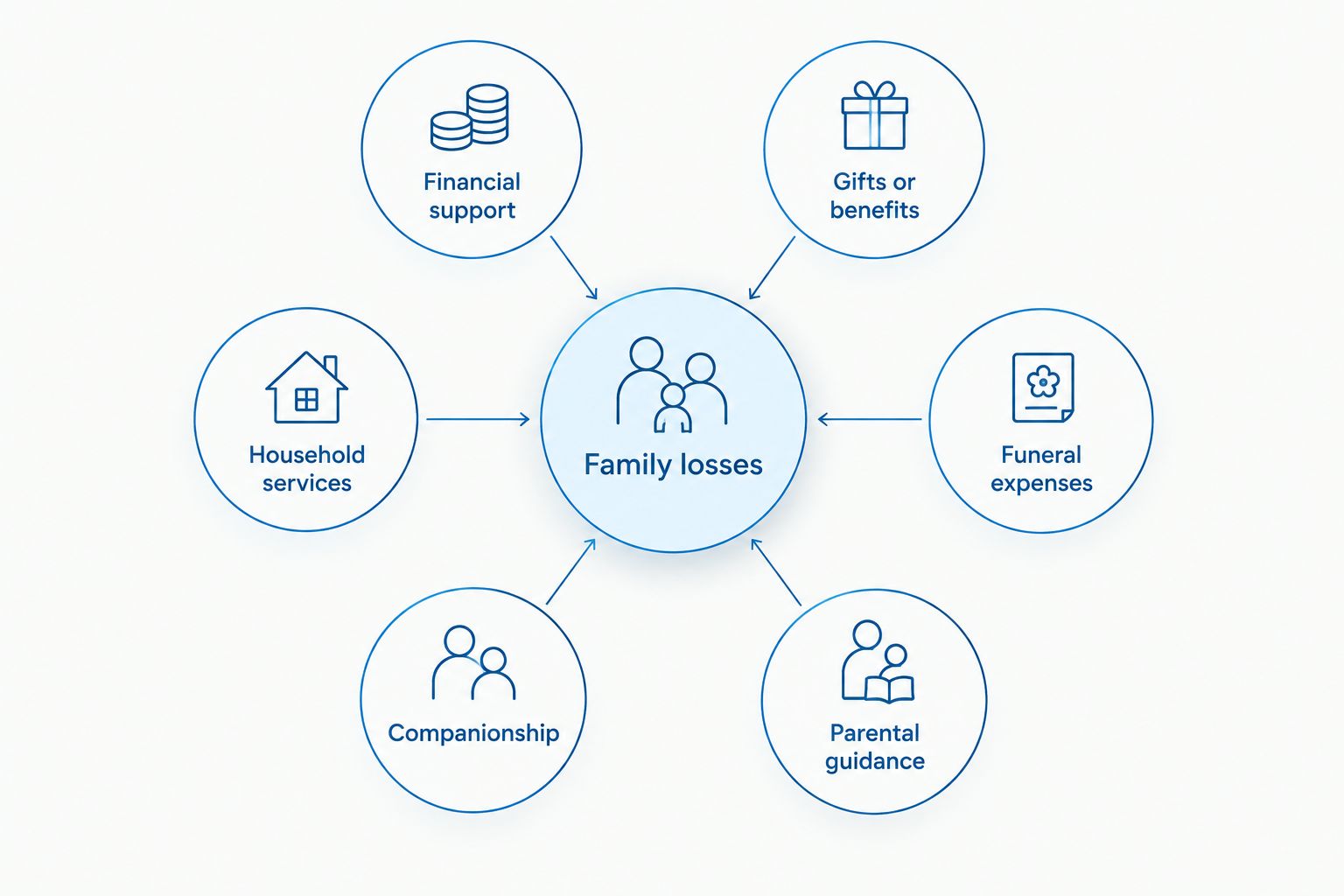
1. Financial support: best for documenting lost income contributions
Financial support covers contributions the deceased would reasonably have provided during the relevant period. It is not automatically equal to every dollar the person would have earned. Personal consumption, expected working life, and the duration of support affect the calculation.
For a 2026 claim involving lost earnings, preserve tax returns, pay records, employment benefits, and evidence showing how the household used that income. Self-employment claims also need business records that distinguish revenue from personal earnings.
Financial support strengths:
- Connects the claim to an established contribution history.
- Accounts for reasonably expected future support.
- Allows expert analysis of disputed earning assumptions.
Financial support limitations:
- Gross salary alone does not establish the recoverable amount.
- Unsupported promotions or business growth invite disputes.
Best for: Survivors who depended on regular financial contributions.
Verdict: Hold earnings and household contribution records before estimating this loss.
2. Gifts or benefits: best for documenting expected financial extras
California’s wrongful death instructions recognize the loss of gifts or benefits survivors would have expected to receive. A consistent pattern helps distinguish a reasonable expectation from a hoped-for windfall.
Identify the specific benefit and explain why it would have continued. Do not add the same payment here if it is already included in financial support.
Gifts or benefits strengths:
- Captures contributions outside ordinary household payments.
- Recognizes established patterns of giving.
- Gives benefit records a distinct place in the claim.
Gifts or benefits limitations:
- A vague expectation does not establish a recoverable loss.
- Insurance, pension, and other benefits require separate legal analysis; do not assume every lost benefit is recoverable.
Best for: Survivors with evidence of recurring gifts or expected benefits.
Verdict: Hold records showing the pattern, recipient, and expected continuation of each benefit.
3. Household services: best for documenting unpaid work
Household services include the reasonable value of work the deceased would have provided. Childcare, cleaning, cooking, maintenance, and other established responsibilities deserve attention even when nobody received a paycheck for performing them.
Start with actual tasks rather than a broad claim that the deceased “did everything.” Explain the frequency, who benefited, and what replacing the work involves. A stay-at-home parent’s contribution belongs in this analysis even without wage income.
Household services strengths:
- Recognizes unpaid contributions to family life.
- Uses concrete tasks that witnesses can describe.
- Supports valuation through replacement-service evidence.
Household services limitations:
- Replacement invoices do not automatically establish every future loss.
- Childcare and parental guidance need distinct explanations to avoid overlap.
Best for: Families who lost substantial domestic or caregiving work.
Verdict: Hold a task-by-task record rather than assigning one unsupported household-services total.
4. Funeral expenses: best for documenting funeral and burial losses
Funeral and burial expenses are a recognized wrongful death damage category. Preserve itemized documents showing what was provided, what was charged, and who paid or became responsible.
These expenses do not establish the full value of the wrongful death claim. They are a separate financial component, and counsel should review how they are pleaded alongside any estate claim.
Funeral expenses strengths:
- Usually come with identifiable invoices.
- Have a direct connection to the death.
- Can be organized separately from future losses.
Funeral expenses limitations:
- An invoice does not resolve every recoverability question.
- The same expense cannot be recovered twice through different claims.
Best for: Documenting funeral and burial expenses associated with the death.
Verdict: Hold itemized invoices and payment records, including records of who incurred each expense.
5. Companionship: best for documenting the lost relationship
California wrongful death damages recognize lost love, companionship, comfort, care, assistance, protection, affection, society, and moral support. A surviving spouse or registered domestic partner also has relationship-specific considerations, including lost sexual relations where applicable.
There is no invoice for these losses. Describe the relationship through concrete examples: daily contact, shared responsibilities, support during illness, and established family routines.
Companionship strengths:
- Recognizes losses that earnings records cannot capture.
- Accounts for the actual relationship between survivor and deceased.
- Allows testimony from people with firsthand knowledge.
Companionship limitations:
- Grief, sorrow, and mental anguish themselves are excluded from this wrongful death category.
- General praise is less informative than specific relationship evidence.
Best for: Eligible survivors documenting the personal relationship they lost.
Verdict: Hold photographs, messages, and witness details that show the relationship rather than simply describing distress.
6. Parental guidance: best for documenting a child’s lost guidance
Children can lose a parent’s training and guidance in addition to financial support and companionship. Focus on what the parent actually did: teaching skills, helping with school, setting boundaries, and supporting important decisions.
Explain how that role related to the child’s needs and development. Keep this evidence distinct from the market value of childcare or other household work.
Parental guidance strengths:
- Identifies a parenting loss beyond wages.
- Uses specific examples from the child’s daily life.
- Draws on witnesses familiar with the parenting relationship.
Parental guidance limitations:
- The category requires evidence of the parental role, not assumptions.
- Repeating the same loss under several labels creates double-counting problems.
Best for: Children who lost a parent’s training and guidance.
Verdict: Hold school communications and examples of teaching, supervision, and decision-making support.
How these compensation types are ranked
The order starts with financial contributions and moves toward relationship losses because that gives you a practical evidence-organizing sequence. It is not a prediction of which category will produce the largest recovery.
The right priority is the loss your evidence supports. For a household supported mainly through unpaid caregiving, household services deserve early attention. For a child who lost a parent, guidance and companionship require their own detailed account.
Separate family losses from estate losses
A wrongful death action compensates eligible survivors for their losses. A survival action preserves certain claims the deceased could have brought and is generally pursued by the personal representative or qualifying successor in interest under Code of Civil Procedure section 377.30.
Pre-death medical expenses and earnings losses therefore require a separate analysis from the family’s lost future support. Do not place them into the wrongful death demand without identifying the correct claimant and legal basis.
For a death or filing in 2026, ask counsel specifically about the current rules for survival-action pain-and-suffering damages. Filing dates and statutory requirements matter. Punitive damages also have separate rules and are not a standard wrongful death category; Code of Civil Procedure section 377.61 contains a narrow felony-homicide exception.
Protect the claim before discussing a settlement
California’s general wrongful death filing period is 2 years from death under Code of Civil Procedure section 335.1. Exceptions and different rules apply, including medical malpractice claims. A claim involving a public entity generally requires an administrative claim within 6 months under Government Code section 911.2.
For a 2026 claim, do not treat either deadline as permission to wait. An insurance discussion does not, by itself, extend the filing period.
Use this preparation sequence:
- Confirm eligibility. Identify all potentially eligible survivors before filing or settling.
- Preserve evidence. Save incident records, financial documents, communications, and witness information.
- Separate losses. Organize financial support, services, expenses, and relationship evidence into distinct folders.
- Review deadlines. Identify private defendants, public entities, and any special legal rules.
- Evaluate the release. Understand which claims and parties a proposed settlement would cover.
Khachikyanlawfirm provides personal injury representation in Glendale. Bring the available records and ask which survivor and estate claims require evaluation before signing a release.
Discuss your legal options
Ask about eligible claimants, supporting evidence, and the deadlines that apply to your circumstances.
Which compensation types should you pursue?
Pursue every applicable, supported category—not whichever category sounds largest. Begin with documented support, benefits, services, and funeral expenses, then develop specific evidence of companionship and parental guidance.
Do not accept a claim valuation that ignores unpaid work or treats relationship losses as an afterthought. Equally, do not inflate a demand by repeating the same contribution under multiple headings. A useful evaluation explains each loss, its evidence, and its legal limits.
FAQ
What compensation can a family recover in a California wrongful death claim?
Eligible survivors can seek lost financial support, expected gifts or benefits, household services, funeral and burial expenses, and recognized relationship losses. The recoverable categories depend on the claimant’s relationship and supporting evidence.
Can I recover damages for grief after a wrongful death?
Grief, sorrow, and mental anguish themselves are not recoverable wrongful death damages under California’s standard jury instructions. Lost love, companionship, comfort, care, and other recognized relationship losses are different and can be compensable.
Can a family recover compensation if the deceased did not have a job?
Yes, wage income is not required for every wrongful death damage category. Household services, companionship, and parental guidance can represent compensable losses when the claimant qualifies and the evidence supports them.
Are medical bills included in a wrongful death claim?
Pre-death medical bills generally belong in the analysis of a separate survival action rather than the survivors’ wrongful death damages. Counsel should identify the proper claimant and prevent duplicate recovery.
How long do I have to file a California wrongful death lawsuit?
The general California deadline is 2 years from death under Code of Civil Procedure section 335.1. Public-entity claims generally require an administrative claim within 6 months, and medical malpractice or other circumstances can change the applicable rules.
Can siblings or unmarried partners bring a wrongful death claim?
Siblings and unmarried partners do not automatically qualify solely because of their relationship with the deceased. Eligibility depends on Code of Civil Procedure section 377.60, including intestate succession and specific statutory dependency categories.
Does every California wrongful death claim include punitive damages?
No, punitive damages are not a standard component of California wrongful death damages. A narrow felony-homicide exception and separate survival-action rules require specific legal review.
What should I bring when contacting Khachikyanlawfirm about personal injury representation?
Bring available incident records, financial records, funeral invoices, and information identifying survivors and witnesses. Ask which materials are needed to evaluate wrongful death eligibility, damages, and any separate estate claim.
One last thing
A paycheck does not measure a person’s entire contribution to a family. Before a consultation, write down one ordinary week of the deceased person’s responsibilities: who received support, which tasks were completed, and how the person provided care or guidance. Specific examples give your lawyer evidence to assess; a general statement that the loss was enormous does not do that work.
This article provides general California legal information for 2026, not legal advice about your circumstances.


