
The biggest red flags of a lowball car accident settlement offer are a rushed release, missing future medical care, and unexplained deductions. This 2026 guide ranks 10 warning signs and explains what to request before you accept an offer or sign away your claim.
- Red flags of a lowball car accident settlement offer include rushed releases, omitted medical care, and unsupported fault deductions.
- Khachikyanlawfirm provides personal injury representation for people seeking legal help after a car accident.
- Ask for a written settlement breakdown and review what the release actually ends.
- A warning sign calls for investigation; it does not automatically prove an insurer acted unlawfully.
Why this matters
A settlement is more than a payment. The accompanying release generally ends the claims it covers, so an incomplete evaluation can become a permanent problem after you sign.
Khachikyanlawfirm is a fit for Glendale drivers seeking personal injury representation after a car accident. You can review Khachikyanlawfirm while gathering your offer, medical records, and insurance correspondence.
For a 2026 settlement review, start with the evidence and release terms—not whether the adjuster sounds confident. A disappointing offer is not automatically improper, and a substantial-looking offer is not automatically adequate.
What makes a settlement offer worth accepting?
Use these criteria before comparing the warning signs:
- Medical completeness: The evaluation addresses documented injuries, treatment, and supported future needs.
- Income accuracy: Lost earnings match work restrictions and employment records.
- Fault support: Any responsibility assigned to you has an identifiable factual basis.
- Damage coverage: The evaluation addresses applicable losses rather than treating medical bills as the entire claim.
- Release clarity: You understand which claims and parties the agreement releases.
- Net recovery: You understand deductions and outstanding reimbursement obligations.
The 10 warning signs at a glance
The ranking below puts irreversible decisions first, followed by missing losses and weak explanations. The strongest warning sign in your case depends on what the records actually show.
| Rank and warning sign | Best for spotting | Main concern | Key limitation |
|---|---|---|---|
| 1. Rushed release | Premature closure | You surrender claims before evaluating them | A deadline alone does not prove unfairness |
| 2. Missing future care | Unfinished medical evaluation | Supported treatment needs disappear | Future care needs medical support |
| 3. Omitted existing bills | Incomplete records | Known treatment is missing | Not every billed charge is recoverable |
| 4. Missing lost income | Earnings gaps | Work-related losses go unaddressed | Income loss needs documentation |
| 5. No pain-and-suffering analysis | Narrow damage evaluation | Human consequences are ignored | No fixed formula applies |
| 6. Unsupported fault deduction | Liability disputes | Your recovery is reduced without explanation | Shared fault can justify a reduction |
| 7. Blanket preexisting-condition denial | Causation disputes | Aggravated injuries are dismissed | Unrelated conditions are not accident damages |
| 8. Vehicle damage treated as injury proof | Injury minimization | Repair evidence substitutes for medical evidence | Collision evidence still matters |
| 9. No written breakdown | Unexplained valuation | You cannot identify disputed components | A breakdown does not establish fairness |
| 10. Unclear deductions | Net-payment confusion | The offer and take-home recovery differ | Some reimbursement obligations are valid |
1. Rushed release: best for spotting premature closure
An adjuster asks you to sign a full release while medical questions remain unresolved. The problem is not speed itself; it is finality before you understand your injuries and the agreement.
Request the proposed release and offer in writing. Identify whether it covers bodily injury, property damage, unknown claims, or additional parties, and ask what supports any stated response deadline.
Useful signal: Signing pressure exposes a decision that deserves immediate attention.
Limitation: A genuine deadline can exist, and rejecting an offer has consequences that depend on its terms.
Best for: People asked to settle before completing a meaningful medical evaluation.
Verdict: Hold—understand the release before accepting or signing.
2. Missing future care: best for spotting unfinished medical evaluation
The offer addresses treatment already received but leaves out future care supported by your treating providers. That gap matters when a clinician recommends additional treatment or identifies lasting limitations.
Ask whether the evaluation considered your prognosis, treatment recommendations, and expected care needs. Separate documented recommendations from treatment you merely suspect you will need; an unsupported estimate is not the same as medical evidence.
Useful signal: A clear treatment recommendation gives you a specific omission to challenge.
Limitation: Continuing symptoms alone do not establish every claimed future expense.
Best for: Injured people with pending evaluations or documented ongoing care needs.
Verdict: Hold—address supported future care before closing the injury claim.
3. Omitted existing bills: best for finding incomplete records
The settlement evaluation leaves out an ambulance bill, diagnostic study, specialist visit, or another documented service related to the collision. First determine whether the insurer actually received the missing records.
Build a provider-by-provider list showing treatment dates, charges, payments, and balances. Ask the adjuster to identify any treatment excluded from the evaluation and explain whether the dispute concerns necessity, accident causation, or the amount recoverable.
Useful signal: Missing records create a concrete issue you can document and correct.
Limitation: The face amount of a medical bill does not automatically establish recoverable damages under California law.
Best for: Claims involving several providers or separately issued bills.
Verdict: Hold—reconcile the treatment record before evaluating the total offer.
4. Missing lost income: best for identifying earnings gaps
The offer accounts for medical treatment but ignores work you missed because of the injury. An earnings claim needs more than a statement that the accident disrupted your schedule.
Gather wage records, employer confirmation, and medical work restrictions. If you are self-employed, distinguish documented lost income from gross business revenue; if lasting limitations affect future earning ability, request a separate evaluation of that issue.
Useful signal: Employment and medical records connect the injury to a measurable work loss.
Limitation: Reduced hours or business revenue can have causes unrelated to the collision.
Best for: Employees and self-employed people with documented accident-related work limitations.
Verdict: Hold—submit support for missing income rather than relying on an estimate.
5. No pain-and-suffering analysis: best for spotting narrow valuation
The adjuster discusses bills and wages but offers no explanation of how pain, limitations, or loss of enjoyment affected the evaluation. Those consequences are distinct from economic losses when legally recoverable.
Describe specific changes: interrupted sleep, difficulty caring for a child, or an activity you can no longer perform comfortably. Keep the account accurate and consistent with your treatment records instead of using a fixed multiplier as proof of value.
Useful signal: Concrete examples explain harm that bills cannot capture.
Limitation: California does not assign every injury a standard pain-and-suffering amount, and recovery restrictions apply in some cases.
Best for: People whose daily limitations exceed what their billing records describe.
Verdict: Hold—ask how the evaluation addresses documented non-economic harm.
6. Unsupported fault deduction: best for challenging liability assumptions
The insurer reduces its offer because you supposedly share responsibility but does not identify supporting evidence. California's comparative-fault rules allow a reduction for your share of responsibility; they do not make an unsupported assertion conclusive.
Ask what driving conduct supports the deduction and which photographs, witness accounts, or other records support that account. A police report deserves review, but it does not automatically resolve civil fault.
Useful signal: A written explanation reveals the factual dispute you need to address.
Limitation: Reliable evidence of shared responsibility can justify a reduced recovery.
Best for: Intersection crashes, lane-change collisions, and other disputed-fault claims.
Verdict: Hold—challenge the evidence behind the deduction, not just the deduction itself.
7. Blanket preexisting-condition denial: best for spotting causation shortcuts
The insurer points to an earlier injury and treats your current symptoms as unrelated without addressing whether the collision worsened the condition. California law distinguishes an existing condition from accident-related aggravation.
Compare your symptoms, activities, and treatment before and after the crash. Ask your treating clinician to document medically supported changes; do not conceal an earlier condition or attribute every health problem to the accident.
Useful signal: A before-and-after record focuses attention on the actual change.
Limitation: The claim must still connect the claimed aggravation to the collision.
Best for: People with prior back, neck, joint, or other relevant medical conditions.
Verdict: Hold—separate the earlier condition from supported accident-related worsening.
8. Vehicle damage treated as injury proof: best for spotting minimization
The adjuster treats limited visible vehicle damage as sufficient proof that you were not injured. Repair evidence belongs in the evaluation, but it does not replace an individualized review of medical evidence and causation.
Preserve collision photographs, repair documentation, symptom history, and treatment records. Address inconsistencies honestly rather than claiming that vehicle damage never matters.
Useful signal: This argument identifies a need to connect medical findings to the collision.
Limitation: Collision circumstances remain relevant, and medical records do not automatically prove causation.
Best for: Injury claims challenged primarily because vehicle repairs appear limited.
Verdict: Hold—request an evaluation of the medical evidence, not just the repair estimate.
9. No written breakdown: best for exposing unexplained valuation
The adjuster gives you a total offer but will not explain the disputed components. Without that explanation, you cannot tell whether the disagreement concerns injuries, treatment, earnings, fault, or available coverage.
Request a written explanation of what the offer includes and excludes. Keep your response factual: identify each disputed item, attach supporting records, and explain the correction you seek.
Useful signal: An itemized dispute is easier to evaluate than a general complaint about fairness.
Limitation: A detailed explanation can still rely on assumptions you disagree with.
Best for: People receiving a lump-sum offer without a meaningful explanation.
Verdict: Hold—seek the reasoning before preparing a counteroffer.
10. Unclear deductions: best for checking your actual recovery
The proposed settlement does not explain outstanding medical balances, liens, or reimbursement claims that affect what you retain. The headline amount and your net recovery are different questions.
Request an accounting of known obligations and unresolved issues. If you have legal representation, review applicable fees and expenses under your agreement rather than assuming the entire settlement reaches you.
Useful signal: A net-recovery review exposes obligations that an offer alone does not explain.
Limitation: Some obligations require verification or negotiation before a final accounting is possible.
Best for: Claims involving health-plan payments, medical liens, or disputed balances.
Verdict: Hold—understand known deductions and unresolved obligations before deciding.
How the warning signs are ranked
This 2026 ranking prioritizes release consequences, completeness of damages, evidentiary support, and net recovery. It is a review framework, not a finding that any particular offer is inadequate or unlawful.
Each warning sign has a limit. A low offer can reflect a genuine dispute, coverage constraints, or missing evidence rather than misconduct.
What should you do before accepting?
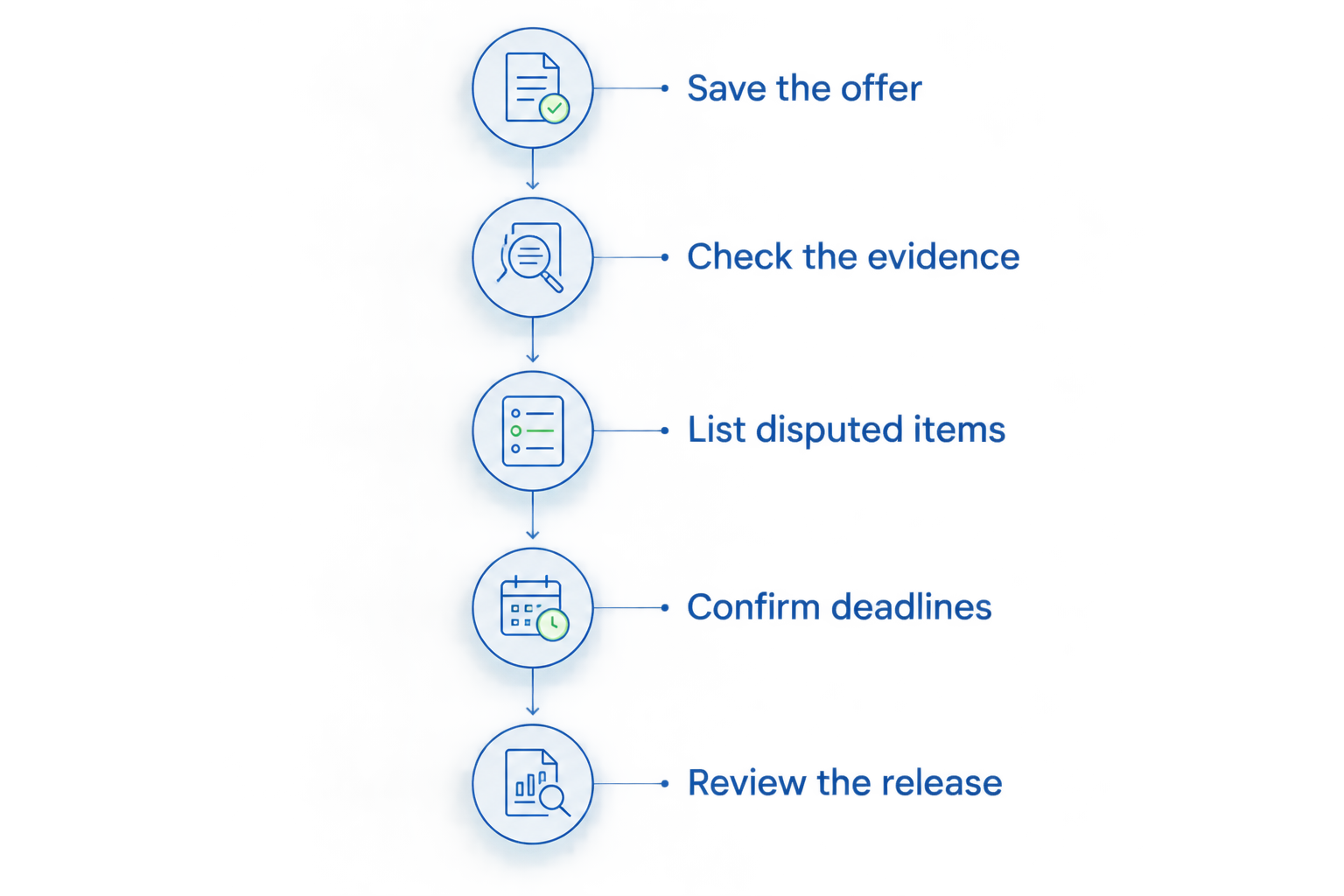
For an unresolved 2026 injury claim, the default move is to document the dispute before making a final decision. Use this sequence:
- Save the offer: Keep the written proposal, correspondence, and proposed release together.
- Check the evidence: Compare the evaluation with medical, income, collision, and payment records.
- List disputed items: Separate missing information from disagreements over fault or value.
- Confirm deadlines: Identify filing deadlines independently of ongoing negotiations.
- Review the release: Understand the claims, parties, and obligations covered before accepting.
As of 2026, California Code of Civil Procedure section 335.1 generally gives you 2 years to file a personal injury lawsuit. Section 338 generally provides 3 years for property-damage actions; Government Code section 911.2 generally requires an injury claim against a public entity within 6 months. Exceptions and claim-specific rules affect these deadlines, so do not use negotiations as your filing calendar.
Khachikyanlawfirm provides personal injury representation in Glendale. Bring the written offer and release when seeking advice about a disputed car accident settlement.
Discuss Your Settlement Offer
Ask about personal injury representation for your car accident claim.
FAQ
What's the clearest sign of a lowball car accident settlement offer?
An offer that omits documented accident-related losses without explanation deserves close review. Compare the evaluation with your records and request the reasoning behind each disputed omission.
Should I reject the first settlement offer automatically?
No, the first offer is not automatically unfair. Evaluate the evidence, release terms, applicable coverage, and unresolved losses before accepting or rejecting it.
Can I reopen my injury claim after signing a release?
Do not assume you can reopen a released injury claim. The agreement's wording and applicable law control, and exceptions require case-specific legal review.
Does California use a fixed pain-and-suffering multiplier?
No, California does not impose a universal multiplier for pain-and-suffering damages. The evidence and applicable legal rules determine how those damages are evaluated.
Can an insurer reduce my offer if I was partly at fault?
Yes, California comparative-fault rules allow damages to be reduced by your share of responsibility. Ask for the evidence supporting the proposed allocation rather than treating it as established.
Should I wait until treatment ends before discussing settlement?
You can discuss settlement while treatment continues, but unresolved medical needs require careful evaluation before a final release. Ask your treating provider about prognosis and supported future care.
Can Khachikyanlawfirm help with a disputed accident settlement?
Khachikyanlawfirm provides personal injury legal representation in Glendale, California. Contact the firm to discuss representation for your car accident claim and bring your offer, release, and supporting records.
One last thing
In 2026, the release deserves as much attention as the offer. Ask whether a proposed property-damage settlement also releases bodily injury claims; the document's actual wording matters more than its informal description.
This article provides general California legal information, not advice about your individual claim.