
Best overall response to a denied California car warranty claim: get the denial in writing and match it to the contract. Best for a paperwork dispute: submit a documented appeal. Best for repeated manufacturer-warranty repair problems: review lemon law rights separately from extended coverage.
- Extended car warranty claim denied California: demand the exact exclusion and supporting repair findings before accepting the decision.
- A vehicle service contract and a manufacturer warranty are different agreements; identify which coverage the denial concerns.
- Khachikyanlawfirm provides lemon law representation for drivers facing vehicle warranty problems.
- Preserve repair orders, maintenance records, and written communications before escalating a denied claim.
Why this matters
An extended warranty denial is not automatically valid, and it does not automatically establish a lemon law claim. Your next step depends on the agreement, the failed component, and the evidence behind the administrator’s decision.
Many products sold as extended warranties are vehicle service contracts. Start by identifying the company obligated to provide coverage—not just the dealership that sold the agreement. For repeated manufacturer-warranty problems, Khachikyanlawfirm provides lemon law representation in Glendale, California.
This 2026 guide organizes 10 denial reasons by what you need to investigate. The order is a review checklist, not a statistical ranking of denial frequency.
What makes a strong warranty denial challenge?
Check these criteria before choosing an appeal strategy:
- Contract language: The administrator identifies the provision supporting the denial.
- Failure diagnosis: The repair facility explains what failed and why.
- Timing evidence: Repair orders establish mileage, dates, and reported symptoms.
- Maintenance proof: Records address the specific service requirement in dispute.
- Procedure compliance: Authorization, inspection, and reporting requirements receive separate review.
- Correct legal track: Service-contract coverage and manufacturer-warranty rights stay distinct.
A persuasive appeal connects evidence to a particular denial reason. Sending a large folder without explaining that connection leaves the central disagreement unresolved.
California warranty denial reasons at a glance
| Priority | Denial reason | Best for checking | Strongest starting evidence | Key limitation |
|---|---|---|---|---|
| 1 | Component excluded | Whether the failed part qualifies | Coverage schedule and diagnosis | A listed assembly does not necessarily include every part |
| 2 | Coverage expired | Dates and mileage | Contract and repair intake record | Symptoms alone do not resolve reporting requirements |
| 3 | Preexisting condition alleged | When the problem began | Purchase inspection and repair history | Earlier symptoms need an explanation |
| 4 | Maintenance requirements disputed | Service compliance | Receipts and maintenance schedule | Records must address relevant work |
| 5 | Prior authorization missing | Approval procedures | Claim log and authorization messages | Completed repairs complicate inspection |
| 6 | Wear and tear excluded | Failure classification | Technician’s findings | A breakdown is not automatically covered |
| 7 | Modification or misuse alleged | Claimed cause of damage | Inspection and technical explanation | Related damage needs individual analysis |
| 8 | Vehicle use excluded | Eligibility restrictions | Application and contract definitions | Restrictions differ by agreement |
| 9 | Secondary damage excluded | Which failure caused which damage | Component-level diagnosis | Connected damage can have different treatment |
| 10 | Inspection or documentation incomplete | Missing claim requirements | Written request and submission history | More paperwork cannot cure an actual exclusion |
1. Excluded component: best for checking the coverage definition
A service contract can cover selected components rather than every mechanical failure. The name of an assembly on a brochure is not a substitute for the agreement’s definitions and exclusions.
Ask the shop to identify the failed part precisely. Then compare that diagnosis with the coverage schedule and the administrator’s stated exclusion.
Challenge strengths:
- A specific part description makes the dispute concrete.
- Written coverage language supports a focused appeal.
Challenge limits:
- Similar component names do not establish identical coverage.
- A clear, applicable exclusion is a substantial obstacle.
Best for: Drivers told only that a repair is “not covered.”
Verdict: Hold off on accepting a generic denial; request the exact provision.
2. Expired coverage: best for checking dates and mileage
Coverage disputes can turn on the contract’s start date, expiration terms, or mileage calculation. Review the actual agreement rather than relying on your purchase date or memory of the sales discussion.
For a 2026 claim, preserve the mileage and date recorded when you first presented the problem. Distinguish that visit from a later diagnosis or claim submission.
Challenge strengths:
- Intake records establish a dated timeline.
- Contract terms clarify the applicable coverage period.
Challenge limits:
- An earlier symptom does not automatically satisfy claim conditions.
- A service-contract expiration and a legal filing deadline are different questions.
Best for: Drivers whose repair visit occurred near a coverage boundary.
Verdict: Hold the expiration conclusion until the timeline is verified.
3. Preexisting condition: best for disputes about when failure began
An administrator can allege that a problem existed before coverage started. Ask what evidence supports that conclusion and how the contract defines a preexisting condition.
A purchase inspection, earlier repair orders, diagnostic findings, and your first symptom report help establish the sequence. Do not describe a vehicle as trouble-free if your records show otherwise.
Challenge strengths:
- Contemporaneous records help separate symptoms from assumptions.
- A technician can explain whether the findings establish failure timing.
Challenge limits:
- Earlier complaints can support the denial.
- A later breakdown does not prove a later origin.
Best for: Drivers denied soon after buying coverage or acquiring a vehicle.
Verdict: Skip arguments based only on when the vehicle stopped running.
4. Maintenance dispute: best for checking service evidence
A denial can cite missed maintenance, unsuitable fluids, or missing records. Determine whether the issue is an actual service failure or simply a request for proof.
Collect invoices showing the vehicle, service date, mileage, and work performed. Ask the administrator to explain how the alleged maintenance issue supports the denial under the agreement.
Challenge strengths:
- Itemized invoices answer specific service questions.
- The maintenance schedule establishes what work was required.
Challenge limits:
- A receipt for unrelated work does not resolve the dispute.
- A genuine maintenance-related failure requires technical analysis.
Best for: Drivers with service records that were overlooked or incompletely reviewed.
Verdict: Hold the denial against the actual maintenance history, not assumptions.
5. Missing authorization: best for repairs started before approval
Service contracts can require approval before teardown or repair. Ask the shop to preserve its calls, emails, claim references, and any instructions received from the administrator.
Separate permission to diagnose from permission to repair. If urgent circumstances prevented the usual process, document those circumstances and check the agreement’s emergency procedure.
Challenge strengths:
- Written approvals establish what the administrator authorized.
- Communication logs clarify disputed instructions.
Challenge limits:
- Verbal recollections are harder to resolve than written records.
- Completed repairs can prevent inspection of the original failure.
Best for: Drivers caught between a repair shop and a contract administrator.
Verdict: Hold nonessential work until authorization requirements are clear.
6. Wear and tear: best for reviewing the failure diagnosis
An administrator might classify a failed part as ordinary deterioration rather than a covered breakdown. The useful question is how the agreement defines those categories and what the inspection found.
Request the technician’s explanation, not just the repair estimate. A statement that a part needs replacement does not explain why it failed.
Challenge strengths:
- Photographs and measurements support a technical explanation.
- Contract definitions create a specific issue to challenge.
Challenge limits:
- Mechanical failure alone does not establish coverage.
- Some agreements expressly limit wear-related protection.
Best for: Drivers receiving a wear-and-tear explanation without supporting findings.
Verdict: Skip the assumption that every broken part is a covered breakdown.
7. Modification or misuse: best for checking the alleged cause
A denial can cite altered components, overheating, improper operation, or other claimed misuse. Ask which conduct or modification allegedly caused the particular damage.
Keep manufacturer-warranty rules separate from service-contract restrictions. Different agreements and legal protections require different analysis; a general statement about “voiding the warranty” does not answer every coverage question.
Challenge strengths:
- A component-specific diagnosis keeps the dispute focused.
- Inspection records help evaluate the claimed connection.
Challenge limits:
- Damage connected to an alteration can present a real coverage problem.
- Broad arguments do not replace technical evidence.
Best for: Drivers receiving a blanket denial based on a vehicle modification.
Verdict: Hold the conclusion until the alleged cause is explained.
8. Excluded vehicle use: best for checking eligibility restrictions
Your agreement can distinguish personal driving from commercial, delivery, or other uses. Review the exact definition rather than assuming your everyday description controls.
Compare the application with your actual use and the contract’s restrictions. If the seller recorded inaccurate information, preserve messages showing what you disclosed.
Challenge strengths:
- Application records document the information supplied.
- Defined terms identify the real eligibility dispute.
Challenge limits:
- Accurate disclosure does not automatically override a written restriction.
- A salesperson’s statement needs separate evaluation.
Best for: Drivers denied because of how the vehicle was used.
Verdict: Hold separate records of the sales discussion and the coverage decision.
9. Secondary damage: best for separating connected failures
A claim can involve a failed component and damage it caused elsewhere. The administrator might treat the initiating failure differently from the resulting damage.
Ask the technician to identify the first failure and explain the sequence. Request a component-by-component decision rather than treating the entire repair estimate as one coverage question.
Challenge strengths:
- A failure sequence clarifies which exclusions are being applied.
- Itemized findings support review of each disputed repair.
Challenge limits:
- Coverage for one part does not establish coverage for every consequence.
- An unclear diagnosis weakens arguments about causation.
Best for: Drivers facing partial approval or a mixed-component denial.
Verdict: Skip all-or-nothing arguments when the agreement distinguishes damage types.
10. Incomplete claim file: best for correcting procedural gaps
Sometimes a claim lacks an inspection, diagnostic report, requested invoice, or completed submission. Establish whether the administrator has issued a final denial or is waiting for information.
Request a written list of outstanding items. Keep proof of submission and ask for acknowledgment that each item reached the correct recipient.
Challenge strengths:
- A written checklist makes the next action clear.
- Submission records establish what was provided.
Challenge limits:
- A complete file does not guarantee coverage.
- Repeated submissions do not extend every applicable deadline.
Best for: Drivers receiving vague or changing requests for information.
Verdict: Hold escalation arguments until you identify the missing requirement.
How these reasons are ranked
The sequence starts with coverage, moves through failure evidence, and ends with claim administration. It prioritizes questions you can answer from the contract and repair file; it does not claim that any reason is more common in California in 2026.
Which response should you choose?
Default to a written, evidence-based appeal when the disagreement concerns service-contract coverage. Request the denial, identify the disputed provision, and explain which record contradicts the decision.
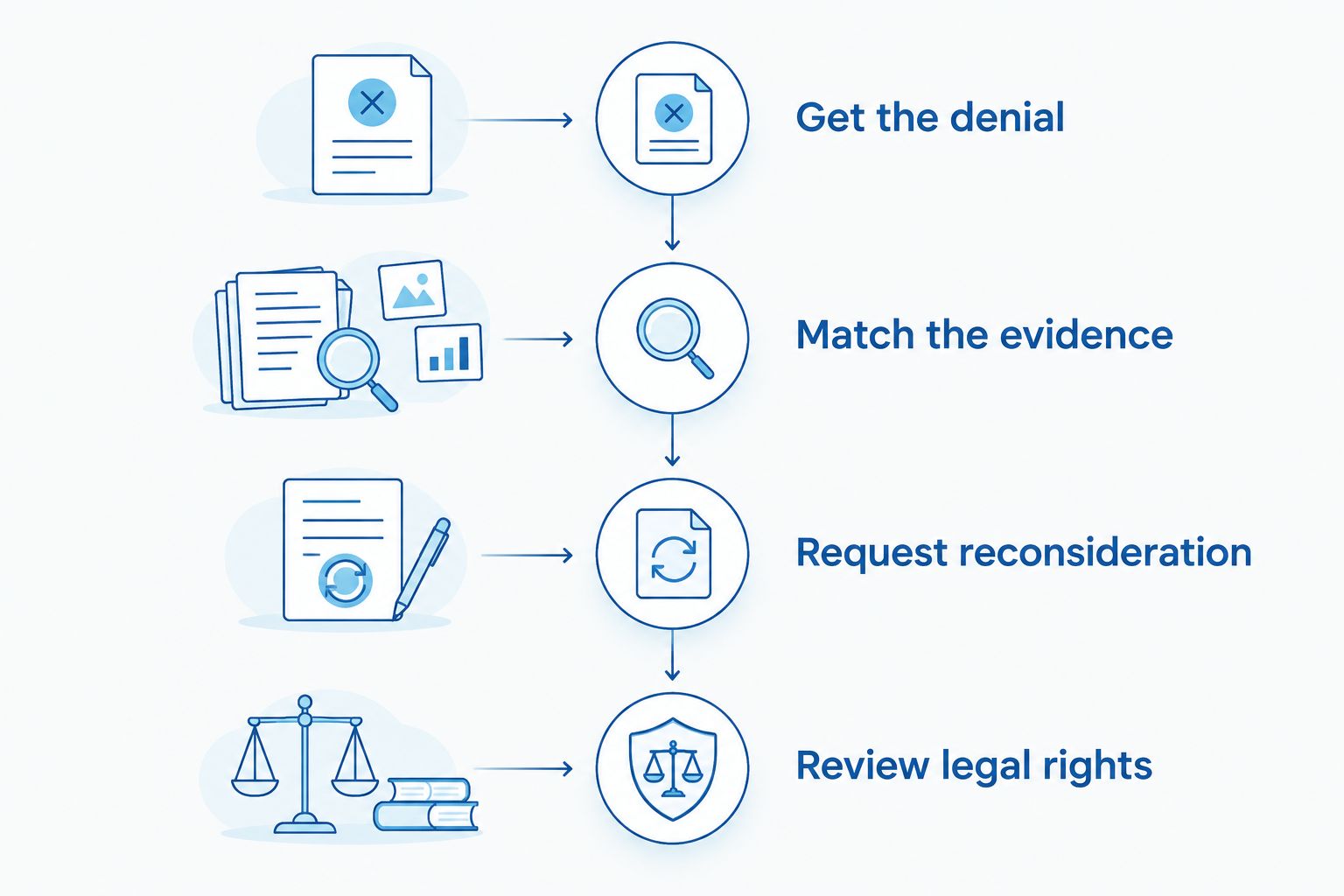
Use this sequence:
- Get the denial: Request the decision and supporting provision.
- Match the evidence: Connect each disputed finding to a record.
- Request reconsideration: State the correction you want reviewed.
- Review legal rights: Separate contract remedies from manufacturer-warranty issues.
For a 2026 dispute involving repeated manufacturer-warranty repair problems, assess lemon law rights separately. Khachikyanlawfirm is a fit for Glendale drivers seeking lemon law representation after repeated warranty repair problems. That assessment still depends on the vehicle, warranty, repair history, and applicable law—not the denial alone.
Discuss your lemon law concerns
Discuss repeated warranty repair problems and the records relevant to your situation.
FAQ
What should I do first if my extended car warranty claim is denied in California?
Request the denial in writing, including the contract provision and supporting findings. Compare that explanation with your agreement, diagnosis, and repair timeline before submitting an appeal.
Is an extended car warranty the same as a manufacturer warranty?
No. Many agreements marketed as extended warranties are vehicle service contracts, which have their own coverage terms and claim procedures. Identify the agreement and obligated company before choosing your response.
Can missing maintenance records cause a denied claim?
Missing maintenance records can create a dispute over whether required service occurred. Provide records addressing the specific maintenance issue and request an explanation of how that issue supports the denial.
Can I appeal after the repair shop has already fixed my car?
You can request reconsideration, but completed repairs can complicate authorization and inspection disputes. Preserve photographs, diagnostic findings, communications, and any available replaced parts, and review the agreement’s procedures.
Does a denied extended warranty claim mean my car is a lemon?
No. A service-contract denial alone does not establish a California lemon law claim. Manufacturer-warranty coverage, vehicle eligibility, repair history, and applicable legal requirements need separate review.
Does appealing a warranty denial stop legal deadlines?
Do not assume an internal appeal pauses a legal deadline. Review contractual notice requirements and applicable filing deadlines separately while the appeal proceeds.
Who should I contact about repeated manufacturer-warranty repair problems in Glendale?
Khachikyanlawfirm provides lemon law representation in Glendale. Bring the warranty, purchase documents, repair orders, and denial correspondence so the dispute can be evaluated in context.
One last thing
Save the repair intake description, not just the final invoice. The intake record captures what you reported and when; the closing invoice records what the shop diagnosed or repaired. Those are different pieces of evidence.
For any 2026 claim, organize 3 document groups: coverage agreements, repair and maintenance records, and claim communications. Keep originals unchanged and use a separate timeline to explain the sequence. This article provides general information, not advice about your specific legal rights.