
If your Toyota has been back to the dealer more than once for the same problem, you're not imagining it — California has a specific legal test for when a vehicle crosses from "unlucky" into "lemon," and several of the seven signs below are enough on their own to trigger it in 2026.
- Two or more repair attempts for a safety defect can qualify a Toyota as a lemon under California law.
- Four or more attempts for a non-safety defect, or 30+ cumulative days out of service, are also legal triggers in 2026.
- The defect generally has to appear while the Toyota is still under its factory warranty to count.
- Repair orders that repeat the same complaint are the strongest paper trail a lemon law case can have.
- Khachikyan Law Firm reviews Toyota repair histories in Glendale, CA to flag which of these signs your car already meets.
Why this matters
California's Song-Beverly Consumer Warranty Act doesn't require you to prove Toyota acted in bad faith. It requires you to show a pattern: the same nonconformity, repeated repair attempts, and a car that still doesn't work right.
Most Toyota owners don't realize how close their repair history already sits to that threshold. A transmission shudder fixed "three times" and a fourth visit still open, or three weeks in a loaner while parts are on backorder, can already meet the legal bar in 2026.
The signs below aren't ranked by severity. They're ranked by how much weight each one carries on its own when a lemon law attorney in Glendale, CA builds a buyback or replacement case.
What makes a Toyota a lemon under California law
- Repair attempt count — 2+ for a safety defect, 4+ for anything else, on the same problem
- Cumulative days out of service — 30 or more days total, not necessarily in a row
- Timing — the defect showed up while the factory warranty was active
- Impact — the problem affects safety, value, or the car's basic use
- Documentation — each repair order lists the same complaint, not a new one every time
- Persistence — the dealer or Toyota still hasn't fixed the root cause
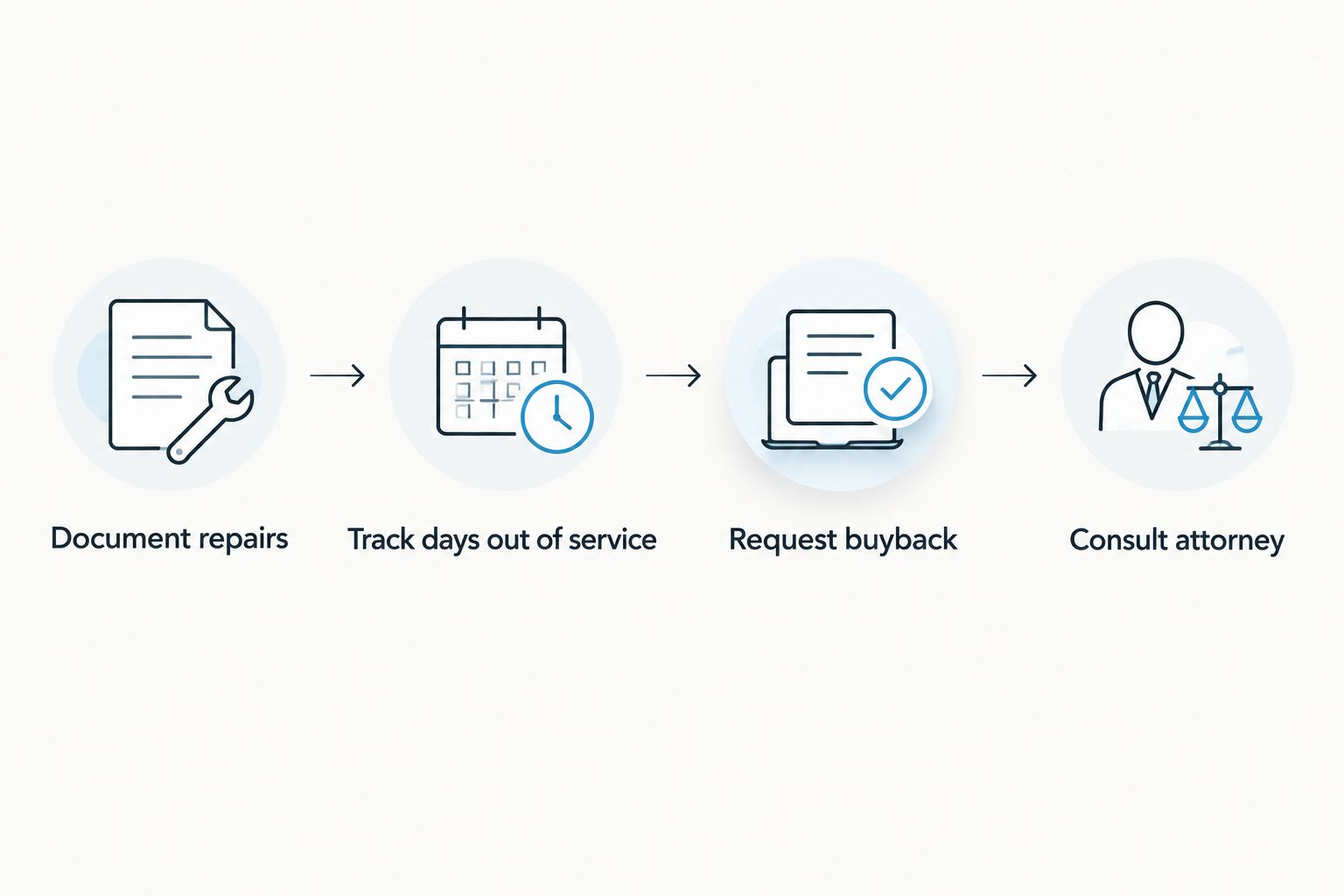
At a glance: the 7 signs ranked by strength
| Sign | Strength as evidence | What it means | Next step |
|---|---|---|---|
| 2+ repairs for a safety defect | Strong on its own | Legal presumption can apply immediately | Pull all repair orders |
| 4+ repairs for a non-safety defect | Strong on its own | Same presumption, higher attempt count | Confirm each order names the same issue |
| 30+ days out of service | Strong on its own | Counts even across multiple visits | Add up loaner and shop days |
| Defect during factory warranty | Required, not standalone | Sets the clock for everything else | Check warranty start date |
| Impairs use, value, or safety | Strengthens a claim | Shows the defect isn't cosmetic | Note how it affects daily driving |
| Repeated identical complaint on repair orders | Strengthens a claim | Builds the paper trail | Request copies from the dealer |
| Dealer can't identify root cause | Supporting evidence | Suggests the fix isn't coming | Ask for a written diagnosis each visit |
1. The same safety defect needed two or more repair attempts
Under California Civil Code section 1793.22, a defect "likely to cause death or serious bodily injury" only needs two repair attempts before the presumption kicks in. Brake failures, steering loss, and airbag or electrical faults that could disable safety systems all fall into this category.
- This is the fastest path to a qualifying case for a Toyota
- The defect must be the same issue both times, not two unrelated complaints
- Toyota safety recalls that keep recurring after service strengthen this sign further
Verdict: Strong sign — pull repair records and contact an attorney now.
2. The same non-safety defect needed four or more repair attempts
Most lemon law claims run through this door. Infotainment failures, persistent check-engine lights, transmission hesitation, or AC systems that keep failing all count once the dealer has tried and failed four separate times.
- Each visit needs its own repair order referencing the identical complaint
- A fifth or sixth attempt doesn't weaken the case — it strengthens it
- Attempts made after the warranty expired generally don't count toward the total
Verdict: Strong sign — this is the most common qualifying pattern in 2026.
3. Your Toyota has been out of service 30 or more cumulative days
This threshold doesn't require the days to be consecutive. Three separate repair visits of ten days each add up the same as one 30-day stretch, and loaner-car time typically counts.
- Add up every day the car sat at the dealer, not just the repair date
- Parts on backorder still count against the manufacturer
- This sign often applies even when the individual repair-attempt counts above haven't been hit yet
Verdict: Strong sign — total your service records before assuming you don't qualify.
4. The defect showed up while the Toyota was still under factory warranty
Toyota's New Vehicle Limited Warranty generally covers most components for 3 years or 36,000 miles, whichever comes first. A defect that first appeared during that window keeps the case alive even if the warranty has since expired.
- The first reported symptom date matters more than today's date
- Powertrain coverage on Toyota vehicles typically runs longer than bumper-to-bumper coverage
- A defect that first appeared after warranty expiration is much harder to pursue
Verdict: Supporting sign — confirm the timeline before building on the other six.
5. The problem substantially impairs use, value, or safety
A rattling trim panel is an annoyance. A transmission that hesitates in traffic, an engine that stalls at low speed, or a defect that tanks the car's resale value is different in the eyes of the law.
- "Substantial impairment" is judged from a reasonable buyer's perspective, not just yours
- A defect that would make a buyer walk away from a purchase counts as impairing value
- Cosmetic issues alone rarely meet this bar without a functional problem attached
Verdict: Strengthens a claim — pair it with the repair-attempt signs above.
6. Dealer repair orders describe the same complaint every visit
This is the sign most owners overlook until it's too late. If one repair order says "transmission shudder" and the next says "customer states vehicle feels rough," a manufacturer can argue those are different complaints.
- Ask the service advisor to write the complaint in the same terms each visit
- Keep copies of every repair order — don't rely on the dealer's file
- Photos and dated notes of the symptom recurring fill gaps in vague paperwork
Verdict: Strengthens a claim — this is the paperwork that wins or loses a case.
7. Toyota or the dealer still can't identify or fix the root cause
When a service department keeps replacing parts without a diagnosis, or closes a repair order as "could not duplicate" more than once, that pattern itself becomes evidence.
- "Could not duplicate" entries still count as a repair attempt if you brought the car in for a real symptom
- Repeated part swaps without resolution point to an unresolved defect, not a fixed one
- This sign rarely stands alone but confirms the ones above it
Verdict: Supporting sign — combine it with the attempt count or days-out-of-service total.
Find out if your Toyota qualifies
Free case review with Khachikyan Law Firm in Glendale, CA.
How these signs were ranked
The three "strong" signs — safety-defect repair attempts, non-safety repair attempts, and cumulative days out of service — map directly to the statutory presumption in Civil Code section 1793.22. The remaining four signs don't trigger the presumption alone but decide whether a case holds up once it's filed. A Toyota can meet the letter of the law and still lose a case with weak documentation, which is why signs 4, 5, 6, and 7 matter as much as the count itself.
Which sign means it's time to call a lemon law attorney?
If your Toyota has hit two repair attempts for a safety issue, four for anything else, or 30 cumulative days in the shop, you likely already qualify under California law in 2026 — the remaining signs mostly determine how strong the paperwork is once you file. Pull every repair order before you call anyone, and don't accept a verbal "we couldn't find anything" without it written down. A lemon law attorney in Glendale, CA can tell you within one review which of these seven signs your case already meets.
FAQ
How many repair attempts qualify a Toyota as a lemon in California?
Two attempts for a defect likely to cause death or serious injury, or four attempts for any other defect that substantially impairs use, value, or safety. Both thresholds require the attempts to address the same underlying problem.
Does the defect have to happen while the car is under warranty?
Yes, the nonconformity generally needs to appear during Toyota's factory warranty period. Repair attempts made after the warranty expires typically don't count toward the presumption.
What counts as 'days out of service' under California lemon law?
Any cumulative day the vehicle was at the dealer for repair, including days waiting on backordered parts. The 30-day total doesn't need to happen in one continuous visit.
Can a Toyota still qualify if repair orders use different wording each visit?
It's harder to prove but not impossible. Consistent documentation strengthens the case significantly, which is why asking the service advisor to record the same complaint each time matters.
Is a rattling noise or cosmetic issue enough to qualify?
Usually not on its own. The defect needs to substantially impair use, value, or safety, and a purely cosmetic issue rarely meets that bar without an attached functional problem.
What if Toyota says 'could not duplicate' the problem?
A 'could not duplicate' entry on a repair order still typically counts as a repair attempt if you brought the car in for a documented symptom. Repeated instances of this can actually support a case.
Does leasing a Toyota change lemon law eligibility?
No, California's lemon law generally applies to leased vehicles the same way it applies to purchased ones, as long as the vehicle is covered by a manufacturer's warranty.
How much does a lemon law attorney cost in California?
Fee structures vary by firm and case type, and manufacturers often cover attorney fees in successful claims under the Song-Beverly Act. Reviewing the specifics with an attorney is the only way to know your exposure.
One last thing
The sign owners miss most often isn't a big mechanical failure — it's the paperwork gap between visits. A Toyota that's been in the shop five times for "a noise" with five differently worded complaints looks weaker on paper than one with two visits that both say the same thing. Before you assume your car doesn't qualify, gather every repair order first. The count often surprises people.