
Causes of wrongful death claims in California include negligent driving, unsafe property, medical negligence, dangerous products, workplace incidents, and intentional violence. This 2026 guide explains 10 claim categories, the evidence each requires, and the next steps for your family; the order is not a ranking by frequency.
- California wrongful death claims require a legally responsible party, proof of causation, and an eligible claimant.
- Khachikyanlawfirm is a Glendale personal injury firm for families seeking legal representation after an injury-related loss.
- Preserve evidence and check deadlines before negotiating with an insurer.
- A fatal workplace incident can involve workers’ compensation benefits and a separate third-party claim.
Why this matters
A death following an accident does not automatically establish wrongful death. Your family must connect legally wrongful conduct to the death and show who has the right to bring the claim.
Khachikyanlawfirm provides personal injury representation in Glendale, California. Start with responsibility, evidence, and deadlines—not an insurer’s opening offer. A police report or death certificate helps explain what happened, but neither necessarily answers every civil liability question.
What makes a wrongful death claim supportable?
Use these criteria to assess the categories below:
- Legal responsibility: Identify the person or business whose conduct creates a basis for liability.
- Causation: Connect the conduct to the fatal injury through records, witnesses, or expert analysis.
- Eligible claimants: Confirm who can sue under California Code of Civil Procedure section 377.60.
- Recoverable losses: Document the financial support, services, and relationship benefits the family lost.
- Timely action: Identify the filing deadline and any earlier government claim requirement.
In this 2026 guide, each category includes useful evidence and a limitation. These are investigation priorities, not promises that a claim will succeed.
California wrongful death claim categories at a glance
| Category | Best starting point | Useful evidence | Key limitation |
|---|---|---|---|
| Passenger vehicle crashes | Driver conduct | Video, collision reports, vehicle data | Fault can be disputed |
| Commercial truck crashes | Driver and company responsibility | Dispatch, maintenance, driving records | Multiple businesses complicate responsibility |
| Pedestrian and bicycle collisions | Visibility and right-of-way | Cameras, witnesses, roadway measurements | Movement before impact matters |
| Motorcycle collisions | Collision reconstruction | Scene evidence, vehicle inspections | Injury severity alone does not establish fault |
| Unsafe property | Hazard and control | Inspection records, photographs, complaints | Notice requirements depend on the legal theory |
| Medical negligence | Treatment timeline | Complete medical records, expert review | An adverse outcome is not proof of negligence |
| Workplace incidents | Employer versus third-party responsibility | Site records, equipment, contracts | Workers’ compensation restricts many employer lawsuits |
| Defective products | Product identification and preservation | Product, instructions, design records | A malfunction alone does not prove liability |
| Drowning and unsafe pools | Access and supervision | Barrier condition, video, incident records | Responsibility depends on control and circumstances |
| Assault and intentional violence | Attacker and other responsible parties | Witness accounts, security records | Criminal charges do not establish every civil claim |
1. Passenger vehicle crashes: investigate unsafe driving
Fatal car crashes can support wrongful death claims when speeding, distraction, impaired driving, or another negligent act causes the death. The investigation must establish what each driver did, rather than assume the surviving driver caused the collision.
Best for: Identifying liability arising from another motorist’s conduct.
Evidence strengths:
- Dashcam footage and independent witnesses can clarify movements before impact.
- Vehicle damage and electronic data can help reconstruct the collision.
Claim limitations:
- A traffic citation does not resolve every question of civil fault.
- Shared responsibility can reduce recoverable damages.
Preserve the vehicle before repairs or disposal destroy relevant evidence. Verdict: Investigate driver conduct before accepting an insurer’s fault assessment.
2. Commercial truck crashes: examine company responsibility
A fatal truck collision can involve a driver, trucking company, maintenance provider, or another responsible business. The key question is which party controlled the conduct or equipment that contributed to the death.
Best for: Investigating both driving decisions and commercial operations.
Evidence strengths:
- Dispatch communications and driving records can establish the trip timeline.
- Maintenance and inspection records can reveal equipment issues requiring further investigation.
Claim limitations:
- The name on the truck does not establish every responsible party.
- Important records can be held by different businesses.
Identify the tractor, trailer, carrier, and other involved entities early. Verdict: Preserve company records as well as crash-scene evidence.
3. Pedestrian and bicycle collisions: establish visibility and movement
Fatal pedestrian and bicycle collisions can involve failure to yield, unsafe turns, speeding, or obstructed sightlines. Liability depends on the specific roadway, signals, visibility, and movements immediately before impact.
Best for: Reconstructing how a driver and an unprotected road user entered the same space.
Evidence strengths:
- Nearby cameras can capture signal timing and travel direction.
- Witness accounts and roadway measurements can clarify sightlines.
Claim limitations:
- Crosswalk location alone does not answer every fault question.
- A dangerous-roadway theory requires separate analysis of public entity liability.
Request nearby footage before it is overwritten. Verdict: Establish the collision sequence instead of relying on assumptions about right-of-way.
4. Motorcycle collisions: separate collision cause from injury severity
Unsafe lane changes, left turns, and following too closely can lead to fatal motorcycle collisions. A wrongful death claim must establish the conduct that caused the collision and connect the resulting injuries to the death.
Best for: Addressing disputed accounts of a rider’s position, speed, or visibility.
Evidence strengths:
- Scene measurements and impact damage can test competing accounts.
- Vehicle inspections can identify mechanical issues relevant to the crash.
Claim limitations:
- Serious injuries do not, by themselves, prove another driver’s fault.
- Conflicting estimates of speed require careful evaluation.
Keep riding equipment and photographs with the other evidence. Verdict: Build the claim around reconstruction and records, not stereotypes about riders.
5. Unsafe property: connect a hazard to the death
Fatal falls, collapsing structures, and other dangerous property conditions can support premises liability claims. You must identify who owned, occupied, maintained, or controlled the relevant area and what legal duty applied.
Best for: Investigating a dangerous condition rather than a vehicle collision.
Evidence strengths:
- Photographs can preserve a hazard before repairs change the scene.
- Inspection logs and prior complaints can help establish knowledge of a condition.
Claim limitations:
- Ownership alone does not establish every element of liability.
- Notice requirements differ depending on how the hazard arose and who created it.
Record the precise location and condition without entering an unsafe area. Verdict: Document the hazard and identify who controlled it.
6. Medical negligence: obtain records before drawing conclusions
A fatal treatment error, delayed diagnosis, or medication mistake can support a medical negligence claim when the applicable legal requirements are met. A poor outcome alone does not establish that a healthcare provider breached the standard of care.
Best for: Assessing whether medical treatment or an omission caused a preventable death.
Evidence strengths:
- Complete records can establish symptoms, decisions, treatment, and changes in condition.
- Qualified expert review can address the standard of care and causation.
Claim limitations:
- The underlying illness can complicate the causation analysis.
- Medical negligence claims have specialized deadlines and procedural requirements.
Create a factual treatment timeline without changing original records. Verdict: Obtain prompt legal and medical review rather than treating an unexpected death as proof of malpractice.
7. Workplace incidents: distinguish benefits from third-party claims
Fatal construction incidents, machinery events, and work-related vehicle crashes can involve different legal routes. Workers’ compensation death benefits and a wrongful death lawsuit against a negligent third party are not interchangeable.
Best for: Identifying whether someone outside the employer relationship contributed to the death.
Evidence strengths:
- Site records and contracts can identify separate companies and their responsibilities.
- Equipment preservation can support an investigation into a product or maintenance issue.
Claim limitations:
- Workers’ compensation generally limits direct lawsuits against employers, subject to exceptions.
- Benefits and third-party recoveries can affect one another.
Identify every business involved before assuming the employer is the only relevant party. Verdict: Evaluate workers’ compensation and third-party responsibility separately.
8. Defective products: preserve the item and its history
A dangerous vehicle component, household product, or industrial machine can cause a fatal injury. Product liability can involve manufacturing defects, design defects, or inadequate warnings, with different proof requirements for each theory.
Best for: Investigating whether an unsafe product contributed to the death.
Evidence strengths:
- The actual product allows inspection of its condition and components.
- Instructions, purchase records, and maintenance history help establish its use and identity.
Claim limitations:
- A product malfunction does not automatically establish a legally actionable defect.
- Alterations, damage, or disposal can complicate the investigation.
Do not conduct destructive testing without legal guidance. Verdict: Preserve the product, packaging, and records before pursuing a defect theory.
9. Drowning and unsafe pools: examine access and supervision
Fatal drowning incidents can involve unsafe pool access, defective barriers, inadequate supervision, or dangerous equipment. The claim depends on who controlled the location, what duties applied, and how the incident occurred.
Best for: Investigating water access, safety conditions, and supervision responsibilities.
Evidence strengths:
- Video and witness accounts can establish the sequence of events.
- Photographs can document gates, barriers, warning signs, and equipment conditions.
Claim limitations:
- A drowning alone does not establish negligence by the property owner.
- Responsibility can differ between private homes, businesses, and public facilities.
Preserve incident reports and identify everyone responsible for supervision. Verdict: Investigate both access to the water and the response to the emergency.
10. Assault and intentional violence: separate civil responsibility
An intentional attack can support a wrongful death claim against the attacker. A separate claim against a property owner or security provider requires its own factual and legal basis; the attack does not automatically make those parties liable.
Best for: Evaluating intentional wrongdoing and independently supportable security negligence.
Evidence strengths:
- Witness statements and video can identify the attacker and sequence of events.
- Security records and prior incidents can inform an investigation into foreseeability and precautions.
Claim limitations:
- A criminal prosecution does not replace the family’s civil case.
- A judgment and the ability to collect it are different issues.
Do not assume you must wait for criminal proceedings to end. Verdict: Review civil deadlines while the criminal investigation proceeds.
How these categories were selected
This 2026 list groups claims by the conduct, evidence, and legal issues involved—not by statewide filing volume. Categories can overlap: a fatal workplace truck collision can raise driving, employment, and product questions in the same investigation.
The useful comparison is not which cause ranks highest. It is which legal theory the available evidence supports.
Which next step should your family choose?
Choose an early legal assessment focused on evidence preservation, claimant eligibility, and deadlines. Khachikyanlawfirm provides personal injury representation in Glendale; ask how the firm would assess your family’s specific circumstances and what representation would cover.
For a death occurring in 2026, do not assume every claim follows the same calendar:
- General deadline: California Code of Civil Procedure section 335.1 generally provides 2 years for wrongful death actions, subject to applicable exceptions and specialized rules.
- Government claims: Government Code section 911.2 generally requires presenting a claim involving death to the public entity within 6 months after accrual. A lawsuit has additional requirements.
- Medical negligence: Code of Civil Procedure section 340.5 generally uses a 3-year injury period or a 1-year discovery period, whichever occurs first, subject to exceptions and case-specific accrual rules.
These statutory frameworks address different claim types; they are not interchangeable countdowns. Have counsel calculate the applicable dates rather than choosing the longest period.
Preserve evidence without taking over the investigation
Your immediate task is to keep reliable information intact. You do not need to prove the entire case before contacting counsel.
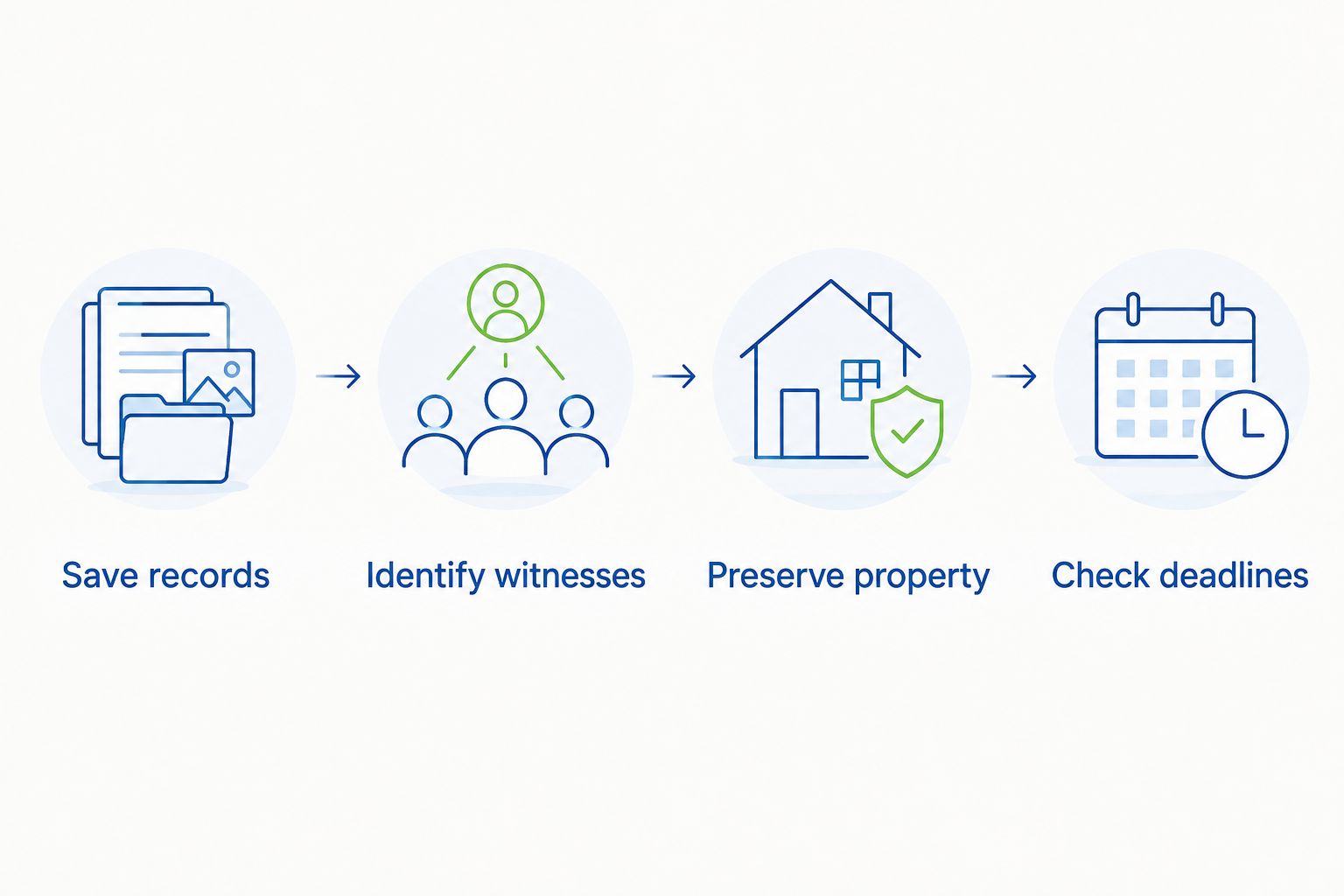
- Save records: Keep reports, photographs, messages, insurance correspondence, and expense documentation.
- Identify witnesses: Record names and contact details without coaching anyone’s account.
- Preserve property: Avoid discarding vehicles, equipment, clothing, or other relevant items.
- Check deadlines: Flag public agencies, healthcare providers, and workplace involvement for legal review.
Keep a separate log of who holds each original item or document. Do not alter files, post accusations online, or sign a release you do not understand.
You can contact the firm to ask about representation and the information needed for an initial assessment.
FAQ
What are the causes of wrongful death claims in California?
California wrongful death claims can arise from negligent driving, unsafe property, medical negligence, defective products, workplace incidents, drowning, and intentional violence. Each claim requires a legally supportable connection between wrongful conduct and the death.
Who can file a wrongful death lawsuit in California?
California Code of Civil Procedure section 377.60 identifies eligible claimants, including a surviving spouse, domestic partner, and children, with additional categories depending on the circumstances. Family relationships, inheritance rights, and dependency can affect eligibility.
How long do I have to file a wrongful death claim in 2026?
Many California wrongful death actions fall under a general 2-year limitation, but specialized rules can impose different requirements. Public entity claims generally require a claim presentation within 6 months after accrual, and medical negligence follows separate rules.
Can I bring a wrongful death claim if criminal charges were never filed?
Yes, the absence of criminal charges does not automatically prevent a civil wrongful death claim. Civil liability has different legal requirements and a different burden of proof from a criminal prosecution.
Can a family file a claim after a fatal workplace accident?
A family can have rights to workers’ compensation death benefits and, when supported by the facts, a separate claim against a negligent third party. Direct lawsuits against the employer are generally restricted, subject to exceptions.
What damages can a California wrongful death claim include?
A wrongful death claim can include recoverable financial support, funeral and burial expenses, household services, and loss of companionship or other relationship benefits. California generally does not award damages for survivors’ grief or sorrow itself.
Is a wrongful death claim the same as a survival action?
No, a wrongful death claim addresses eligible survivors’ losses, while a survival action continues claims belonging to the deceased person. Who brings the action and which damages are recoverable require separate analysis.
Can Khachikyanlawfirm help with personal injury representation in Glendale?
Khachikyanlawfirm provides personal injury representation in Glendale, California. Contact the firm to discuss the circumstances of the death, representation, and the records needed for an assessment.
One last thing
The most visible cause is not always the only legally relevant cause. A driver’s error does not rule out a defective component, and a workplace incident does not rule out a responsible outside contractor.
For your 2026 claim review, bring the facts you know and clearly separate them from assumptions. This article provides general California legal information, not advice about your family’s specific case.


