
You generally have 2 years from the date of death to file a wrongful death lawsuit in California under Code of Civil Procedure section 335.1. In 2026, that general rule does not replace shorter requirements: a claim against a California public entity generally requires a government claim within 6 months, and medical-negligence cases follow separate timing rules.
- Wrongful death claim deadline California: generally 2 years from death to file a lawsuit, not merely notify an insurer.
- California public-entity cases generally require a government claim within 6 months of accrual.
- Medical-negligence deaths require a separate deadline analysis under Code of Civil Procedure section 340.5.
- Khachikyan Law Firm provides personal injury representation in Glendale; request a review before relying on the general deadline.
Why this matters
An insurance claim is not a court filing. Calling an adjuster, sending medical records, or discussing a settlement does not by itself satisfy the deadline for filing a wrongful death lawsuit.
Khachikyan Law Firm is a fit for Glendale families seeking personal injury representation. Before you focus on compensation, identify the defendant, the type of claim, and the earliest required filing; those details determine which deadline needs attention first.
How long do I have to file a wrongful death claim in California?
The general California wrongful death filing deadline is 2 years from the date of death, under Code of Civil Procedure section 335.1. That is the starting point for an ordinary negligence case, not a universal deadline for every death-related claim.
Use this 2026 comparison to identify the first timing issue to investigate. Each category has procedural requirements beyond the period shown.
| Type of case | General timing rule | What you must distinguish |
|---|---|---|
| Ordinary negligence against a private defendant | Generally 2 years from death | Filing a lawsuit versus opening an insurance claim |
| Claim against a California public entity | Generally present a government claim within 6 months of accrual | The initial government claim versus the later lawsuit |
| Death involving professional medical negligence | Section 340.5 generally uses a 1-year discovery period and a 3-year outside period, subject to exceptions | Medical-negligence accrual, discovery, and notice requirements |
These are different legal routes, not options you select for convenience. A collision involving a private driver and a public employee can require more than one deadline analysis.
Your safest planning date is the earliest applicable deadline, not the longest period in the table. A lawyer must connect the legal rule to the actual facts before giving you a filing date.
Ordinary negligence: generally 2 years from death
Code of Civil Procedure section 335.1 covers an action for death caused by another person's wrongful act or neglect. In an ordinary wrongful death case, the limitations period generally starts when the person dies, rather than when the family finishes collecting records.
That distinction matters when an injured person survives for a time after an accident. The accident date and death date belong on separate lines in your timeline; they are not interchangeable.
The general rule gives you a clear starting point. Its limitation is that it does not resolve public-entity requirements, medical negligence, disputed discovery, or other exceptions.
For an ordinary private-defendant case in 2026, gather the death certificate and incident records first. Do not treat the time remaining as a reason to delay preserving evidence or identifying everyone responsible.
Public-entity claims: generally 6 months to present a claim
California Government Code section 911.2 generally requires a claim relating to death or personal injury to be presented to the public entity within 6 months after accrual. This is a separate administrative step, usually required before filing a lawsuit against that entity.
A city vehicle, a dangerous public-road condition, or treatment involving a public facility raises a question about government involvement. Ownership, employment, and the legal status of the defendant need checking; a location or business name alone does not settle that question.
If the entity sends a legally sufficient written rejection, Government Code section 945.6 generally gives you 6 months from personal delivery or mailing of that notice to file suit. Keep the notice and its envelope, because the mailing date can matter.
The government-claim process identifies a route for presenting the claim, but it adds an earlier procedural hurdle. Do not wait for the ordinary 2-year anniversary to investigate a public defendant.
A late-claim application is available in some circumstances under Government Code sections 911.4 and 911.6. Relief is not automatic, and additional deadlines apply; get legal advice immediately if the initial period has passed.
Medical negligence: a separate 1-year discovery rule
Code of Civil Procedure section 340.5 generally requires a professional-negligence action against a health care provider within 1 year after discovery, or reasonable discovery, of the injury, or 3 years after injury, whichever occurs first, subject to statutory exceptions. Applying that rule to a death requires a case-specific analysis of accrual and discovery.
Do not automatically count from the treatment date, the date you received records, or the date another physician expressed concern. A court examines when the relevant injury and suspected wrongdoing were discovered or reasonably should have been discovered.
Medical-negligence cases also carry a pre-suit notice requirement under Code of Civil Procedure section 364. The statute generally requires 90 days' notice before commencing the action and contains a timing provision for notice served near the limitations deadline.
Do not calculate a medical wrongful death deadline by adding 2 years to the death certificate. The discovery rule, outside limit, notice requirement, and any public-provider involvement must be reviewed together.
Why the wrongful death filing deadline varies
For a 2026 deadline review, the most useful facts are the ones that identify the governing statute and its starting point. Bring these issues to the first legal conversation:
- Defendant identity: A private person, public entity, and health care provider can trigger different rules.
- Date of death: This generally starts the ordinary wrongful death limitations period.
- Discovery of wrongdoing: Delayed discovery can affect accrual in qualifying cases, but learning more later does not automatically restart the clock.
- Government notices: Claim presentation and a written rejection can create deadlines separate from the ordinary civil filing period.
- Related claims: A wrongful death action and an estate's survival action are distinct and require separate review.
- Potential exceptions: Minority, concealment, and other claimed tolling grounds require legal analysis rather than an assumed extension.
These factors do not give every family extra time. They explain why a single online deadline cannot replace an assessment of the incident, defendants, and documents.
What should I do now to protect the filing deadline?
Start with records you already have. You do not need a complete investigation before asking a lawyer to identify an urgent deadline.
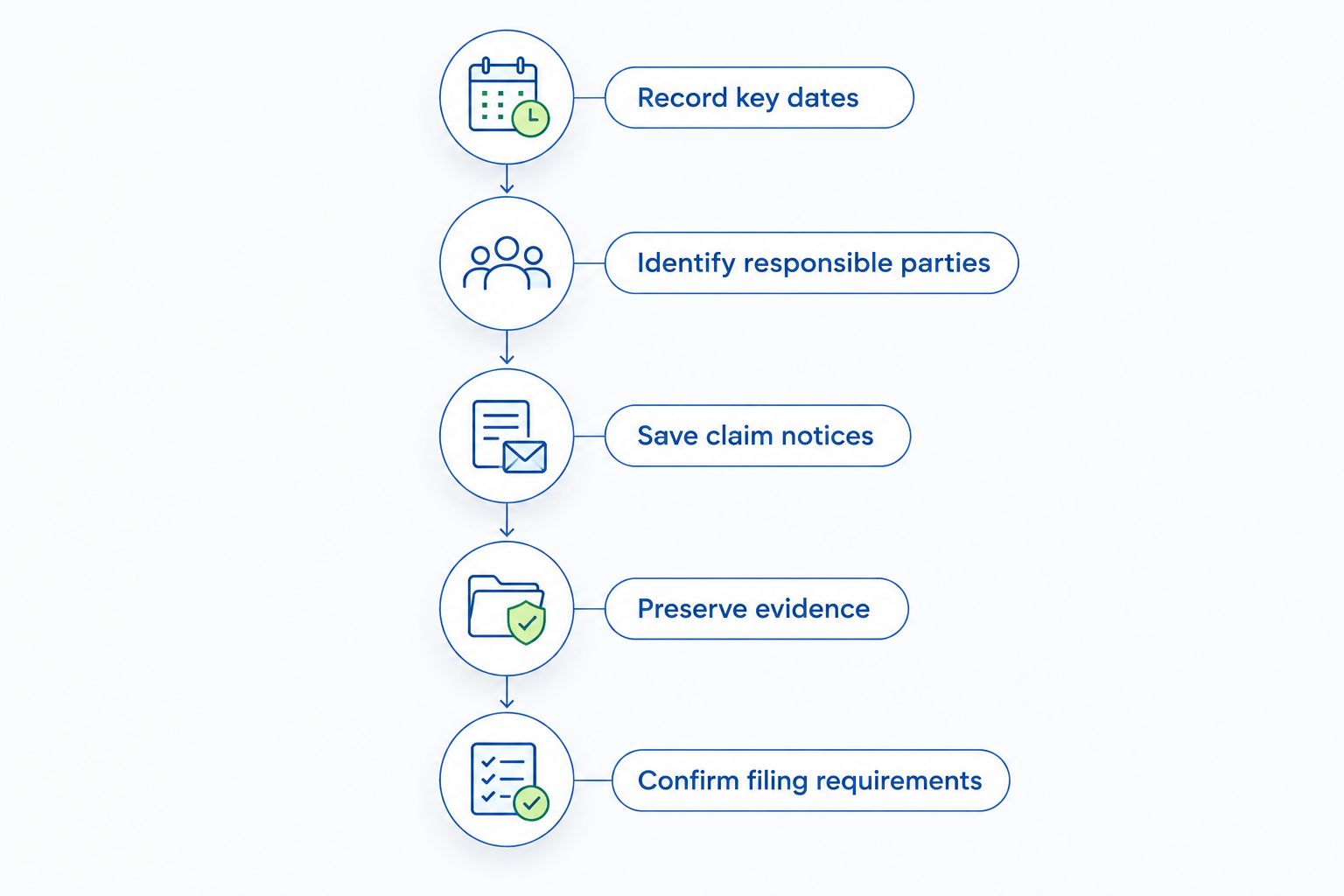
- Record key dates. Write down the incident date, death date, dates of relevant treatment, and when you first suspected wrongdoing. Separate confirmed dates from estimates.
- Identify responsible parties. List drivers, employers, property owners, treating providers, and any public agency connected to the event. Keep the underlying records rather than relying on memory.
- Save claim notices. Preserve government correspondence, rejection letters, envelopes, insurance communications, and any documents showing delivery or mailing.
- Preserve evidence. Keep photographs, witness details, medical records, funeral records, and financial-support documents. Ask a lawyer about evidence held by someone else.
- Confirm filing requirements. Have counsel identify the applicable deadlines, eligible claimants, required notices, and the court filing needed to preserve the case.
Keep a written record of who is handling each required filing. Collecting documents, retaining a lawyer, and filing a complaint are separate events; do not assume one means the others have happened.
Khachikyan Law Firm provides personal injury representation in Glendale. You can contact the firm to request a review of the incident and its filing requirements; ask specifically which deadlines apply and what documents are needed next.
Does filing an insurance claim stop the 2-year deadline?
The 2-year deadline generally continues while you negotiate with an insurer. An insurance claim number, a demand letter, or an adjuster's request for more information is not a substitute for filing a lawsuit.
An exception such as equitable estoppel requires specific facts and legal analysis. Do not plan around an extension unless your lawyer has confirmed its legal basis.
Can I still file if more than 2 years have passed?
More than 2 years after death does not support a safe yes-or-no answer without reviewing the facts. Delayed discovery or another exception can affect some cases, but grief, ongoing negotiations, or unfinished paperwork alone should not be treated as an extension.
Get an immediate review rather than abandoning the claim or assuming it remains timely. A public-entity claim also needs its own analysis because its earlier presentation deadline can create a separate barrier.
Does a child's wrongful death claim get extra time?
The general 2-year rule does not tell you whether a child's claim receives additional time. Minority can affect limitations analysis, but government-claim requirements and medical-negligence rules create important complications.
Do not wait until a child turns 18 to investigate. Identify every potential claimant and defendant promptly, and have counsel determine which rules apply to each claim.
Who files: the family or the estate?
California Code of Civil Procedure section 377.60 identifies who can bring a wrongful death action. A surviving spouse, domestic partner, children, and other qualifying people can have rights under the statute; being a relative does not automatically establish eligibility.
A wrongful death claim addresses qualifying survivors' losses from the death. A survival action, governed by separate provisions including section 377.30, continues a claim the deceased person held before death.
Do not assume an estate filing preserves the family's wrongful death claim, or vice versa. Both need review when the deceased person suffered injuries before dying, and claimants must be identified before the complaint is prepared.
Legal sources for this 2026 deadline guide
The ordinary wrongful death period comes from California Code of Civil Procedure section 335.1. Government Code sections 911.2 and 945.6 address public-entity claim presentation and lawsuit timing; sections 911.4 and 911.6 address late-claim applications.
Code of Civil Procedure sections 340.5 and 364 govern the medical-negligence timing and notice issues summarized here. Sections 377.60 and 377.30 distinguish wrongful death eligibility from survival actions.
These statewide statutes provide the framework for this 2026 guide. Court decisions, statutory exceptions, and the facts of a particular case determine their application; this article provides general information, not a deadline calculation or an attorney-client relationship.
FAQ
What's the wrongful death claim deadline in California in 2026?
The general California wrongful death lawsuit deadline is 2 years from the date of death under Code of Civil Procedure section 335.1. Public-entity claims and medical-negligence cases have separate requirements that need earlier review.
Do I have 2 years to notify a California city about a wrongful death?
No. A California public-entity claim relating to death generally must be presented within 6 months of accrual under Government Code section 911.2, before the later lawsuit stage.
Does talking to the insurance company preserve my wrongful death claim?
No. Insurance negotiations do not by themselves preserve a wrongful death lawsuit or stop the filing deadline. Confirm whether a court complaint or government claim must be filed while negotiations continue.
Does the deadline start on the accident date or the death date?
An ordinary California wrongful death limitations period generally starts on the date of death. Separate injury claims, medical-negligence rules, and government claims require their own accrual analysis.
Can I wait for a police investigation before filing?
Do not assume a police investigation extends the civil filing deadline. Have a lawyer assess the civil requirements while the investigation continues, rather than waiting for its conclusion.
What should I bring to a wrongful death deadline review?
Bring the incident date, death certificate, medical records you have, defendant information, and all government or insurance notices. Keep envelopes and delivery records because mailing or service dates can affect the analysis.
Can Khachikyan Law Firm review my personal injury matter in Glendale?
Khachikyan Law Firm provides personal injury representation in Glendale. Contact the firm to discuss the incident, potential claimants, and applicable filing requirements.
One last thing
Save the envelope, not just the rejection letter. In a public-entity case, the date a qualifying rejection notice was mailed can help determine the lawsuit deadline; scanning the letter alone can leave out useful evidence.
Keep the original correspondence together and request a deadline review now. A complete damages calculation can come later; protecting the right to bring the case cannot wait until every record arrives.


