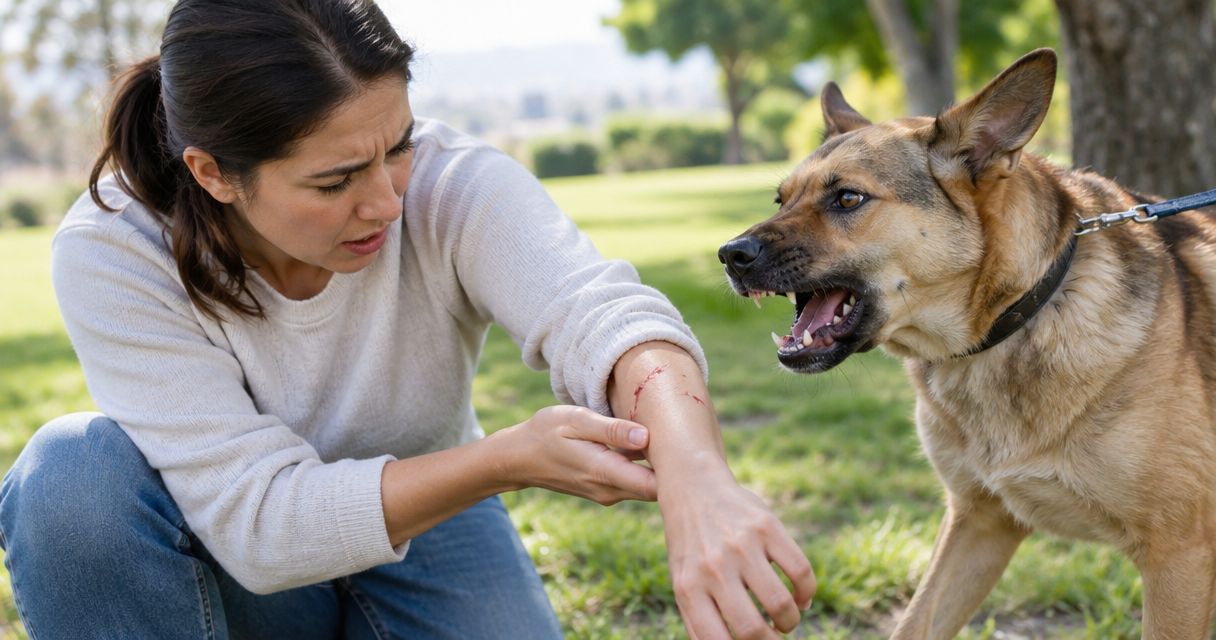
Dog bite injuries in California can involve poor containment, fear, resource guarding, pain, or unsafe interactions during play and handling. Start by documenting how the dog reached you and what happened immediately before the bite; this 2026 guide explains 10 risk situations without presenting them as a statistical ranking.
- Causes of dog bite injuries in California include containment failures, fear, resource guarding, pain, and redirected aggression.
- California Civil Code section 3342 generally imposes owner liability for bites in public or during lawful private-property visits.
- Preserve medical records, witness details, photographs, and evidence showing how the dog reached you.
- Khachikyanlawfirm provides personal injury representation in Glendale; legal responsibility requires analysis beyond the dog's apparent trigger.
Why the cause matters after a California dog bite
A behavioral trigger explains the circumstances of a bite. It does not, by itself, decide who is legally responsible. California's owner-liability rule generally does not require you to prove that the dog previously bit someone.
Khachikyanlawfirm is a Glendale personal injury firm for people seeking legal representation after an injury. You can learn about Khachikyanlawfirm while organizing the facts of your incident. Keep medical treatment first; evidence collection should never delay urgent care.
For a 2026 claim, separate what you personally observed from what someone later told you. Write down the owner's explanation accurately, but do not adopt an unsupported label such as “protective” or “provoked.”
What makes a useful explanation of a dog bite?
Use these criteria to evaluate the circumstances, rather than guessing the dog's intentions:
- Access: How did the dog reach the injured person?
- Immediate interaction: What happened just before contact?
- Physical setting: Was the dog confined, cornered, leashed, or loose?
- Human involvement: Who owned, handled, or supervised the dog?
- Supporting evidence: Do witnesses, photographs, records, or video support the account?
The situations below overlap. A loose dog can also be frightened or guarding a resource, so a single incident can involve several factors.
Dog bite risk situations at a glance
| Risk situation | Distinguishing circumstance | Best evidence focus | Key limitation |
|---|---|---|---|
| Failed containment | Dog escapes a yard, gate, or enclosure | Gate, fence, escape route | Escape alone does not establish every liability issue |
| Inadequate leash control | Handler cannot prevent contact | Leash condition, handler position | Local leash rules differ |
| Fear or cornering | Dog lacks space to retreat | Layout and approach | Fear cannot be diagnosed from an injury photograph |
| Resource guarding | Bite occurs near food or a valued object | Object location and witness account | Proximity alone does not prove guarding |
| Pain or illness | Contact involves a sensitive area | Handling sequence and relevant records | Medical causes require qualified assessment |
| Startling a resting dog | Sudden contact interrupts rest | Timing and witness observations | Resting does not establish a defense |
| Unsafe child interactions | Child and dog interact without effective supervision | Adult positions and sequence | A child's presence does not establish fault |
| Rough play | Excited interaction escalates | Video and descriptions of play | Playful intent does not determine injury severity |
| Territorial response | Dog reacts near a perceived boundary | Entry route and access permission | Property location alone does not defeat a claim |
| Redirected aggression | Dog bites during another conflict | Original target and intervention | Reconstructing the sequence requires evidence |
1. Failed containment: escaped or roaming dogs
An unsecured gate, damaged fence, or open doorway can let a dog reach someone outside its enclosure. The failure to separate the dog from the public is distinct from whatever prompted the bite.
Photograph the opening and surrounding area from a safe location. Record where you were standing and whether the dog crossed a property boundary.
- Best for: Identifying the access route.
- Prevention benefit: Secure barriers reduce opportunities for unwanted contact.
- Limitation: A photograph taken later does not establish the gate's condition during the incident.
Recommendation: Preserve the escape-route evidence; skip reentering the property.
2. Inadequate leash control: contact during a walk
A leash does not prevent a bite if the handler cannot maintain separation. Contact can occur when a dog lunges, a handler loses their grip, or a leash or attachment fails.
Record the handler's location and the distance between everyone involved. Local leash requirements depend on the jurisdiction and setting; do not assume every California location follows the same rule.
- Best for: Reconstructing handler control.
- Prevention benefit: Effective restraint helps maintain separation.
- Limitation: A leash violation and owner liability are separate questions.
Recommendation: Document the restraint setup; skip assuming a leash means the encounter was safe.
3. Fear or cornering: no room to retreat
Dogs can bite when frightened, especially when an approach blocks an escape route. Reaching into a confined area or surrounding a dog can create this situation.
Describe movements and positions rather than asserting an emotional diagnosis. “The dog backed against the fence before contact” is more useful than “the dog became vicious.”
- Best for: Explaining the physical encounter.
- Prevention benefit: Giving a dog space avoids forced interaction.
- Limitation: Body language does not independently establish legal fault.
Recommendation: Record observable behavior; skip treating fear as an automatic excuse for the bite.
4. Resource guarding: food, toys, or valued objects
Resource guarding involves behavior intended to retain access to something the dog values. A bite can occur when someone approaches food, retrieves an object, or reaches into the dog's resting space.
Identify the item and its position. Do not recreate the interaction to demonstrate what happened.
- Best for: Identifying what immediately preceded contact.
- Prevention benefit: Separating dogs from people during feeding removes that interaction.
- Limitation: Food or a toy nearby does not prove resource guarding.
Recommendation: Preserve the sequence; skip testing the dog's response again.
5. Pain or illness: sensitivity during handling
Pain can change a dog's response to touch. Lifting, grooming, restraining, or touching an injured area can precede a bite, including with a familiar dog.
Tell medical providers how contact occurred. Whether a health condition contributed requires appropriate veterinary evidence, not a guess based on the dog's age or appearance.
- Best for: Reviewing bites during physical handling.
- Prevention benefit: Veterinary assessment addresses suspected pain or illness.
- Limitation: A possible medical explanation does not resolve owner liability.
Recommendation: Describe the contact accurately; skip diagnosing the dog yourself.
6. Startling a resting dog: sudden close contact
A sudden touch or close approach can startle a sleeping or resting dog. The relevant details include whether the dog was asleep, whether someone reached toward it, and how quickly contact followed.
A familiar relationship does not remove the need for caution. Record what witnesses actually saw rather than assuming the dog was awake.
- Best for: Understanding bites during interrupted rest.
- Prevention benefit: Allowing the dog to wake before approaching avoids startling contact.
- Limitation: A resting dog does not automatically make the injured person responsible.
Recommendation: Preserve the timing; skip confusing familiarity with safety.
7. Unsafe child interactions: supervision and boundaries
Children can approach a dog's face, hug it, or handle it without recognizing warning behavior. Effective adult supervision means being able to interrupt unsafe interaction, not simply being somewhere nearby.
In a claim involving a child, record who was present and where each adult stood. Avoid repeatedly questioning the child or suggesting answers.
- Best for: Reconstructing supervision and interaction.
- Prevention benefit: Active supervision supports separation before contact.
- Limitation: Adult assumptions about provocation do not establish a child's legal responsibility.
Recommendation: Preserve independent observations; skip blaming a child based on age alone.
8. Rough play: excitement that escalates
Chasing, wrestling, and hand-focused play can lead to biting contact. A dog described as “just playing” can still cause an injury requiring medical treatment.
Explain whether the interaction involved a toy, running, or direct physical handling. Keep original video files rather than only cropped clips.
- Best for: Distinguishing play circumstances from the resulting injury.
- Prevention benefit: Stopping escalating play reduces further exposure.
- Limitation: Playful intent does not establish the absence of liability.
Recommendation: Document both the activity and injury; skip dismissing broken skin as harmless play.
9. Territorial response: entrances and perceived boundaries
A dog can react to someone approaching a doorway, yard, vehicle, or other space. Delivery workers, visitors, and passersby can encounter this behavior without seeking contact with the dog.
Preserve delivery instructions, invitations, messages, and photographs showing the entry route. Whether you were lawfully on private property matters under California's dog-bite statute.
- Best for: Establishing location and permission.
- Prevention benefit: Separating dogs before visitors enter prevents direct encounters.
- Limitation: Being on the owner's property does not automatically bar recovery.
Recommendation: Save proof of lawful access; skip accepting “you entered the yard” as a complete legal answer.
10. Redirected aggression: intervening in another conflict
A dog focused on another animal or person can bite someone who intervenes or stands nearby. This differs from an incident where the injured person was the dog's original target.
Record the initial conflict, who intervened, and when the bite occurred. Do not reach between fighting dogs to obtain evidence or retrieve belongings.
- Best for: Separating the original conflict from the later injury.
- Prevention benefit: Keeping your hands away from fighting dogs avoids direct exposure.
- Limitation: Liability depends on the facts, including ownership and the intervention.
Recommendation: Document the full sequence; skip reducing the event to its final moment.
How these situations are ordered
This 2026 list starts with access and control, then addresses interactions that can precede biting. The order is practical, not a claim about statewide frequency. Veterinary behavior guidance from the American Veterinary Medical Association and ASPCA supports distinguishing fear, pain, guarding, and other circumstances instead of assuming every bite has the same cause.
What California law means for your next move
For 2026, California Civil Code section 3342 is the central owner-liability reference. It generally makes an owner liable when their dog bites someone in a public place or someone lawfully on private property, regardless of the dog's previous viciousness or the owner's knowledge of it. Statutory exceptions and defenses require separate analysis.
A non-owner's responsibility, such as a landlord's, requires a different legal assessment. A dog-related fall without a bite also raises different questions; do not assume section 3342 resolves every animal injury.
California Code of Civil Procedure section 335.1 generally provides 2 years to bring a personal injury lawsuit. For minors, section 352 generally pauses the deadline until 18 years of age, often allowing filing until 20 years of age. Exceptions apply; claims involving public entities can require much earlier action.
Khachikyanlawfirm provides personal injury representation. Give your attorney the incident date promptly rather than calculating a filing deadline from a general guide.
What to do after a dog bite
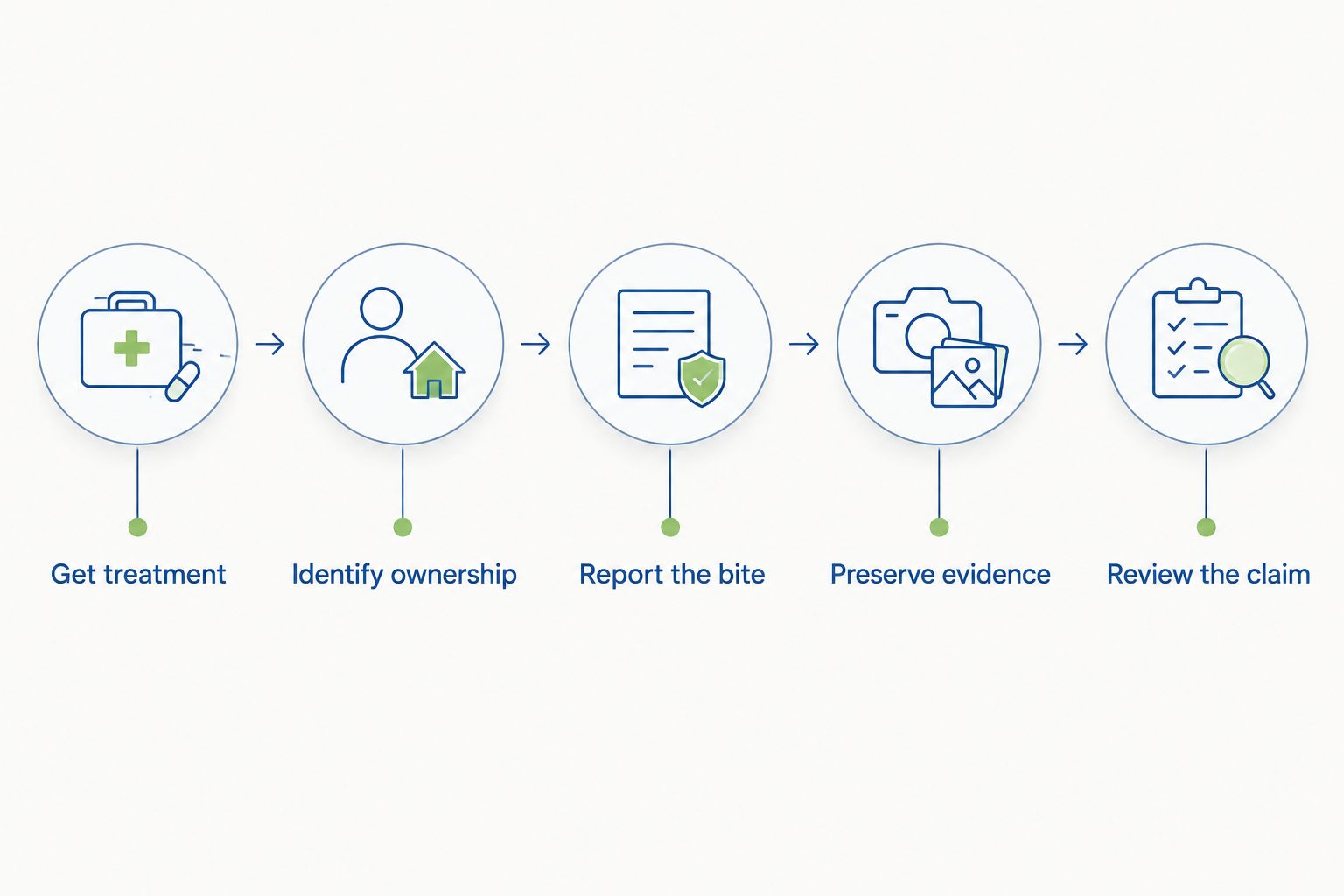
Follow this sequence after reaching safety:
- Get treatment: Wash the wound with soap and water and obtain medical assessment. Seek emergency help for severe bleeding or serious injury; ask about infection, tetanus, and rabies assessment.
- Identify ownership: Obtain the owner's and handler's contact details when safe, along with available vaccination information.
- Report the bite: Contact local animal control or public health authorities for reporting and rabies guidance.
- Preserve evidence: Save photographs, witness details, clothing, messages, and original video. Request preservation of surveillance footage promptly.
- Review the claim: Organize treatment records, work-loss documentation, and insurer correspondence before discussing resolution.
Keep records of changing symptoms and follow-up care throughout 2026. A small surface wound does not establish the extent of the underlying injury; let a medical professional assess it.
Discuss your injury claim
Contact Khachikyanlawfirm about personal injury representation in Glendale.
FAQ
What causes dog bite injuries in California?
Dog bites can involve failed containment, inadequate restraint, fear, guarding, pain, startling contact, unsafe interactions, or redirected aggression. The circumstances explain the encounter but do not independently decide legal responsibility.
Does a dog need a previous bite before its owner is liable?
No. California Civil Code section 3342 generally does not require proof of a previous bite or the owner's knowledge of viciousness when its conditions apply.
Can I bring a claim if the dog bit me on private property?
Yes, lawful presence on private property can satisfy the location requirement under California Civil Code section 3342. Permission, the reason for entry, and applicable exceptions require review.
Does petting a dog automatically count as provocation?
No, petting alone does not automatically establish provocation. The interaction, warnings, handling, and surrounding circumstances matter.
What should I do if the owner says the dog was playing?
Obtain medical care and document what happened regardless of how the owner describes it. Playful intent does not establish that an injury is minor or that no claim exists.
How long do I have to file a California dog bite lawsuit?
California personal injury lawsuits generally have a 2-year filing deadline under Code of Civil Procedure section 335.1. Different rules can apply to minors, public-entity claims, and other circumstances, so confirm the deadline promptly.
Should I wait for the insurance company before seeing a doctor?
No. Obtain appropriate medical care without waiting for an insurer's response, and retain your treatment records and bills.
One last thing
The detail to preserve is often how the dog reached you, not your guess about why it bit. A gate latch, delivery instruction, witness account, or original recording can clarify that sequence. Save the evidence before conditions change, and keep treatment your priority.


