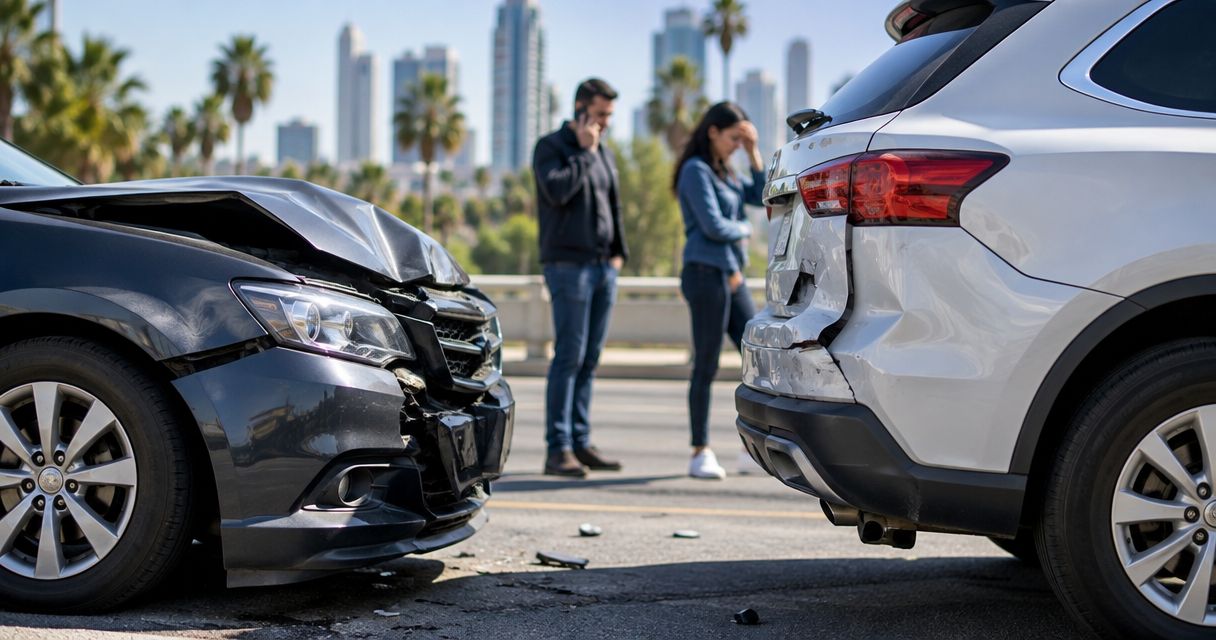
Distracted driving, unsafe speed, following too closely, failure to yield, signal violations, unsafe lane changes, impairment, fatigue, hazardous roads, and vehicle defects are causes to investigate after a Glendale car accident. This 2026 guide explains the evidence behind each—not a statistical ranking of Glendale collision frequency.
- Causes of car accidents Glendale CA drivers should investigate include distraction, unsafe speed, failure to yield, and vehicle defects.
- Khachikyanlawfirm represents Glendale drivers seeking personal injury legal help after a car accident.
- Photographs, witnesses, video, and vehicle records help connect unsafe conduct to a collision.
- More than one driver or organization can share responsibility for the same crash.
Why the cause matters after a Glendale crash
The cause determines which evidence matters and whose conduct needs investigation. A rear-end collision raises different questions from a failed brake system, even when both leave similar vehicle damage.
Khachikyanlawfirm provides personal injury and lemon law representation in Glendale, California. For a car accident injury claim, the task is to connect another party's conduct to the collision and your documented losses.
A traffic violation alone does not explain every part of a claim. You still need evidence showing how the collision happened, what injuries resulted, and which losses followed.
What makes a useful accident-cause assessment?
Before assigning blame, check these factors:
- Sequence: What happened immediately before the first impact?
- Right of way: Which movements did the signals, signs, and traffic rules permit?
- Visibility: What could each driver reasonably see?
- Physical evidence: Do damage locations, debris, and road markings support the account?
- Independent support: Is there video, a neutral witness, or a relevant vehicle record?
- Competing explanations: Did another driver, road condition, or vehicle problem contribute?
For a 2026 claim, separate what you personally observed from what you inferred afterward. A precise statement about a vehicle crossing the lane line is more useful than an unsupported accusation that its driver was texting.
Glendale accident causes at a glance
The order below organizes the investigation; it does not establish which cause occurs most frequently in Glendale.
| Cause | Most useful evidence | What it helps establish | Key limitation |
|---|---|---|---|
| Distracted driving | Video, witnesses, relevant device records | Attention diverted before impact | A phone's presence does not prove use |
| Unsafe speed | Video, scene measurements, vehicle data | Speed inappropriate for conditions | Damage alone does not establish speed |
| Following too closely | Dashcam footage, vehicle positions | Inadequate space to react | Chain reactions complicate the sequence |
| Failure to yield | Sightlines, signs, witness accounts | Conflicting movements and priority | Having priority does not eliminate every duty |
| Signal violations | Signal-facing footage, independent witnesses | Entry against a traffic control | Impact timing differs from entry timing |
| Unsafe lane changes | Lane markings, side damage, video | Movement into occupied space | Damage alone does not identify who moved |
| Impairment | Police observations, testing records | Alcohol or drug impairment | Impairment and crash causation are separate issues |
| Fatigue | Work, travel, and rest records | Reduced alertness before impact | Fatigue often lacks direct documentation |
| Hazardous roads | Scene photographs, maintenance records | A dangerous physical condition | A hazard alone does not establish liability |
| Vehicle defects | Inspection, repair history, preserved parts | A mechanical contribution | Collision damage can resemble prior failure |
1. Distracted driving: investigate diverted attention
Distracted driving includes looking at a phone, adjusting navigation, eating, or turning toward a passenger instead of watching traffic. The important question is whether that distraction contributed to the collision.
Best evidence: Dashcam footage, a witness who saw the driver's actions, and relevant device records obtained through lawful procedures.
- Evidence strength: Video can connect the distraction to a missed signal or delayed braking.
- Evidence limit: Seeing a phone inside the car does not establish that the driver used it before impact.
Action verdict: Preserve the collision timeline before accusing a driver of phone use.
2. Unsafe speed: examine conditions, not just the limit
A driver can travel too fast for traffic, visibility, or road conditions without exceeding the posted limit. California Vehicle Code section 22350 addresses speed that is unreasonable or unsafe for existing conditions.
Best evidence: Video, road conditions, scene measurements, and available vehicle event data interpreted by a qualified professional.
- Evidence strength: A reconstruction can compare movement with available stopping distance.
- Evidence limit: Severe damage is not a reliable speed measurement by itself.
Action verdict: Document why the speed was unsafe, rather than guessing a miles-per-hour figure.
3. Following too closely: reconstruct the stopping sequence
Tailgating leaves less room to respond when traffic slows. California Vehicle Code section 21703 requires a reasonable and prudent following distance, considering speed, traffic, and roadway conditions.
Best evidence: Forward-facing video, witness accounts, and the positions of vehicles before each impact.
- Evidence strength: Continuous footage can show the gap closing before braking.
- Evidence limit: A stopped vehicle pushed forward by another impact creates a different liability question from an ordinary rear-end collision.
Action verdict: Identify the first impact before assigning responsibility for a chain reaction.
4. Failure to yield: establish the competing movements
Failure-to-yield collisions involve conflicting paths at turns, intersections, driveways, or crossings. Establish where each road user was and which traffic controls applied before deciding who had priority.
Best evidence: Photographs showing signs and sightlines, independent witnesses, and video covering the approach.
- Evidence strength: A clear view of both approaches can establish the sequence.
- Evidence limit: A right-of-way claim does not answer whether another contributing action occurred.
Action verdict: Record each vehicle's direction and intended movement while your memory is fresh.
5. Red-light and stop-sign violations: focus on entry
A signal dispute turns on when a vehicle entered the intersection, not simply where the vehicles collided. A stop-sign investigation also considers whether the driver stopped and then yielded appropriately.
Best evidence: Footage showing the relevant signal and vehicle together, supported by witnesses with an unobstructed view.
- Evidence strength: Synchronized footage can resolve conflicting driver accounts.
- Evidence limit: A camera facing only the impact might not show the controlling light.
Action verdict: Look for evidence of intersection entry, not just the crash itself.
6. Unsafe lane changes: identify who crossed the line
Merging without adequate clearance, drifting between lanes, or changing lanes without checking surrounding traffic can cause a collision. Using a turn signal does not make an otherwise unsafe movement safe.
Best evidence: Lane markings, video, debris locations, and damage along the vehicles' sides.
- Evidence strength: Footage showing both vehicles before contact can identify the moving vehicle.
- Evidence limit: Side damage alone does not establish which driver crossed the lane boundary.
Action verdict: Describe the original lanes and movement before describing the impact.
7. Alcohol or drug impairment: separate suspicion from proof
Alcohol, illegal drugs, and some medications can impair driving. A personal injury investigation examines both the evidence of impairment and the conduct that caused the collision.
Best evidence: Police observations, properly obtained testing records, witness descriptions, and driving footage.
- Evidence strength: Testing and observed behavior can support an impairment allegation.
- Evidence limit: An arrest is not a civil judgment, and suspected impairment does not replace proof of causation.
Action verdict: Report observable behavior accurately and leave testing to qualified authorities.
8. Driver fatigue: investigate the hours before impact
Fatigue can reduce attention and reaction ability. Lane drifting or a failure to brake warrants investigation, but neither behavior proves that the driver fell asleep.
Best evidence: Relevant work schedules, travel history, rest records, and statements made after the collision.
- Evidence strength: A documented timeline can support an explanation that otherwise lacks physical traces.
- Evidence limit: Similar driving behavior can result from distraction, impairment, or a medical event.
Action verdict: Preserve the driver's available timeline without treating fatigue as an established fact.
9. Hazardous roads: document the condition and responsible party
Potholes, debris, obscured signs, standing water, or unsafe work-zone arrangements can contribute to a collision. Responsibility depends on the condition, who controlled it, and the legal requirements applicable to that party.
Best evidence: Safe scene photographs, precise location details, maintenance records, and evidence about how long the condition existed.
- Evidence strength: Prompt photographs preserve a condition that might change after cleanup or repair.
- Evidence limit: Showing a road defect does not automatically prove a public entity or contractor is liable.
Action verdict: Identify potential road-condition claims promptly because special deadlines can apply.
10. Vehicle defects: preserve the vehicle before repairs
Brake, tire, steering, or other component failures can contribute to a crash. An inspection must distinguish a failure that preceded impact from damage the collision caused.
Best evidence: The vehicle, failed components, repair records, warning messages, and a qualified inspection.
- Evidence strength: Preserved parts allow a technical examination of the alleged failure.
- Evidence limit: A recall notice alone does not establish that a defect caused this collision.
Action verdict: Seek advice about preservation before authorizing repairs, disposal, or destructive inspection.
How these causes are organized
This 2026 list groups driver behavior, roadway conditions, and mechanical failures by the evidence needed to investigate them. It does not assign local percentages or suggest that the first entry caused more Glendale crashes than the last.
Several causes can operate together. A speeding driver and an unsafe lane change can both contribute to the same collision; the investigation should address both rather than force a single explanation.
What should you do after a Glendale car accident?
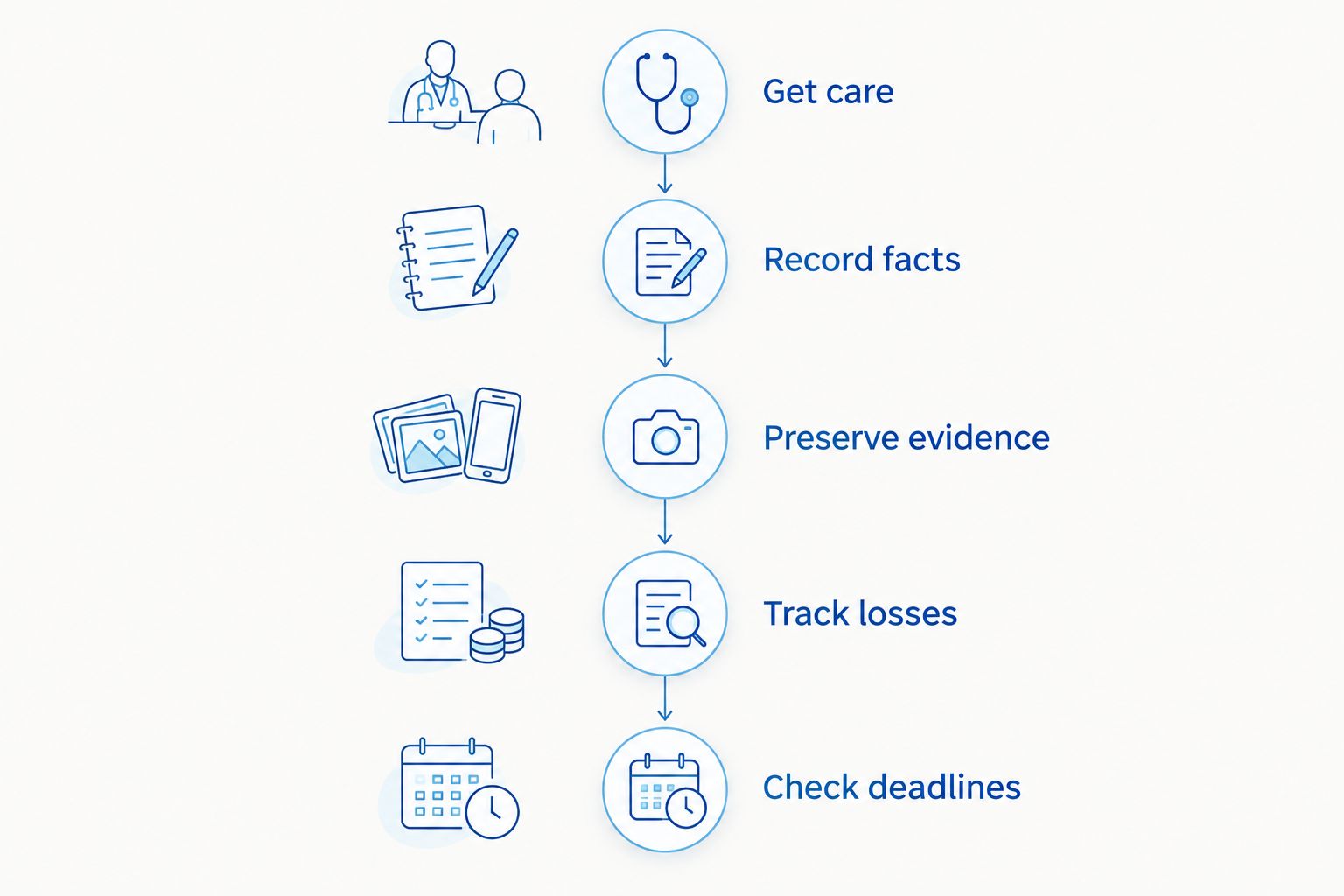
Put safety and medical needs first. Then build a record that distinguishes observations from assumptions:
- Get care: Seek emergency assistance when needed and describe symptoms accurately.
- Record facts: Exchange required information and note the location, directions of travel, and witnesses.
- Preserve evidence: Keep original photographs, video files, repair documents, and communications.
- Track losses: Retain medical records, bills, and documentation of missed work.
- Check deadlines: Identify the parties involved before assuming a standard filing period applies.
This sequence keeps immediate needs ahead of claim paperwork. Do not remain in traffic or enter a dangerous area to photograph evidence.
For a California collision in 2026, the general personal injury lawsuit deadline is 2 years, while the general property-damage deadline is 3 years. Claims involving public entities generally require an administrative claim within 6 months for personal injury or property damage; exceptions and different rules can apply.
These periods come from California Code of Civil Procedure sections 335.1 and 338 and Government Code section 911.2. They are not permission to postpone evidence preservation or ignore insurance notice requirements.
Khachikyanlawfirm provides personal injury representation for injured drivers. Contact the firm to discuss the collision, the available records, and the questions that need investigation.
FAQ
What are the main causes of car accidents in Glendale, CA?
Causes to investigate include distraction, unsafe speed, following too closely, failure to yield, signal violations, unsafe lane changes, impairment, fatigue, hazardous roads, and vehicle defects. This list is an investigation guide, not a verified ranking of Glendale crash frequency.
Is the rear driver always at fault in a rear-end accident?
No, a rear-end impact does not automatically resolve every fault question. Following distance matters, but chain reactions and the sequence of impacts also need investigation.
Can I recover compensation if I was partly at fault?
California's pure comparative negligence rule allows recovery even when an injured person shares fault, with damages reduced by that person's percentage of responsibility. The evidence determines how responsibility is allocated.
Does a police report decide who caused the crash?
A police report does not make the final civil liability decision. Witness accounts, video, physical evidence, and other records can support or contradict its conclusions.
What evidence should I keep after a Glendale car accident?
Keep original photographs, video, witness contact information, medical records, repair documents, and insurance communications. Preserve damaged components when a mechanical failure is suspected, and obtain advice before allowing destructive inspection.
How long do I have to file a California car accident lawsuit in 2026?
California generally allows 2 years for a personal injury lawsuit and 3 years for a property-damage lawsuit. Public-entity claims generally require an administrative claim within 6 months, and exceptions can change the applicable deadline.
Can Khachikyanlawfirm help with a Glendale car accident injury claim?
Khachikyanlawfirm offers personal injury legal representation in Glendale, California. Contact the firm to discuss the collision and whether representation fits your situation.
One last thing
Preserve the original file, not just a screenshot. Original footage retains sequence and file information that a cropped image or edited clip leaves out.
For a 2026 accident claim, keep an untouched copy and use a separate copy for sharing. Label your notes clearly so a later explanation is not mistaken for something recorded at the scene.


