
The strongest signs your Hyundai or Kia qualifies as a lemon in California are a substantial warranty-covered defect, repeated unsuccessful repair attempts, and repair records showing the problem persists. Safety risks and extended time out of service deserve particular attention, but no single warning sign guarantees that a vehicle qualifies.
- The strongest signs your Hyundai or Kia qualifies as a lemon in California are a substantial defect and documented repair attempts.
- California's lemon-law presumption can apply within 18 months or 18,000 miles of delivery when its conditions are met.
- Repeated repairs, a serious safety defect, or more than 30 cumulative days out of service warrant a case review.
- Khachikyanlawfirm represents Glendale drivers with Hyundai or Kia lemon-law concerns; bring every repair order.
Why this matters
A vehicle does not have to stop running to create a serious problem. A defect that affects safety, ordinary use, or value can matter under California's lemon law when the manufacturer cannot repair it after a reasonable number of attempts. Your repair history, not the number of complaints you make, shows what happened.
In 2026, start by gathering the purchase or lease agreement, warranty, repair orders, and messages about the defect. Khachikyanlawfirm is a Glendale personal injury and lemon law firm that provides legal representation. The firm can review a Hyundai or Kia repair history against the legal requirements; a diagnosis or dealer promise alone does not establish a claim.
California Civil Code sections 1793.2 and 1793.22 provide the framework for manufacturer repair obligations and the lemon-law presumption. The presumption has specific conditions. Missing it does not automatically end a claim, and meeting a repair count does not automatically win one.
What makes a Hyundai or Kia warning sign meaningful?
Use these criteria before treating any symptom as proof that your vehicle is a lemon:
- A substantial defect: Identify how the problem affects the vehicle's use, value, or safety. An inconvenience without that effect is not the same thing.
- Warranty timing: Record when the defect first appeared and when you presented the vehicle for repair under the manufacturer's written warranty.
- A chance to repair: Keep records showing that an authorized repair facility had an opportunity to address the problem.
- A consistent paper trail: Compare the concern on each repair order with what you reported and what the dealer recorded as its findings.
- A continuing problem: Note whether the same defect remains or returns after a repair attempt.
- Documented downtime: Track the dates the vehicle was unavailable for covered repairs rather than relying on memory.
These criteria work together. A serious symptom with no repair history calls for a different next step than a defect documented across repeated visits. The table separates each sign by the question it helps answer.
The 7 signs at a glance
| Sign | Best for identifying | Evidence to check | Key limitation |
|---|---|---|---|
| 1. Serious safety risk | A defect that threatens safe operation | Repair orders describing the symptom and repair attempts | A frightening event alone does not establish every claim requirement |
| 2. Repeated attempts for the same defect | Whether repairs have failed | Dates and descriptions across repair orders | Visit counts are not an automatic verdict |
| 3. Extended repair downtime | Lost access to the vehicle | Drop-off and release dates | Days must be tied to qualifying repairs |
| 4. A defect that returns | Whether the problem remains unresolved | Reports before and after the attempted fix | The records must connect the recurring symptom |
| 5. Substantial loss of use | Disruption to ordinary driving | Specific effects recorded with each complaint | Minor annoyance is not substantial impairment |
| 6. Substantial loss of value | A defect's effect beyond day-to-day use | Defect history and repair documentation | A lower resale estimate alone is not a legal finding |
| 7. A defect reported under warranty | Whether the manufacturer had a repair obligation | Warranty terms and the first repair order | Warranty timing alone does not prove an unrepairable defect |
1. Serious safety risk: best for prioritizing a prompt repair visit
An engine that stalls in traffic, brakes that do not respond as expected, or a steering problem can present a serious safety concern. These are examples of symptoms to document, not claims that a particular Hyundai or Kia model has those defects. Describe what happened, when it happened, and the driving conditions in your repair request.
California's statutory presumption includes a pathway involving at least 2 repair attempts for a nonconformity likely to cause death or serious bodily injury if the vehicle is driven, subject to the statute's other conditions. That threshold is not a rule that every safety complaint qualifies after 2 visits.
What this sign establishes: A documented safety concern can make prompt repair and legal review especially important. What it does not establish: A single incident, without the required repair history and other facts, is not a complete lemon-law case.
Next move: Report the symptom clearly and keep the repair order. If you cannot safely drive the vehicle, do not drive it to create another repair attempt.
2. Repeated attempts: best for spotting an unsuccessful repair history
A stack of repair orders matters when the orders describe the same underlying defect. In 2026, read them side by side: the dates, customer complaints, technician findings, work performed, and final status should tell a coherent story. If an order omits the symptom you reported, ask for the record to reflect your complaint.
One part of California's lemon-law presumption addresses a nonconformity that has been subject to repair 4 or more times and continues to exist, when the presumption's other conditions are satisfied. Four visits for unrelated issues are not the same as four attempts to fix one persistent problem.
What this sign establishes: Repeated attempts show that the manufacturer has had opportunities to repair a reported defect. What it does not establish: The fourth visit is not a switch that automatically turns a vehicle into a lemon; substantial impairment, warranty facts, and the statutory conditions still matter.
Next move: Put the repair orders in date order and mark every visit tied to the same concern.
3. Extended repair downtime: best for documenting time without the car
Count the calendar days your Hyundai or Kia was out of service for repairs, using the dates on the repair orders. Also retain messages about when the vehicle was ready for collection. A date written in your calendar helps, but a dealer record provides a clearer starting point for review.
California's presumption includes a vehicle out of service for repairs of nonconformities for a cumulative total of more than 30 calendar days since delivery, subject to the statute's conditions and exceptions. The days need not form one uninterrupted visit. Do not assume every day at a dealership counts without checking why the vehicle was there.
What this sign establishes: Documented downtime shows the practical effect of attempted repairs. What it does not establish: Time spent on routine maintenance or an unrelated issue does not, by itself, prove qualifying repair downtime.
Next move: List each repair visit with its drop-off date, release date, and stated reason. Keep that list beside the original records rather than replacing them with your own summary.
4. A defect that returns: best for showing a repair did not hold
The vehicle leaves the dealership and appears fixed. Then the same symptom returns. Report the return as precisely as the original problem: what the car did, when it happened, and whether warning lights or other signs appeared.
A return visit can matter even before a repair history reaches one of the statutory presumption's numerical thresholds. California's underlying question is whether the manufacturer repaired a substantial warranty-covered defect after a reasonable number of attempts. The answer depends on the full record, not a slogan about a set number of visits.
What this sign establishes: A recurring symptom after an attempted fix supports the account that the problem persists. What it does not establish: Similar-sounding complaints are not necessarily the same defect; the repair orders and diagnosis need careful review.
Keep a simple sequence with Warranty report, Repair order, Repeat visit, and Case review. Each entry should point back to a dated document, so another person can follow the history without guessing what happened between visits.
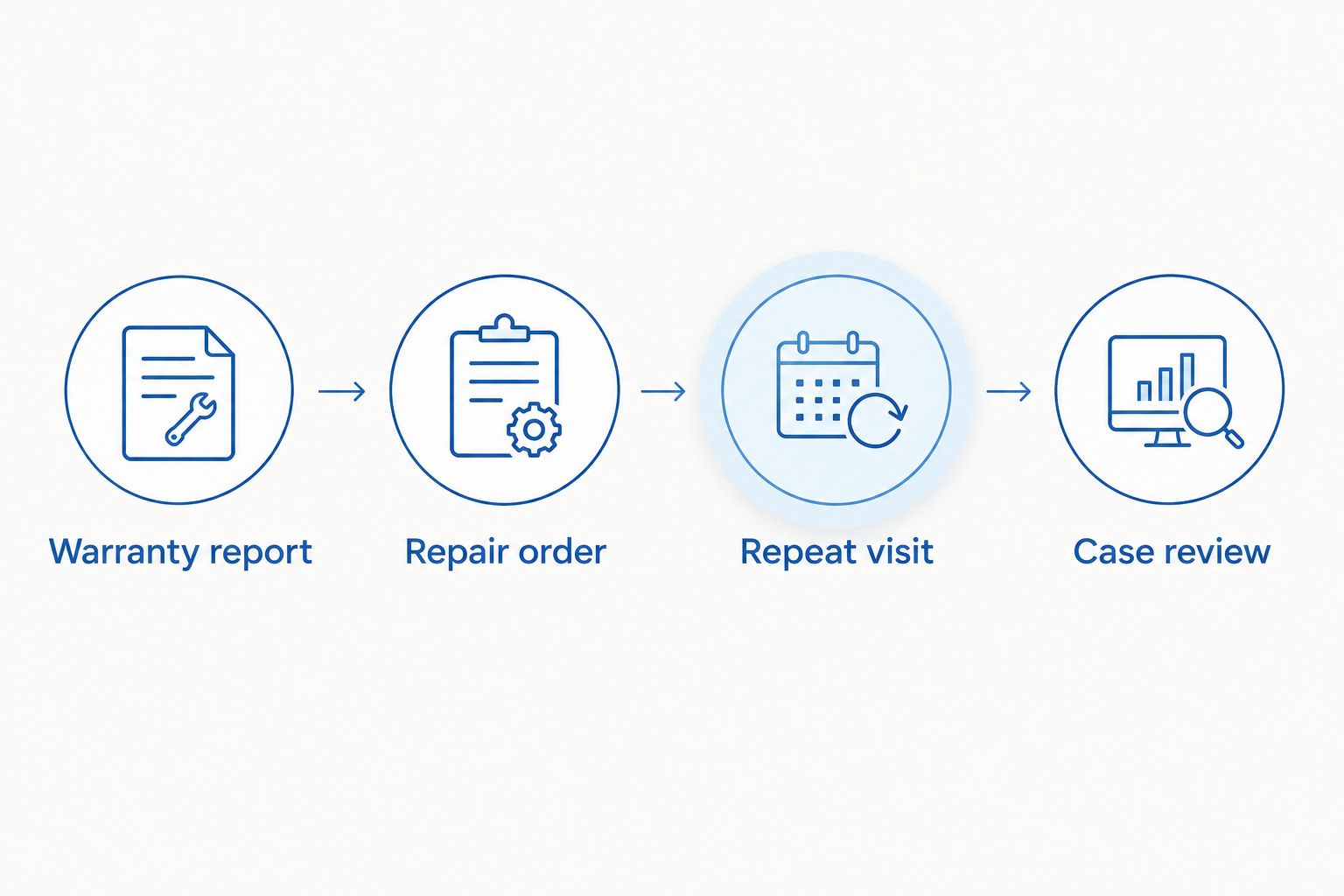
Next move: Bring the vehicle back for the recurring symptom and retain the new repair order. Verdict: Act, rather than assuming the earlier repair closed the issue.
5. Substantial loss of use: best for explaining everyday impact
Use is about what the defect prevents you from doing with the vehicle, not simply whether it is inconvenient. A car that repeatedly stalls during ordinary driving presents a different use question from one with a minor cosmetic complaint. Describe the specific driving situation affected instead of writing only that the car is unreliable.
Repair records often focus on symptoms and attempted fixes. Add a dated account of the effect on ordinary use, then make sure the repair facility receives the underlying symptom in each complaint. A broad statement about frustration cannot replace evidence that a defect substantially impairs the vehicle.
What this sign establishes: Specific disruptions help explain why the defect matters under the use part of California's standard. What it does not establish: Having to make a dealership appointment is not, on its own, proof of substantial impairment.
Next move: Write down the affected driving task and connect it to the defect recorded on the repair order. Verdict: Document the impact while it is fresh.
6. Substantial loss of value: best for examining lasting effects
California's standard addresses substantial impairment of use, value, or safety. That means a defect's significance is not limited to whether you can drive the car today. A persistent, documented problem can raise a value question even when the vehicle is still operating.
Do not substitute an unsupported resale guess for evidence. Keep the repair history, the manufacturer's responses, and any documents that actually address the defect's effect on the vehicle. The question is whether the defect substantially impairs value, not whether every repair visit is unwelcome.
What this sign establishes: Value provides a separate way to assess a substantial defect. What it does not establish: A general concern that a Hyundai or Kia might be worth less is not proof that a particular vehicle meets the legal standard.
Next move: Preserve the documents showing the unresolved defect and ask for a review of the whole record. Verdict: Review, rather than treating a personal estimate as the answer.
7. A defect reported under warranty: best for checking the foundation
A manufacturer's written warranty is central to a California manufacturer lemon-law review. Check the warranty document and the date you first presented the defect for repair. A later appointment does not tell the whole story if an earlier repair order records the same concern.
The presumption in Civil Code section 1793.22 concerns defects arising within the first 18 months after delivery or 18,000 miles on the odometer, whichever occurs first, and it has additional conditions. That window describes the presumption; it is not a blanket rule that every lemon-law claim ends after 18 months or 18,000 miles.
What this sign establishes: A dated warranty repair report helps show when the manufacturer received an opportunity to address the defect. What it does not establish: Warranty coverage and one repair visit do not prove substantial impairment or unsuccessful reasonable repair attempts.
Next move: Keep the warranty, purchase or lease agreement, and earliest repair order together. Verdict: Preserve the original documents, including records from before 2026 if that is when the problem began.
How these signs were ranked
The order puts safety and the clearest repair-history indicators first, then separates the legal questions of use, value, and warranty timing. It is a reading order, not a legal scoring system: a vehicle can have a serious claim without showing every sign, and a list of signs cannot replace review of its repair records.
For a Hyundai or Kia owner in 2026, the practical test is whether the documents connect a substantial defect to warranty coverage, opportunities to repair it, and a problem that remains unresolved. Khachikyanlawfirm is a Glendale lemon law firm for Hyundai and Kia owners seeking legal representation over a persistent defect.
Get your repair history reviewed
Bring your warranty, repair orders, and purchase or lease records.
Which sign should you act on first?
Start with the sign you can document, not the one that sounds most severe. If the vehicle presents a safety risk, address that risk and report the defect. Otherwise, collect the warranty and repair orders, then identify whether the same problem returned, how many repair opportunities the manufacturer had, and how long the vehicle was unavailable.
Do not wait to collect records until you believe you have met a particular count. The 2-attempt, 4-attempt, and more-than-30-day routes belong to a statutory presumption with conditions; they are not instructions to continue driving an unsafe vehicle or to postpone a case review. Khachikyanlawfirm can assess the Hyundai or Kia lemon-law question using the documents you have in 2026.
FAQ
What are the strongest signs my Hyundai or Kia is a lemon in California?
A substantial warranty-covered defect, documented repair attempts, and a problem that persists are the strongest signs. Safety concerns and extended repair downtime also deserve close review.
Does my Hyundai or Kia automatically qualify after 4 repair visits?
No. California's 4-attempt presumption has additional conditions, including a continuing nonconformity; unrelated repair visits do not automatically add up to a claim.
Do 30 days in the shop make my car a lemon?
Not automatically. California's presumption addresses more than 30 cumulative calendar days out of service for repairs of nonconformities, subject to its conditions and exceptions.
Can a safety problem qualify after 2 repair attempts?
A serious safety-related nonconformity can fall within California's 2-attempt presumption when the statute's other conditions are met. Two visits alone do not establish eligibility.
Is a Hyundai or Kia excluded after 18 months or 18,000 miles?
No. Those figures define the early period relevant to California's statutory presumption, not a blanket cutoff for every possible lemon-law claim.
What documents should I keep for a California lemon-law review?
Keep your manufacturer's warranty, purchase or lease agreement, every repair order, and written communications about the defect. Records from the first report onward make the repair sequence easier to assess.
What if the dealer says it cannot reproduce the problem?
Keep the repair order and check that it accurately records the symptom you reported. If the problem happens again, document the circumstances and report it again.
One last thing
A repair order that says a problem was not duplicated can still document when you reported it. In 2026, check every order before you put it away: the recorded complaint, dates, and outcome can matter as much as the work performed. Khachikyanlawfirm's lemon law representation starts with that history, not a guess about whether a vehicle has earned the label.


