If your Honda has needed four or more repair visits for the same problem, or sat in a shop for 30 days or more under warranty, it likely qualifies as a lemon under California's Song-Beverly Consumer Warranty Act in 2026 — and you may be entitled to a buyback, replacement, or cash settlement.
- Four-plus repair attempts for one defect is the strongest sign your Honda qualifies as a lemon in California.
- 30+ cumulative days out of service during the warranty period triggers a legal presumption under Song-Beverly.
- Safety defects like brake or steering failures need only two failed repair attempts to count.
- Repair order paperwork, not memory, is what actually wins a lemon law claim in 2026.
- California's lemon law makes the manufacturer pay your attorney fees if you win, not you.
Why this matters
Honda builds reliable cars, which is exactly why owners hesitate when something keeps breaking — it feels like bad luck instead of a legal problem. It isn't luck. California's lemon law exists specifically for the Civic that's been back for the same transmission shudder three times, or the CR-V that's spent a month total at the dealership.
The team at Khachikyan Law Firm reviews Honda lemon law cases out of Glendale, and the pattern is consistent: owners wait too long to connect the dots because each individual repair visit feels minor. Recognizing the signs early protects your paperwork trail and your claim.
What makes a sign strong evidence
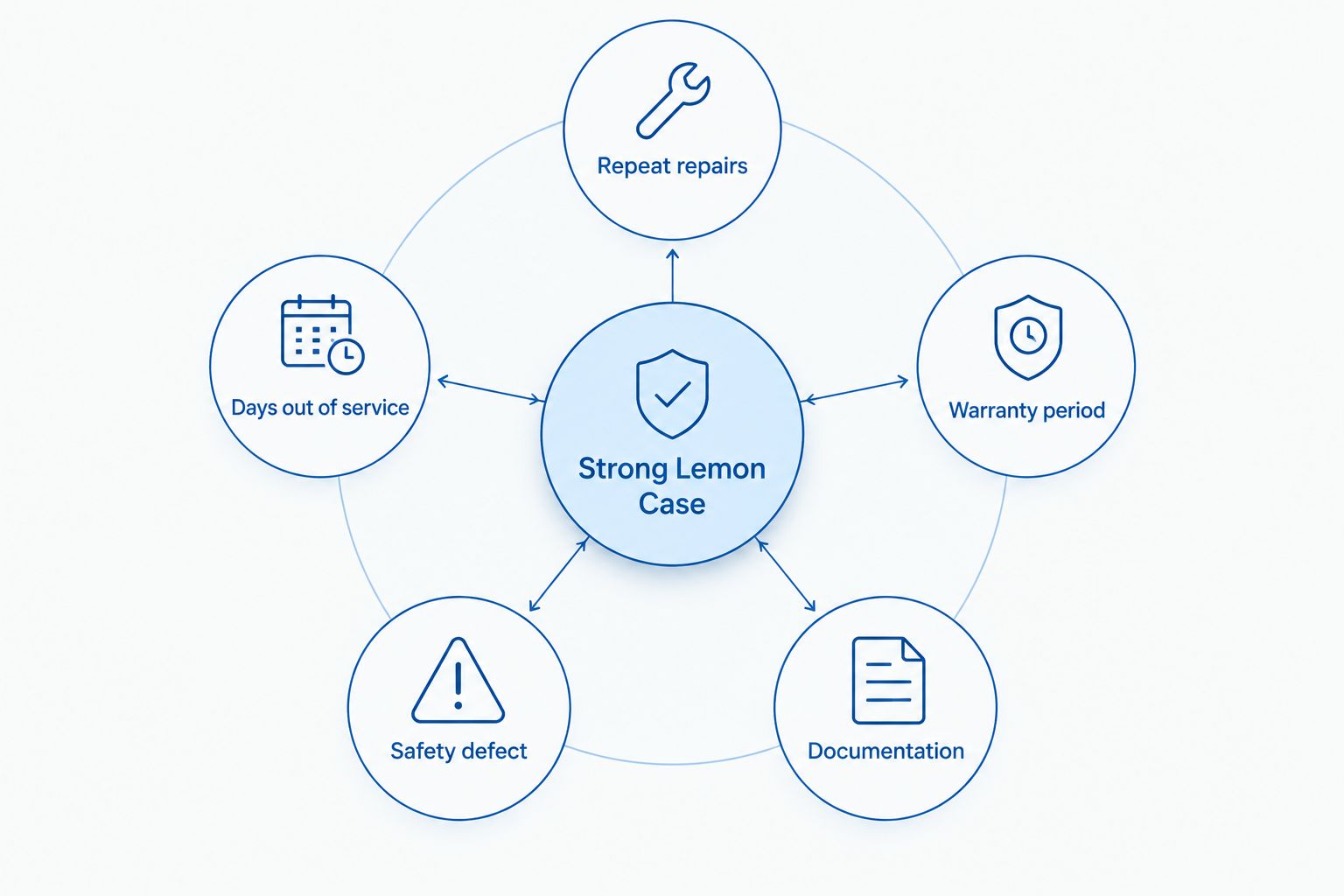
Not every annoying repair builds a case. California's Song-Beverly Act leans on a handful of specific triggers:
- Repeat repair attempts for the identical defect, not a string of unrelated issues
- Cumulative days out of service — the 30-day threshold doesn't need to be one continuous stretch
- Timing inside the warranty period, since coverage after expiration weakens most claims
- Safety impact — brakes, steering, and airbags carry a lower repair-attempt bar
- Written documentation on every visit, including the exact complaint each time
- A pattern that matches known Honda issues, such as widely reported CVT transmission or infotainment complaints filed with NHTSA
At a glance: the 7 signs
| Sign | What Qualifies | Evidence Strength | Verdict |
|---|---|---|---|
| 1. Same defect, 4+ repairs | Identical complaint on repair orders | Strong on its own | Strong sign |
| 2. Safety defect, 2+ repairs | Brakes, steering, airbags | Strong on its own | Strong sign |
| 3. 30+ days out of service | Total shop days during warranty | Strong on its own | Strong sign |
| 4. Defect within warranty | Problem started before coverage ended | Supports a claim | Moderate sign |
| 5. Impairs use, value, or safety | You can't drive it the way you bought it to | Supports a claim | Moderate sign |
| 6. Documented complaint history | Consistent wording on every repair order | Case-defining | Critical, not optional |
| 7. Matches a known Honda pattern | CVT, infotainment, recall-linked issues | Adds weight | Supporting sign |
1. Your Honda has gone back four or more times for the same problem
This is the clearest statutory trigger in California lemon law. If a dealer has attempted to fix the identical defect — the same CVT shudder, the same electrical short — four separate times and it's still not resolved, the law presumes your Honda is a lemon.
Why it counts: Four unsuccessful attempts is the exact threshold written into Song-Beverly for non-safety issues. What weakens it: Repair orders that describe the complaint differently each visit, making it look like four separate problems instead of one recurring one.
Verdict: Strong sign.
2. A safety-related defect needed two or more repair attempts
Brake failure, steering pull, airbag warning lights, or a seatbelt that won't latch — these get special treatment. California only requires two failed repair attempts for defects that could cause death or serious injury, not four.
Why it counts: The lower bar exists because safety defects carry higher risk with each additional attempt. What weakens it: Vague dealer notes like "customer concern noted" instead of a documented diagnosis and repair attempt.
Verdict: Strong sign.
3. Your Honda has been out of service for 30 days or more
This doesn't need to be one long stay. Add up every day your Civic, Accord, or CR-V sat at the dealership for repairs within the warranty period — loaner-car days count against you, not for you, since the clock runs on your car's downtime.
Why it counts: 30 cumulative days is a hard statutory number under Song-Beverly. What weakens it: Missing loaner agreements or invoices that don't show clear drop-off and pickup dates.
Verdict: Strong sign.
4. The defect showed up while Honda's factory warranty was still active
A problem that starts on day 400 of a 3-year/36,000-mile warranty still counts, even if repairs stretch past the expiration date. What matters is when the defect first appeared, not when the last repair attempt happened.
Why it counts: Coverage timing at the moment of the first complaint is what the law looks at. What weakens it: No record of when you first reported the issue, only later repair dates.
Verdict: Moderate sign — pair it with attempts or days.
5. The problem affects how you use, trust, or value the car
A rattling cup holder isn't a lemon law case. A transmission that hesitates in traffic, or a check-engine light that keeps coming back, is a defect that substantially impairs use, value, or safety — the legal standard California actually applies.
Why it counts: "Substantial impairment" is the phrase written into the statute itself. What weakens it: Cosmetic or convenience-feature complaints with no safety or reliability impact.
Verdict: Moderate sign.
6. You have a paper trail showing the same complaint every visit
This is less a "sign" and more the foundation everything else stands on. Every repair order, every invoice, every text or email to the dealer builds the record that proves a pattern instead of a series of coincidences.
Why it counts: Without matching documentation, even four legitimate repair attempts can look unrelated to a judge. What weakens it: Verbal-only complaints that never made it onto a written repair order.
Verdict: Critical — build this from the first visit.
7. Your Honda's issue matches a known model pattern
Certain Honda models have generated recurring public complaints — CVT transmission shudder on some Civics and CR-Vs, infotainment freezes, and various recall campaigns tied to specific components. A defect that echoes a widely reported pattern strengthens a claim, even though it isn't required on its own.
Why it counts: A documented pattern across many owners supports that the defect is manufacturing-related, not driver-caused. What weakens it: Assuming a recall alone equals a lemon law case — a recall repair that actually fixes the problem resets the clock.
Verdict: Supporting sign, not a standalone trigger.
How this list was ranked
The first three signs sit at the top because they map directly to Song-Beverly's statutory presumptions — four repair attempts, two for safety defects, or 30 days out of service. Signs four through seven support a claim but rarely win one alone; they're the context that makes the top three signs credible in front of a judge or arbitrator.
“Four repair attempts on paper beats a strong memory of ten visits with no paperwork.”
Which sign matters most for your Honda?
If you're checking off two or three of the first three signs — repeat repairs, a safety issue, or a month in the shop — you very likely have a lemon law case in 2026, and the next move is pulling every repair order Honda's dealer has issued.
If you're only seeing signs four through seven, the case isn't dead, but it needs the documentation from sign six to hold up. Either way, a Honda lemon law claim in California moves faster the earlier the paperwork starts.
Find out if your Honda qualifies
Free case review with a Glendale lemon law attorney.
FAQ
What is the lemon law in California for Honda vehicles?
California's Song-Beverly Consumer Warranty Act requires manufacturers like Honda to repurchase or replace vehicles that can't be fixed after a reasonable number of repair attempts. It applies to defects that substantially impair use, value, or safety while the vehicle is under warranty.
How many times does a Honda need to be repaired to qualify as a lemon?
Four or more repair attempts for the same defect is the standard presumption in California. Safety-related defects, like brake or steering failures, only need two failed repair attempts.
How many days can a Honda be in the shop before it's a lemon in California?
30 cumulative days out of service for repairs during the warranty period triggers California's lemon law presumption. The days don't need to be consecutive.
Does California's lemon law cover used Hondas?
Yes, as long as the defect occurred while the vehicle was still covered by a manufacturer's warranty, including a certified pre-owned warranty. The original mileage or ownership history doesn't disqualify a claim on its own.
What compensation can you get for a lemon Honda in 2026?
A successful claim typically results in a full repurchase of the vehicle, a replacement vehicle, or a cash settlement, depending on the case. The exact outcome depends on mileage, usage, and the specific defect involved.
Is a Honda CVT transmission issue a lemon law case?
It can be, if the transmission problem required multiple repair attempts or significant time out of service during the warranty period. A single repair that resolves the issue permanently generally does not qualify.
Do I need a lawyer to file a lemon law claim in California?
You're not legally required to have one, but California's lemon law includes a fee-shifting provision that makes the manufacturer pay your attorney's fees if you win. That structure is why most owners use an attorney rather than negotiate directly.
How much does a lemon law attorney cost in California?
Cost structures vary by firm and case type, and Song-Beverly's fee-shifting provision often changes who ends up paying. Reviewing the specifics for your situation before filing is worth the time.
One last thing
Most Honda owners don't realize California's lemon law makes the manufacturer pay your attorney's fees when you win — not you, and not out of your settlement. That fee-shifting rule under Song-Beverly is why so few legitimate lemon claims actually go to trial in 2026: manufacturers settle rather than run up a legal bill they'll owe regardless of outcome. If you're sitting on repair orders for the same Honda defect, that paperwork is worth more than it looks.


