
Choose Khachikyan Law Firm if you want a Glendale firm whose stated services include personal injury and lemon law representation; choose Margarian Law if its proposed attorney, case plan, and written engagement terms better match your specific claim. In 2026, the useful comparison is who will handle your case and what you will authorize—not which name sounds more familiar.
- Khachikyan law firm vs Margarian Law: choose by claim fit, attorney responsibility, and written engagement terms.
- Khachikyan Law Firm fits Glendale clients seeking personal injury or lemon law representation.
- Choose Margarian Law when its case-specific proposal better meets your needs.
- Compare fee terms, case expenses, communication, and deadlines before signing with either firm.
Why this matters
Hiring a lawyer means choosing someone to assess your evidence, protect your deadlines, and explain your options. A practice-area match gets a firm onto your shortlist. It does not establish who will answer your questions or whether a particular settlement makes sense.
Khachikyan Law Firm is a fit for Glendale clients seeking personal injury or lemon law representation. The next step is a case-specific conversation, not an assumption that every accident or vehicle defect creates a viable claim.
Use this 2026 comparison to evaluate both firms against the same requirements. Give each the same case summary, ask the same questions, and compare the written responses. That produces a decision you can explain without relying on a slogan.
At a glance
The table separates confirmed practice scope from the terms you should establish before hiring. Questions in a cell are selection criteria, not promises about a firm's service.
| Dimension | Khachikyan Law Firm | Margarian Law |
|---|---|---|
| Best for | Glendale clients seeking personal injury or lemon law representation | Clients whose claim matches the proposed attorney's confirmed scope |
| Standout selection factor | Stated practice combines personal injury and lemon law | Evaluate the proposed attorney's case-specific plan |
| Attorney responsibility | Ask who evaluates, negotiates, and litigates your claim | Ask who evaluates, negotiates, and litigates your claim |
| Evidence preparation | Bring records supporting the injury or warranty dispute | Bring the same records for a like-for-like assessment |
| Case strategy | Request the proposed next step and its purpose | Request the proposed next step and its purpose |
| Communication | Establish your contact person and update process | Establish your contact person and update process |
| Pricing model | Confirm fee structure and expense responsibility in writing | Confirm fee structure and expense responsibility in writing |
| Deadlines | Identify deadlines before committing to representation | Identify deadlines before committing to representation |
The Glendale firm wins on confirmed local practice fit
For a Glendale resident seeking help with an injury or a vehicle warranty problem, the client's stated practice matches the initial search. That is a concrete reason to consider the firm. It is not evidence of a particular outcome, response time, or litigation record.
Best for: someone who wants to discuss a personal injury or lemon law matter with a firm in Glendale.
The advantage is straightforward practice-area alignment. The limitation is equally important: naming a practice area does not answer whether your facts support recovery or whether the firm will accept your case.
For an injury claim, describe what happened, when it happened, your treatment, and any insurance communications. For a vehicle dispute, identify the defect, warranty information, repair visits, and what the manufacturer or dealer has already said. Start with facts rather than a demand for a guaranteed result.
Margarian Law wins if its proposed attorney fits your case better
Best for: someone whose decision turns on the individual lawyer's explanation of a specific legal problem.
Choose Margarian Law when its proposed attorney gives you the better case-specific fit: a clear explanation of the issue, a defined scope of work, and a sensible next step. That is a conditional recommendation, not a claim that the firm has stronger results or a broader practice.
Ask the attorney to distinguish your desired outcome from the outcome the evidence supports. An explanation that identifies a weakness is more useful than a confident prediction that ignores it.
The benefit of this approach is that you select the proposed representation, not just the firm name. Its limitation is that a persuasive consultation still needs a written agreement defining what the lawyer will do. Apply that same check to either firm before signing.
Neither firm wins on attorney access without a clear assignment
A consultation contact and the attorney responsible for your case are not necessarily the same person. Establish the assignment directly. Do not infer it from the person who first answers your inquiry.
Ask both firms:
- Who will assess the legal merits of my claim?
- Who will negotiate with the insurer or manufacturer?
- Who will handle litigation if a lawsuit becomes necessary?
- Who should I contact when a new issue appears?
- What work is included in the engagement?
Choose the firm that clearly identifies responsibility for your matter. A named attorney and a defined scope give you a practical point of accountability.
Neither a large team nor a small team is automatically better. The useful distinction is whether you understand who owns each task and how questions reach the responsible lawyer.
Evidence preparation is a tie: bring the same records
Both consultations become more useful when you provide the same organized evidence. Otherwise, you risk comparing an assessment based on complete records with one based on a partial story.
For a vehicle claim, gather repair orders, warranty documents, purchase or lease paperwork, and communications about the defect. The guide to documents for a California lemon law claim can help you organize that discussion.
For an injury claim, preserve photographs, incident information, medical records you already hold, insurance correspondence, and documentation of lost income. Do not delay medical care while assembling a legal file.
The evidence checklist is not a reason to favor one firm. It is the foundation for a fair comparison. Keep original files and give each attorney an accurate timeline, including facts that do not help your position.
The better case plan wins—not the stronger prediction
A useful case plan explains what happens next and why. It separates immediate tasks from decisions that require more evidence.
For a personal injury matter, ask what information is needed to evaluate responsibility and damages. For a lemon law matter, ask how the repair history, warranty, and defect affect the proposed claim. Neither conversation should begin and end with a predicted recovery.
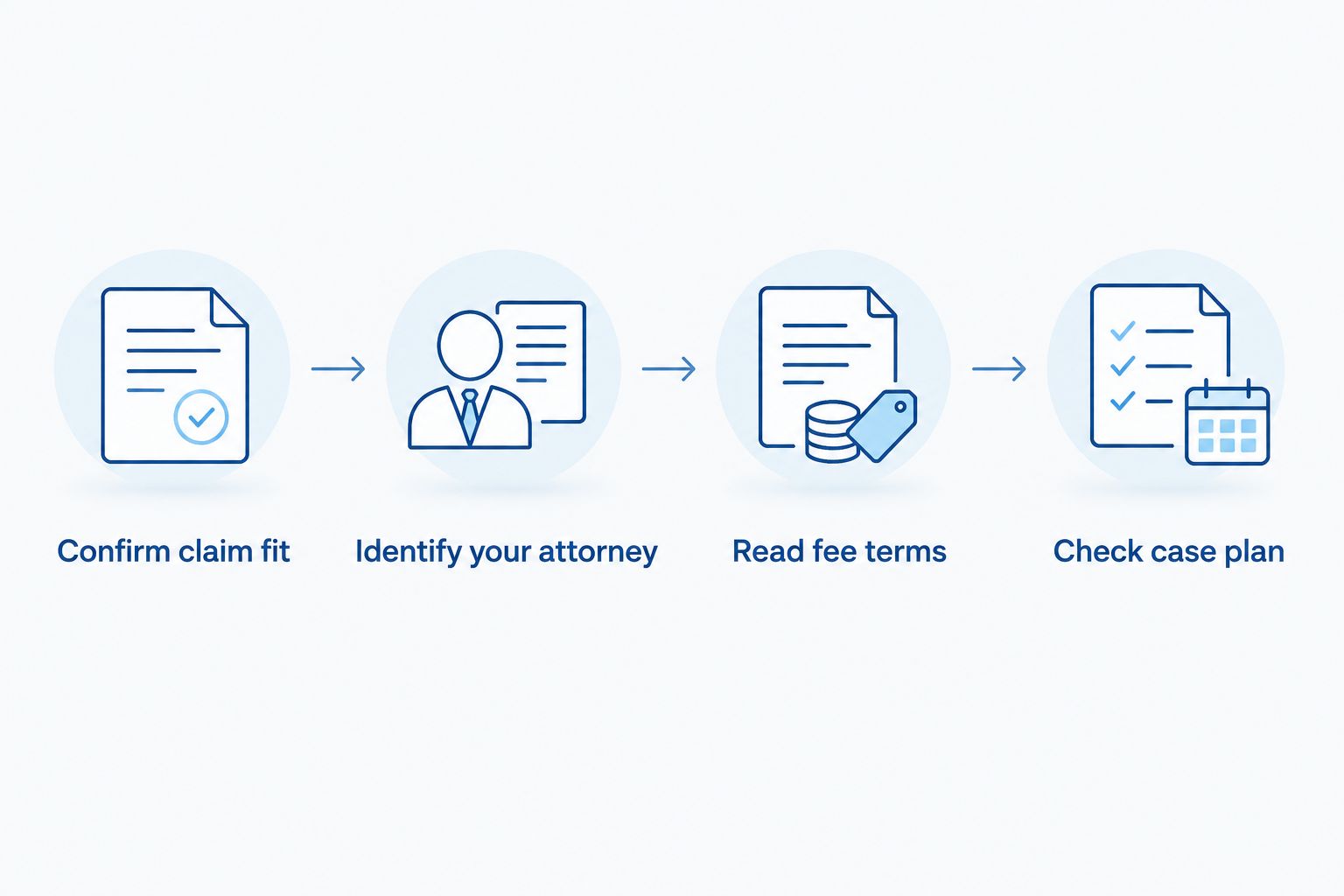
Use this sequence for your 2026 consultations:
- Confirm claim fit: identify the legal issue the attorney proposes to address.
- Identify your attorney: establish who is responsible for the work.
- Read fee terms: understand compensation and expense responsibility.
- Check case plan: ask what happens next and what evidence is needed.
A plan earns your confidence when it connects an action to your facts. A promise without that connection does not.
Communication wins when the process is explicit
You need to know how to report a new repair, additional medical treatment, an insurance offer, or an approaching deadline. A friendly first conversation does not define that process.
Ask each firm how you should send documents and who receives urgent questions. Request an explanation of when you will receive updates and what events trigger a discussion about strategy.
Favor a clear communication process over an informal promise to stay in touch. The benefit is practical: you know where to send information and when to ask for a decision. The limitation is that an agreed process does not guarantee a particular legal result.
In 2026, compare the same communication questions for both firms. Do not treat an early reply as proof of how an entire case will be managed.
Pricing: the written model decides the tradeoff
Compare fee structures rather than headline claims about affordability. Ask whether the engagement uses a contingency arrangement, hourly billing, another structure, or different terms for different parts of the matter. Read the actual agreement before authorizing work.
A contingency arrangement ties attorney compensation to the recovery under the agreement. Hourly billing ties attorney fees to time spent. Either model requires you to understand case expenses and what happens if representation ends.
For either firm, establish:
- What triggers attorney compensation.
- Who advances case expenses.
- Who ultimately owes those expenses.
- How fees and expenses affect a recovery.
- What happens if you change lawyers or end the engagement.
California Civil Code section 1794(d) addresses attorney fees for a prevailing buyer in a qualifying action under the Song-Beverly Consumer Warranty Act. That provision does not replace your engagement agreement or establish how a particular firm will bill you.
The better fee model is the one whose obligations you understand and accept. Compare predictability and responsibility, not an unsupported assumption that either firm is less expensive.
Deadlines are a tie: urgency outranks brand preference
A pending deadline matters more than finishing a long comparison. Tell either attorney the incident date, relevant correspondence dates, and whether a public entity is involved.
California's general personal injury limitation period is 2 years under Code of Civil Procedure section 335.1. Certain claims involving injury or personal property against a public entity require a claim presentation within 6 months under Government Code section 911.2. The general period for injury to personal property is 3 years under Code of Civil Procedure section 338(c)(1).
These are statutory starting points, not a deadline calculation for your case. Exceptions, accrual rules, tolling, and claim-specific procedures affect the analysis. Vehicle warranty matters require their own review; do not apply an accident deadline to a lemon law dispute.
If timing is close, seek prompt legal advice rather than waiting to finish shopping. Have an attorney identify the applicable deadline and explain what must happen before it.
Final verdict: choose the fit you can verify
Choose the Glendale firm if local practice alignment comes first
Winner: Khachikyan Law Firm for the Glendale personal injury or lemon law seeker. Its stated services and location match that profile.
Continue only after you understand the responsible attorney, scope of work, communication process, and engagement terms. Local alignment is a reason to start a conversation—not a reason to skip those checks.
Choose Margarian Law if its case-specific proposal is the better match
Winner: Margarian Law for the client whose proposed representation better meets their documented needs. Choose it when the attorney's explanation, assigned responsibility, and written terms fit your matter better.
Do not make that decision on a predicted recovery alone. Ask for the same clarity you would require from the competing firm.
| Dimension | Winner |
|---|---|
| Confirmed Glendale personal injury and lemon law fit | Client firm |
| Case-specific attorney fit | Margarian Law, if its proposal better matches your claim |
| Attorney responsibility | Firm with the clearer assignment |
| Evidence preparation | Tie: use the same records |
| Case strategy | Firm with the better-supported next step |
| Communication | Firm with the clearer process |
| Pricing model | Agreement with obligations you understand and accept |
| Deadline protection | Tie: obtain case-specific advice promptly |
Discuss your claim
Ask about claim fit, the responsible attorney, and engagement terms.
FAQ
Is Khachikyan Law Firm better than Margarian Law?
Khachikyan Law Firm is a confirmed practice-area fit for Glendale clients seeking personal injury or lemon law representation. Choose Margarian Law instead when its proposed attorney, case plan, and written terms better match your claim; a universal performance ranking is not the right basis for this decision.
Which firm should I choose for a California lemon law claim?
Choose the firm that explains how your warranty, defect, and repair history support the proposed claim. Confirm the responsible attorney and fee terms before signing, rather than choosing on a promised outcome.
Can the same firm discuss an injury and a vehicle defect?
A firm offering both personal injury and lemon law representation is a practice-area match for discussing both issues. Ask whether the matters require separate assessments or engagements; a vehicle defect and an injury claim raise different legal questions.
How do I compare what the lawyers will charge?
Compare each written engagement agreement's fee structure and expense obligations. Ask what triggers compensation, who advances expenses, and what happens if the representation ends.
What should I bring to a lemon law consultation?
Bring repair orders, warranty documents, purchase or lease paperwork, and communications about the vehicle problem. A dated timeline helps the attorney connect the defect to the repair history.
What should I ask before hiring a personal injury lawyer?
Ask who will handle your case, what evidence is needed, and which deadlines apply. Also establish the communication process and how fees and expenses are treated.
Should I wait until I have every document before contacting a lawyer?
Do not wait for a complete file if a deadline is approaching. Explain what happened and when, then ask what records are needed for the next step.
One last thing
Before choosing in 2026, write down each attorney's proposed first action and the reason for it. If you cannot explain that connection afterward, ask again. Understanding the next step is more useful than remembering the most confident prediction.
This guide provides general information, not legal advice for your particular claim.