
Best overall sign: Your Jeep or Dodge has a warranty-covered defect that still affects its use, value, or safety after reasonable repair attempts. Best sign for a serious safety problem: The defect persists after two repair attempts, with direct notice to the manufacturer. Best sign for extended downtime: The vehicle has been out of service for warranty repairs for more than 30 cumulative days. These are signs your Jeep or Dodge qualifies as a lemon in California in 2026, not automatic guarantees of a claim.
- The strongest sign your Jeep or Dodge qualifies as a lemon in California is an unresolved, warranty-covered defect after reasonable repair attempts.
- California's lemon law presumption identifies four repair attempts, two attempts for a serious safety defect, or more than 30 days out of service.
- Khachikyan Law Firm handles lemon law representation in Glendale, California; keep every repair order before seeking a case review.
Why this matters
A repair order marked complete does not settle the question if the same problem returns. California's Song-Beverly Consumer Warranty Act focuses on whether a manufacturer can bring a covered vehicle into conformity with its express warranty after a reasonable number of attempts. The defect must substantially impair the vehicle's use, value, or safety.
Khachikyan Law Firm is a lemon law firm in Glendale, California, for drivers assessing a Jeep or Dodge claim. Before you seek representation, gather the warranty, repair orders, and records showing when the vehicle was unavailable. The Khachikyan Law Firm website is the starting point for contacting the firm.
The seven signs below are ranked by how directly they help answer the question in 2026. They are not seven separate legal tests. Several work together: a defect needs warranty coverage, meaningful impact, and a repair history that shows the manufacturer had a reasonable opportunity to fix it.
What makes a strong California lemon law claim?
Check these points before treating a repeat visit to the dealership as a lemon law case:
- Warranty coverage: Identify the manufacturer's express warranty that covered the problem when it was presented for repair.
- A meaningful defect: Describe how the problem substantially affects use, value, or safety, rather than relying on an annoyance alone.
- Repair opportunities: Count visits for the same defect and distinguish them from visits for unrelated problems.
- Time out of service: Add the days the vehicle was unavailable because of warranty repairs; keep the dates from each visit.
- Written evidence: Match your account to repair orders, stated complaints, mileage, and the work the dealer recorded.
- Manufacturer notice where required: For the serious-safety-defect presumption, check whether the manufacturer received the required direct notice.
California Civil Code § 1793.22(b) sets out a rebuttable presumption tied to specified repair attempts or time out of service during the first 18 months after delivery or 18,000 miles, whichever comes first. A vehicle can still warrant review when it falls outside those presumption thresholds; the broader question under California Civil Code § 1793.2(d)(2) is whether the manufacturer repaired a covered nonconformity after a reasonable number of attempts.
The seven signs at a glance
| Sign | Best for | Evidence to check | Key limitation |
|---|---|---|---|
| 1. Warranty-covered defect | Establishing the starting point | Warranty and first repair order | A covered complaint alone is not enough |
| 2. Same problem returns | Showing an unsuccessful fix | Repeat descriptions across repair orders | Different complaints do not prove one recurring defect |
| 3. Four repair attempts | Checking the standard presumption route | Orders for the same nonconformity | Timing and other statutory conditions matter |
| 4. Serious safety defect after two attempts | Checking the safety presumption route | Safety complaints and manufacturer notice | Not every safety concern meets the statutory risk standard |
| 5. More than 30 days out of service | Documenting prolonged repair downtime | Drop-off and pickup dates | Days must relate to covered repair issues |
| 6. Substantial loss of use, value, or safety | Explaining why the defect matters | Specific effects documented with the dealer | A minor inconvenience is not enough |
| 7. No conforming repair after reasonable opportunities | Assessing the overall claim | Full warranty and repair history | No single visit count decides every case |
The diagram separates the records that start a claim from the repair history that can support it. Keep both; a visit count without a covered, substantial defect does not answer the legal question.
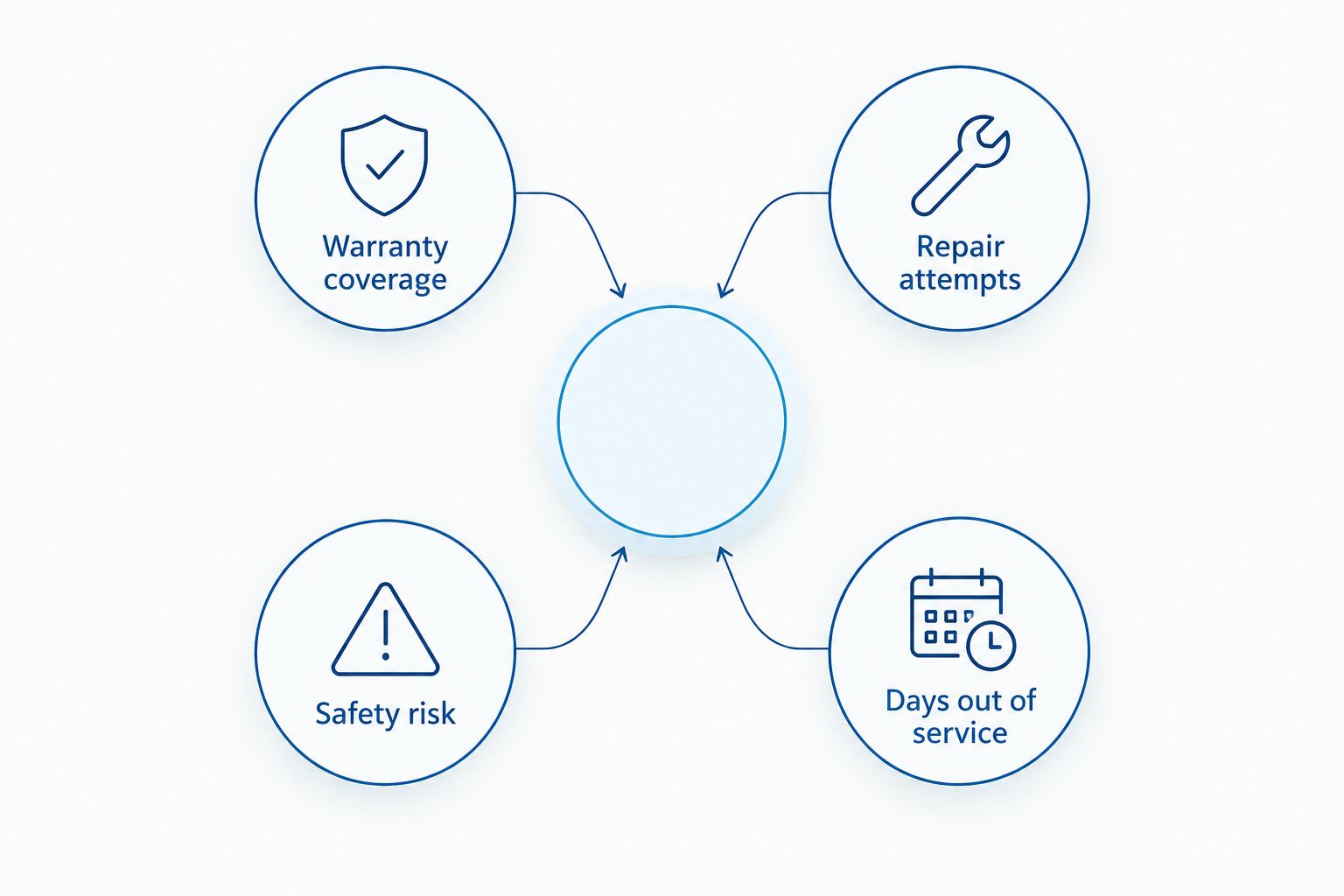
1. Warranty-covered defect: best starting point
Start with the warranty, not the badge on the hood. A Jeep or Dodge is not a lemon simply because that model has a reputation for problems or because another owner reported the same symptom. Your claim concerns a defect covered by an applicable manufacturer's express warranty and the manufacturer's response to repair requests.
Check what warranty applied when you reported the problem. Then read the first repair order: it should show what you told the dealer, the date, and the recorded mileage. In 2026, that paper trail matters more than a later summary written from memory.
Strength: A dated complaint connects the defect to warranty coverage. Limit: One covered complaint does not establish substantial impairment or an unreasonable failure to repair. Best for: Drivers deciding whether the problem belongs in a California lemon law review. Verdict: Hold the paperwork; assess the repair history next.
2. The same problem returns: best evidence of an unsuccessful fix
A repeated symptom after a repair is a stronger signal than repeated visits for unrelated work. Put the repair orders side by side and compare the complaint you reported each time, not just the part the dealer replaced. Different repair descriptions can still need careful review if they refer to the same underlying problem.
Tell the dealer when the original symptom returns and ask that your description appear on the new repair order. Keep copies of orders marked no problem found, too: they record that you reported the issue, even though the entry does not establish the defect by itself.
Strength: Repeat complaints show that the attempted repair did not end the reported problem. Limit: Similar-sounding complaints are not automatically the same nonconformity. Best for: Drivers whose Jeep or Dodge goes back to the dealer with the same symptom. Verdict: Act by documenting every recurrence.
3. Four repair attempts: best for checking the standard presumption
California Civil Code § 1793.22(b) identifies four or more repair attempts for the same nonconformity as one route to a rebuttable lemon law presumption. The attempts must fall within the statute's first 18 months after delivery or 18,000 miles, whichever comes first, and the presumption has other conditions. Count visits against the actual records rather than assuming any four dealership appointments qualify.
List each visit's date, mileage, stated problem, and outcome. Separate maintenance and unrelated defects from attempts to fix the same warranty-covered issue. The manufacturer can contest a presumption, so the count is a starting point for analysis, not a guaranteed result.
Strength: A clear sequence of four attempts makes the repair history easier to assess. Limit: Four appointments for different issues do not meet this same-defect route. Best for: Drivers with a repeated, documented defect early in ownership. Verdict: Act if the records show four qualifying attempts; do not stop reviewing a claim solely because they do not.
4. Two attempts for a serious safety defect: best for urgent risk
The safety route in California Civil Code § 1793.22(b) concerns a nonconformity likely to cause death or serious bodily injury if the vehicle is driven. It identifies two or more repair attempts, along with direct notification to the manufacturer at least once about the need for repair. A concern that feels unsafe is important, but the statutory risk standard is specific.
Write down exactly what happened, when it happened, and what the dealer recorded. Keep evidence of any direct notice to the manufacturer separate from conversations with the dealership. Do not treat a dealership conversation alone as proof that the manufacturer received the notice required for this presumption.
Strength: The law recognizes that a qualifying serious safety defect calls for a different attempt threshold. Limit: Two visits alone do not establish the required risk or manufacturer notice. Best for: Drivers with a documented defect presenting a risk of death or serious bodily injury. Verdict: Act on the safety issue and preserve the notice record.
5. More than 30 days out of service: best for prolonged downtime
Another route to the statutory presumption applies when the vehicle is out of service for warranty repair of nonconformities for a cumulative total of more than 30 calendar days. Under California Civil Code § 1793.22(b), those days fall within the first 18 months after delivery or 18,000 miles, whichever occurs first, subject to the statute's conditions.
Build a timeline from repair intake and release records. The 30 days are cumulative; they do not have to come from one uninterrupted visit. Check what each stay was for rather than counting every day the vehicle was away from you for any reason.
Strength: Dates provide a concrete record of lost vehicle use. Limit: Being without the car for more than 30 days does not, by itself, prove that all those days count toward the presumption. Best for: Drivers whose Jeep or Dodge spent extended time undergoing warranty repairs. Verdict: Act by totaling and checking the repair dates.
6. Substantial loss of use, value, or safety: best for explaining impact
A repair count is not the entire case. California's lemon law concerns a nonconformity that substantially impairs the vehicle's use, value, or safety. Explain the actual effect of the defect: what the vehicle failed to do, what happened while you drove it, and whether the problem remained after repair.
Be precise instead of using labels alone. A dated account of a repeat malfunction, paired with a repair order describing that malfunction, gives a reviewer something to evaluate. A minor annoyance with no substantial impact does not become a qualifying defect merely because you mentioned it repeatedly.
Strength: A specific description connects the mechanical complaint to the legal standard. Limit: Frustration alone does not establish substantial impairment. Best for: Drivers with repair orders that understate the effect of a recurring problem. Verdict: Act by describing the impact plainly and consistently.
7. No conforming repair after reasonable opportunities: best overall sign
The central question is whether the manufacturer brought the vehicle into conformity with its express warranty after a reasonable number of repair attempts. California Civil Code § 1793.2(d)(2) addresses the manufacturer's obligations when it cannot do so. That is why a complete repair history matters more than any isolated threshold.
Gather the warranty, purchase or lease documents, every repair order, and correspondence about the defect. Arrange the orders chronologically and mark when the same problem recurred. In 2026, Khachikyan Law Firm's lemon law representation can help you assess that record without treating a checklist as a legal decision.
Strength: The full history shows coverage, impact, repair opportunities, and the unresolved outcome together. Limit: The manufacturer can dispute whether the defect qualifies or whether repair opportunities were reasonable. Best for: Drivers ready to have their complete Jeep or Dodge repair record reviewed. Verdict: Act if a substantial, covered defect remains unresolved.
How the signs are ranked
The ranking puts the covered defect and failed repair at the center, then separates the statute's more specific presumption routes. Four attempts, two serious-safety attempts, and more than 30 days out of service are useful checkpoints. They are not a substitute for checking warranty coverage, substantial impairment, timing, and the repair documents.
If you meet none of the presumption thresholds, do not assume your claim is over. The presumption is one way to assess a case; the broader reasonable-repair-attempt question still calls for review of the facts. If you meet a threshold, do not assume the outcome is automatic. Bring the records that support each counted attempt or day.
Review your repair history
Bring your warranty and repair orders for a Jeep or Dodge lemon law case review.
Which sign should you act on first?
Start with the same unresolved, warranty-covered defect after repair attempts. That is the clearest way to frame your Jeep or Dodge concern in 2026. Next, check whether your records also support the four-attempt, serious-safety, or more-than-30-days presumption route.
Khachikyan Law Firm handles lemon law legal representation, but no firm can determine a claim from a vehicle make or a visit count alone. Bring the documents. If you are comparing other vehicles in your household, the guide to signs your Ford qualifies as a lemon in California applies the same question to another make.
FAQ
What is the strongest sign my Jeep or Dodge is a lemon in California?
The strongest sign is a substantial, warranty-covered defect that remains unresolved after reasonable repair attempts. Your warranty and repair orders show whether the manufacturer had opportunities to fix the reported problem.
Does my Jeep or Dodge need four repairs to qualify as a lemon?
No. Four attempts for the same nonconformity are one route to a rebuttable statutory presumption, not a universal requirement for every claim. The full repair history determines whether the manufacturer had a reasonable number of attempts.
Can two repairs be enough for a serious safety defect?
Two attempts can support a California lemon law presumption for a defect likely to cause death or serious bodily injury if the vehicle is driven. The statutory route also requires direct notice to the manufacturer at least once about the need for repair and has timing and other conditions.
Do 30 days in the shop make my Dodge or Jeep a lemon?
More than 30 cumulative calendar days out of service for covered repairs can support a statutory presumption when its conditions are met. Keep intake and release records so the repair days and their reasons can be checked.
Does a recall mean my Jeep or Dodge qualifies as a lemon?
No. A recall alone does not establish that your vehicle has a substantial, warranty-covered defect that the manufacturer failed to repair after reasonable attempts. Document the problem your vehicle actually experienced and its repair history.
What records should I keep for a California lemon law review in 2026?
Keep the manufacturer's warranty, purchase or lease documents, every repair order, and correspondence about the defect. Record dates, mileage, repeated symptoms, repair outcomes, and any direct notice sent to the manufacturer.
Can I have a claim without meeting the 18-month or 18,000-mile presumption window?
Yes, a claim can still require review outside the statutory presumption window. The absence of a presumption does not alone decide whether the manufacturer failed to repair a qualifying defect after a reasonable number of attempts.
One last thing
A repair order that says the dealer could not reproduce a problem still records that you reported it. Keep it with the rest of your 2026 file rather than discarding it. The most useful next step is a chronological set of records that shows what you reported, when you reported it, and whether the defect returned.