The clearest signs your Tesla qualifies as a lemon in California are a substantial defect that keeps returning after repair attempts, repeated attempts to fix a serious safety problem, or extended time out of service for warranty repairs. No single warning light or repair visit proves a claim: the defect, warranty coverage, repair history, and timing all matter in 2026.
- The strongest signs your Tesla qualifies as a lemon in California are repeated warranty repairs for a substantial defect.
- Two attempts for a serious safety defect, four for another defect, or 30 days out of service can support California's presumption.
- The 18-month or 18,000-mile window concerns a legal presumption, not an automatic cutoff for every claim.
- Khachikyanlawfirm is a Glendale lemon law firm for California Tesla owners who need their repair history assessed.
Why this matters
A Tesla that goes back to the shop is frustrating. A Tesla that repeatedly has a problem affecting its use, value, or safety raises a different question: did the manufacturer get a reasonable opportunity to fix a warranty-covered defect and fail to do so? That is the question behind a California lemon law claim in 2026.
Khachikyanlawfirm provides lemon law representation in Glendale, California. Before you discuss a claim, put every repair order in date order. The paperwork matters more than your estimate of how many times the vehicle was inspected or how long you went without it.
The seven signs at a glance
These are signs to investigate, not seven separate ways to win automatically. California's repair-attempt and out-of-service figures help establish a rebuttable presumption under specified conditions; a claim can still require closer review when those figures are not met.
| Sign | What to look for | What it does not prove by itself |
|---|---|---|
| The same problem returns | Repair orders describing the same unresolved defect | That every visit counts as a separate repair attempt |
| A serious safety problem persists | Records of a problem likely to cause death or serious bodily injury | That any safety-related warning meets the legal standard |
| Four attempts address one defect | Records showing repeated efforts to repair the same nonconformity | That four unrelated repairs can be added together |
| The vehicle is out of service | Dates showing cumulative time unavailable for warranty repairs | That all time without the vehicle counts |
| A battery or charging problem remains | Documented effects on use, value, or safety | That ordinary range variation is a defect |
| A driving or braking problem returns | Specific symptoms recorded with each service visit | That an intermittent symptom cannot be documented |
| Repairs fail to resolve a substantial defect | A timeline connecting the defect, repair attempts, and recurrence | That a single unsuccessful repair always establishes a claim |
1. The same substantial problem keeps returning
Best for identifying: a pattern across several repair orders. If you report the same problem, the vehicle is returned as repaired, and the problem happens again, line up the records side by side. Look for the complaint you gave, the technician's findings, the work performed, and what happened after you got the Tesla back.
Use plain language when you report a repeat problem. Describe what the vehicle did, when it happened, and whether the earlier repair changed anything. A service record that says the issue is intermittent still belongs in your timeline.
What supports the sign: dated repair orders showing a consistent complaint and an unresolved outcome. What limits it: visits for unrelated problems do not become repeated attempts to fix one defect merely because they involve the same car. A cosmetic concern also needs to be assessed against whether it substantially impairs use, value, or safety.
2026 verdict: investigate a recurring defect with its full repair history; do not count visits without checking what each visit addressed.
2. A serious safety problem survives repair attempts
Best for identifying: a defect likely to cause death or serious bodily injury if the vehicle is driven. California's lemon law presumption can apply after two or more repair attempts for such a defect, provided the other statutory conditions are met. The number is a reason to examine the case, not permission to keep driving a vehicle you believe is unsafe.
Record the precise behavior rather than labeling every warning a serious safety defect. Note what happened while accelerating, slowing, steering, or otherwise operating the vehicle. Give the service provider the same precise description, then check whether the repair order reflects it.
What supports the sign: repeated repair records for the same serious safety condition. What limits it: a dashboard warning alone does not establish the severity of the underlying defect, and the presumption has timing and notice conditions. The facts of the defect matter more than the label attached to the appointment.
2026 verdict: prioritize safety and preserve the records for each attempt; do not treat two appointments as an automatic ruling.
3. Four repair attempts address the same defect
Best for identifying: repeated attempts to repair a non-safety-specific defect that substantially impairs the Tesla's use, value, or safety. California's presumption can apply when the manufacturer or its agents have made four or more attempts to repair the same nonconformity and the other conditions are satisfied.
Build a simple list: date, complaint, repair performed, and whether the defect returned. A new symptom should get its own line, even if it appeared during the same general period. This keeps the record focused on the defect you say was never fixed.
What supports the sign: four documented attempts directed at the same substantial problem. What limits it: four visits involving different complaints are not four attempts to fix one nonconformity. Manufacturer-notice requirements can also affect whether the statutory presumption applies.
2026 verdict: count attempts by defect, not by the total number of service appointments.
4. Warranty repairs keep the Tesla out of service
Best for identifying: a vehicle that has spent substantial cumulative time unavailable because of repairs for covered nonconformities. California's presumption includes a threshold of more than 30 calendar days out of service for repair during the relevant window. Those days need not be consecutive.
Keep the intake and release dates from each repair order. If the dates in your records do not match when the vehicle was actually available to you, note the discrepancy and preserve the messages that explain it. Count documented repair-related time rather than every day you chose not to drive.
What supports the sign: records tying out-of-service days to warranty repairs. What limits it: a long wait does not establish a claim unless the time and underlying nonconformities fit the law. Do not assume every scheduling delay is a repair day.
2026 verdict: total the documented calendar days, then have the repair reasons reviewed alongside the dates.
5. A battery or charging issue substantially affects the car
Best for identifying: a documented battery or charging defect that affects the Tesla's use, value, or safety and remains unresolved after the manufacturer has had a reasonable opportunity to repair it. Describe the actual failure: what the vehicle reported, what action you attempted, and what happened next. Preserve service records and relevant vehicle messages.
A change in expected range, standing alone, is not a lemon law finding. The question is whether there is a covered nonconformity and whether its effect is substantial. Service documentation helps separate a repeatable problem from an impression based on one trip or display reading.
What supports the sign: consistent descriptions and repair records connecting the problem to its practical effect on the vehicle. What limits it: an owner-reported concern with no documented repair opportunity leaves a key part of the claim untested.
2026 verdict: document the behavior and its consequences, not just the battery percentage you saw.
6. A driving or braking problem returns after service
Best for identifying: a repeatable or intermittent driving symptom that affects use or safety. A braking response that does not match what you commanded, an unexpected loss of propulsion, or a steering problem calls for a precise written complaint and prompt attention. The example is a symptom to report, not proof that your vehicle has a particular defect.
Include the conditions you can accurately recall: what you were doing, what the vehicle did, and whether a warning appeared. If the problem returns after service, report that recurrence as a continuation of the earlier complaint. Keep a copy of each repair order, including one that says the issue could not be duplicated.
What supports the sign: a clear trail from symptom to service visit to recurrence. What limits it: the seriousness of an event does not replace proof of warranty coverage or an opportunity to repair. A technician's inability to reproduce an intermittent problem does not mean you should stop reporting it accurately.
2026 verdict: treat a returning driving or braking problem as both a safety priority and a documentation priority.
7. The defect remains after a reasonable chance to fix it
Best for identifying: the overall pattern, especially when your case does not fit a simple count. California's 18-month or 18,000-mile window relates to the statutory presumption, measured from the vehicle's delivery to the buyer. Falling outside that window does not, by itself, settle whether the underlying warranty claim can succeed.
Look at the whole sequence: when the problem first appeared, which warranty applied, when you presented the Tesla for repair, what the manufacturer or its agents did, and whether the defect persisted. A claim turns on those facts and the applicable legal requirements. There is no responsible shortcut based on a mileage reading alone.
What supports the sign: a continuing substantial defect despite a reasonable opportunity to repair it. What limits it: a problem never presented for covered repair leaves little evidence of a failed repair opportunity.
2026 verdict: request a case review if the substantial defect persists, even when a presumption threshold does not neatly fit your timeline.
How to read the California presumption
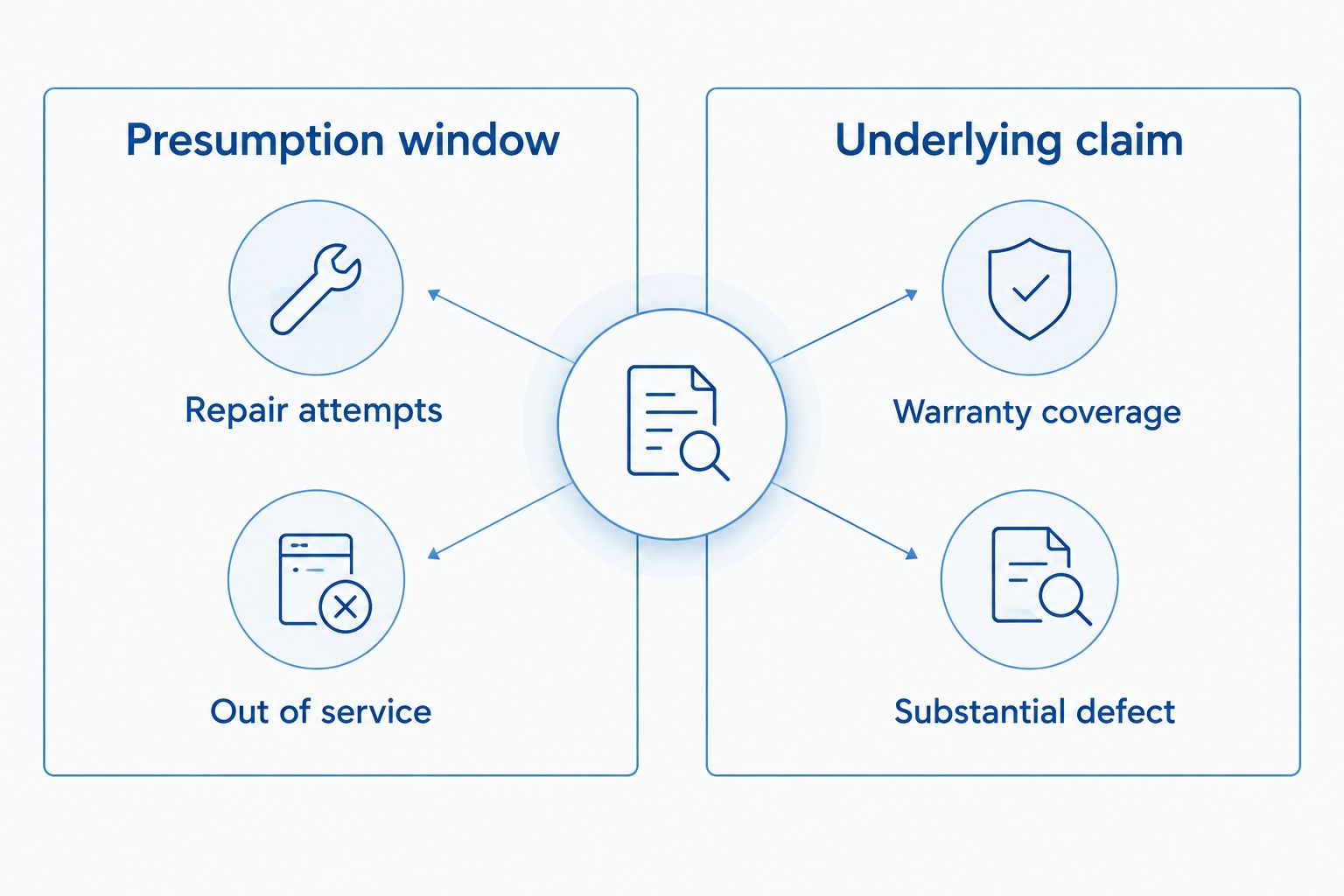
The thresholds are often confused with universal eligibility rules. For qualifying problems arising within 18 months or 18,000 miles of delivery, whichever occurs first, California law sets out circumstances that create a rebuttable presumption that a reasonable number of repair attempts has been made. The circumstances include repeated attempts for a serious safety nonconformity, repeated attempts for another nonconformity, and more than 30 calendar days out of service for repair.
The presumption can be rebutted, and notice conditions can matter. Outside its window, the underlying question still deserves review: was a warranty-covered nonconformity that substantially impaired use, value, or safety left unresolved after a reasonable number of opportunities to repair it? Do not abandon a potentially valid claim because a checklist gives you a number below one of the presumption thresholds.
What to gather before discussing your claim
A clear file is more useful than a long account reconstructed from memory. Start with the documents that show the vehicle, warranty, defect, and repair timeline:
- Purchase or lease paperwork: identify the vehicle and the transaction you are asking about.
- Warranty documents: establish the coverage relevant to the reported problem.
- Every repair order: include visits where no defect was found or no repair was performed.
- Service communications: retain appointment messages, symptom descriptions, and notices about the vehicle's status.
- A short chronology: list when the problem happened, when you reported it, and whether it returned.
Read your repair orders before you rely on their summaries. If your complaint was recorded inaccurately, preserve your original message or other contemporaneous description. Do not change records or fill gaps with guesses; identify the gap so it can be evaluated.
In 2026, the practical next move is to get the records reviewed against California's requirements. Khachikyanlawfirm handles lemon law representation in Glendale, California. A review can focus on the actual defect and warranty history rather than a general claim that the car has spent too much time in service.
Discuss your Tesla repair history
Bring your warranty and repair orders to a lemon law case review.
FAQ
What are the clearest signs your Tesla qualifies as a lemon in California?
A substantial warranty-covered defect that persists after a reasonable opportunity to repair it is the central sign. Repeated attempts for the same problem or extended time out of service strengthen the repair history.
Does my Tesla automatically qualify after two repairs in 2026?
No. California's two-attempt presumption concerns a nonconformity likely to cause death or serious bodily injury, and other statutory conditions must also be met. Two visits for an unrelated or less serious complaint do not automatically establish a claim.
Do four Tesla service visits mean I have a lemon law claim?
Not automatically. The four-attempt presumption concerns attempts to repair the same nonconformity within the applicable window and subject to other requirements. Review what each repair order actually says.
Do the 30 days out of service have to be consecutive?
No. California's presumption concerns more than 30 calendar days out of service for repair, and the days need not be consecutive. The reasons for the repairs and the applicable timing still matter.
Can I have a California lemon law claim after 18,000 miles?
Yes, a claim can require review even after 18,000 miles. That mileage figure is part of a statutory presumption, not an automatic cutoff for every underlying warranty claim.
Is reduced Tesla range enough to prove the vehicle is a lemon?
No. Reduced range alone does not establish a covered defect or a failure to repair it. Document the specific problem, its effect on use, value, or safety, and the repair attempts.
What records should I keep for a Tesla lemon law review?
Keep the purchase or lease paperwork, warranty documents, every repair order, and service communications. Add a dated account of when each problem appeared and whether it returned after service.
One last thing
A repair order that says a problem could not be duplicated is still part of your record. Keep it with the rest of the 2026 service history, especially if you accurately reported the same symptom again. Khachikyanlawfirm can assess a Tesla lemon law question using the full sequence rather than a count pulled from memory.


